The Extraordinary Legacy of Late Dr Masood Ahmed Choudhary
History shows that transformative institutions rarely arise from abundant resources alone. They emerge from imagination, perseverance and the commitment of individuals who see possibilities where others see only obstacles.
Sir Syed Ahmad Khan remains a compelling example. At a time of profound educational disadvantage, the institution he founded became the centre of a movement that continues to shape generations.
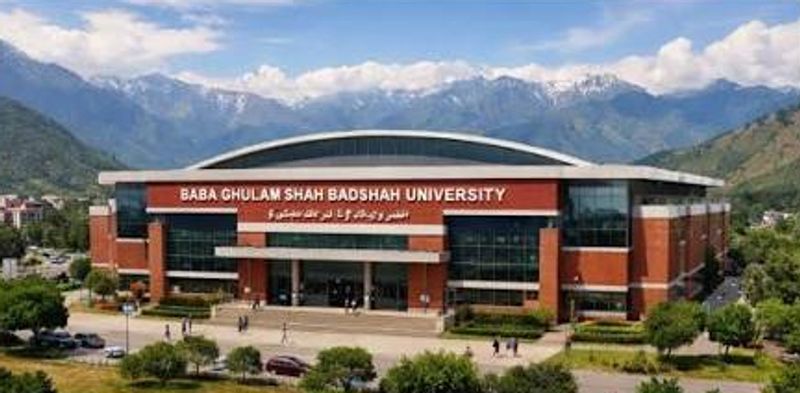
Pir Panjal produced a visionary of its own in Late Dr Masood Ahmed Choudhary-an eminent police officer, administrator, educationist and institution-builder. His most enduring contribution was Baba Ghulam Shah Badshah University in Rajouri, which demonstrates what one determined person can achieve in a region long constrained by isolation, developmental neglect and political marginalisation.
A University Born from Vision
When Dr Choudhary became Founder Vice-Chancellor, he did not inherit a flourishing university. There was no academic ecosystem, impressive infrastructure or accumulated reputation upon which to build. He began virtually from scratch, on rugged land where even ordinary vegetation struggled to grow.
Where others saw barren hills, he envisioned classrooms, laboratories, libraries and residential facilities. Where others saw remoteness, he recognised an opportunity to create a centre of knowledge for one of Jammu and Kashmir’s most educationally deprived regions.
Turning that vision into reality required persistence, persuasion, personal sacrifice and an emotional attachment to the project. Dr Choudhary drew upon the goodwill earned during his distinguished public career and sought support from administrators, academics, friends and well-wishers. For him, this was not a routine official assignment; it was a mission. Brick by brick and department by department, an institution emerged. Roads were laid, buildings constructed, laboratories established, and students and scholars brought to a place previously outside the recognised academic map of the country.
Dr Choudhary did not merely construct a campus; he created confidence in a region long conditioned to believe that prestigious institutions could exist only elsewhere-particularly in Jammu or Srinagar.
From the Margins to the Academic Map
The university soon acquired visibility and academic credibility. It introduced professionally relevant courses in science, technology, management, engineering and emerging disciplines. Faculty and students arrived from different parts of India, giving it the character of a diverse academic institution.
For Rajouri and Poonch, its establishment meant far more than access to higher education. It proved that Pir Panjal could host an institution of national standing. It created employment, encouraged local enterprise and gave families hope that quality education could be available closer to home. Students from outside Jammu and Kashmir encountered the region’s natural beauty, cultural diversity and hospitality. The university thus became a bridge between a historically neglected frontier and the wider national academic community.
This rise was inseparable from the leadership of its Founder Vice-Chancellor. Dr Choudhary possessed the rare combination of vision and execution. Had his work been carried forward with equal seriousness, the university might today rank among northern India’s foremost centres of research and technological education.
From Rise to Loss of Momentum
The departure of a great institution-builder tests the society inheriting his creation. An institution’s strength lies not only in its establishment, but also in its capacity to preserve direction, standards and momentum after its founder has left.
It is here that the story becomes painful. After Dr Choudhary’s tenure, the university grew vulnerable to administrative inconsistency, political indifference and competing interests. Instead of building upon the foundation already laid, it appeared to lose momentum. An institution that once attracted students from distant parts of India began struggling to retain even its natural appeal among students of the surrounding districts. A university cannot survive through buildings alone. It must renew itself through academic innovation, credible leadership, high-quality recruitment, serious research, effective outreach and courses aligned with changing employment and technological needs. When initiative weakens and decisions become captive to political calculations, personal interests or prolonged uncertainty, decline becomes difficult to avoid.
Responsibility cannot be assigned to one government, officer, community or party. Political leaders failed to provide sustained attention; administrators did not always protect the university’s long-term interests; civil society remained largely silent; and the region’s intellectual class did not build a united movement for its advancement.
The Cost of Internal Divisions
Pir Panjal has also suffered from social and political divisions, particularly the prolonged rivalry between sections of the Gujjar and Pahari communities. Legitimate questions of identity, representation and constitutional rights have too often become contests in which one community’s advancement is portrayed as another’s loss. Political elites have benefited while institutions intended to serve everyone were neglected. Baba Ghulam Shah Badshah University belongs to no single tribe, caste, religious group, constituency or party. It belongs equally to Gujjars, Paharis, Kashmiris, Dogras and every other community-and, most importantly, to generations yet to come. Political disagreements may persist, but there must be unity in protecting educational institutions. A university is not a prize to be captured; it is a shared inheritance to be preserved.
The Need for Revival
The university’s decline is not irreversible. It needs visionary and independent leadership, transparent appointments, contemporary professional courses, stronger research facilities, academic partnerships and sustained engagement with industry. It must again attract students from across India while restoring confidence among the people of Rajouri, Poonch and adjoining areas.
Political representatives, academics, businesses, civil society and the Pir Panjal diaspora must unite in support of its revival. A permanent, non-partisan forum could monitor its progress and advocate its legitimate requirements before the government.
Above all, the university must be freed from narrow political and communal considerations. It should become the intellectual heart of Pir Panjal and a premier centre for science and technology, mountain studies, environmental research, border-area development, tribal studies, languages and the region’s cultural heritage.
An Inspiration-and a Warning
Dr Masood Ahmed Choudhary transformed barren land into a seat of higher learning and placed Pir Panjal on India’s educational map. His achievement cannot be measured only in buildings, courses or enrolment figures; its true measure lies in the aspirations he awakened and the confidence he gave to a neglected region.
Yet what one man built through extraordinary effort has not been protected with the same dedication by society. Pir Panjal’s intelligentsia cannot awaken only during elections or remain concerned solely with political representation. It must also protect the region’s universities, colleges, forests, languages, culture and heritage. If we cannot preserve what has already been created, our demands for further development will lose their moral force. Late Dr Masood Ahmed Choudhary fulfilled his responsibility. He conceived a dream, transformed it into an institution and entrusted it to the people. The question is no longer what he did for Pir Panjal; history has recorded that in enduring terms. The real question is: what have we done with the magnificent institution he left to us?
If Baba Ghulam Shah Badshah University is restored to its former dynamism and taken to greater heights, it will remain the finest tribute to its visionary founder. If allowed to deteriorate further, it will stand as a painful monument-not to the failure of the man who built it, but to the collective failure of those who inherited it.