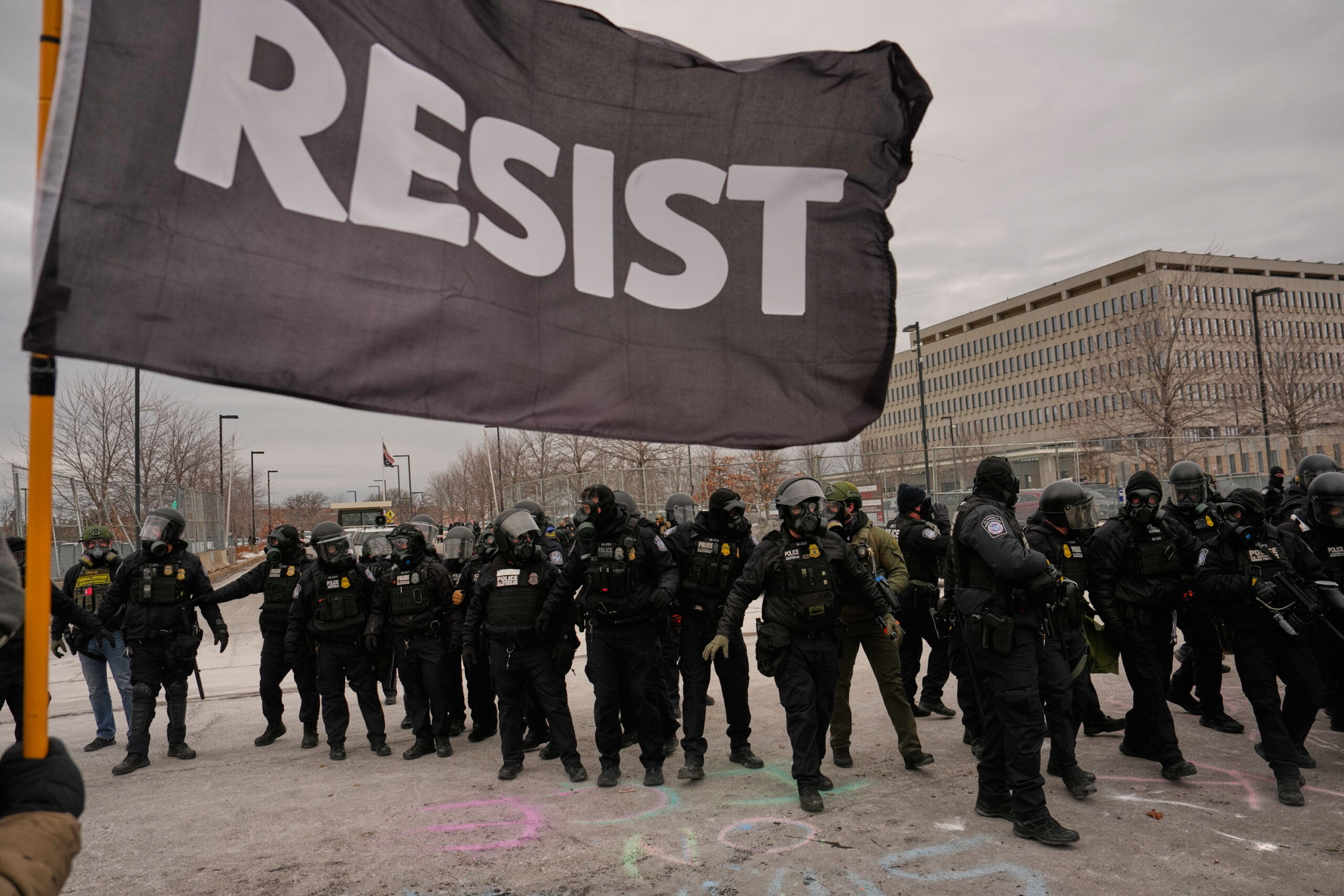
Democrats Prepare Election Protection Campaign Ahead of 2026 Midterms/ TezzBuzz/ WASHINGTON/ J. Mansour/ Democratic organizations are recruiting 10,000 volunteers to monitor polling locations and document any presence by armed federal officers during the midterm elections. Activist and legal groups are preparing protests, court guidance and emergency-response plans amid concerns about possible federal intervention in voting or ballot counting. The Trump administration and Republican National Committee say their efforts are intended to protect lawful voting and public confidence in election results.
Quick Look
- Democratic state parties launched the “New Battlefield Project.”
- Organizers intend to recruit 10,000 polling-place volunteers.
- Activists are preparing demonstrations if federal actions disrupt voting or ballot counting.
- Legal scholars have drafted guidance concerning possible seizures of ballots or voting machines.
- Courts have blocked several Trump administration attempts to change election procedures.
- The administration describes its proposals as election-security measures.
- The RNC says it has built its largest election-integrity operation.
- Civil-rights groups are seeking to prevent ICE officers from appearing at polling locations.
- The Pentagon says it has no plans to deploy military personnel to the polls.
- Activist organizations are encouraging early voting before Election Day.

Deep Look
Democrats launch the ‘New Battlefield Project’
Democratic state parties announced a nationwide election-protection operation Monday as voting approaches in the 2026 midterm elections.
The initiative, called the “New Battlefield Project,” is intended to recruit 10,000 volunteers to monitor polling locations and respond if armed federal officers appear.
Organizers say volunteers could observe activity outside voting sites, document potential problems and share information with Democratic officials and election-protection organizations.
Activist groups are also planning mass demonstrations if they believe the Trump administration is interfering with voting or ballot counting. Legal scholars, meanwhile, are circulating guidance advising judges how to respond to government requests to seize ballots or voting equipment.
“We have never prepared for an election sabotage event like we have now,” said Ezra Levin of the left-leaning organization Indivisible.
The plans reflect concerns among Democrats and civil-rights organizations about attempts by President Donald Trump to change registration, mail-voting and election-administration rules. The administration says its proposals are intended to strengthen election security.
Trump’s election proposals drive preparations
Trump has supported requiring documentary proof of US citizenship when people register to vote. He has also directed the US Postal Service to take a larger role in determining which voters qualify to receive mail ballots.
Democratic officials and advocacy groups contend that the changes could make voting more difficult for eligible citizens. The administration and its Republican supporters characterize them as safeguards intended to ensure that only qualified American citizens participate.
The opposing positions have contributed to extensive contingency planning as states begin distributing ballots and conducting early voting.
Trump’s actions after the 2020 election remain a concern
Democratic groups cite Trump’s conduct following the 2020 presidential election as one reason for their preparations.
Trump refused to accept his loss to Democrat Joe Biden and attempted to overturn the results. His efforts were rejected by courts, career government officials and some Republican officeholders.
After returning to the White House, Trump appointed several people who supported or participated in his efforts challenging the 2020 outcome. His administration has also initiated actions involving political opponents.
Trump pardoned more than 1,000 people prosecuted in connection with the Jan. 6, 2021, attack on the US Capitol, when Congress was meeting to certify Biden’s victory.
Midterms will determine control of Congress
The party controlling the White House has historically tended to lose congressional seats during midterm elections.
Republicans currently control both chambers, and the November results will determine whether the party retains its House and Senate majorities during the final two years of Trump’s term.
Trump has encouraged Republican-led states to redraw congressional maps to create additional districts favorable to GOP candidates. He also organized a Republican midterm convention and has pursued changes to election procedures as states begin issuing ballots.
Democrats view those actions as efforts to preserve Republican power. Republicans describe them as lawful political and election-security initiatives.
Legal scholars prepare guidance for judges
Legal experts have produced guidance for judges who could be asked to authorize federal searches or seizures involving election records.
The project was partly inspired by the Trump administration’s seizure of ballots and other records from the 2020 election in Fulton County, Georgia, which includes Atlanta. The seizure was linked to allegations about the election that had previously been disproved.
Rick Hasen, a UCLA law professor and director of the university’s Safeguarding Democracy Project, helped write guidance addressing potential seizures of voting machines.
Hasen noted that Trump has said he regrets not taking more aggressive action following the 2020 election, including ordering officials to seize voting machines.
“All these things take what was off the wall and put it on the wall,” Hasen said.
He added that organizers should avoid creating unnecessary fear among voters, but acknowledged that it is “hard to walk the line between alarmism and complacency.”
White House defends its election policies
Democrats expressed similar concerns before off-year elections in California, Virginia and other states last year. Those contests proceeded without significant clashes involving federal authorities.
The White House says the current concerns are politically motivated and rejects assertions that its policies threaten qualified voters.
“The only ‘fears’ Americans have about our elections are being fueled by extreme liberal Democrats who refuse to support commonsense legislation that ensures Americans, and Americans only, decide our elections and other basic election security measures like Voter ID,” White House spokeswoman Lauren Bis said in a statement.
The Justice Department maintains that its authorized election monitoring is intended to ensure compliance with federal voting-rights laws. It regularly sends personnel to selected jurisdictions after communicating with local election officials.
Courts block election-rule changes
Trump has not yet succeeded in implementing his most significant proposed voting changes before the midterms.
Federal courts blocked an executive order issued during the previous year that sought to reshape election procedures.
Trump subsequently supported legislation containing broader changes, including proof-of-citizenship provisions. The measure stalled in the Senate because of opposition from Democrats and some Republicans.
The president later issued another executive order seeking to restrict mail voting. Courts blocked those requirements from taking effect before the midterms, and the dispute is now before the Supreme Court.
Election administrators have warned that implementing the proposed requirements before voting concludes would be impractical.
Bar association creates voter hotline
The volume of election litigation and late changes to voting rules prompted the National Bar Association to announce a voter-assistance initiative.
The effort is intended to help voters from both major parties understand changes affecting registration, identification, mail voting and election procedures.
The association also plans to establish a hotline for people who experience difficulty casting their ballots.
Federal laws protect qualified voters against discrimination and intimidation, while separate statutes regulate voter registration and absentee voting in federal elections.
Both parties expand poll-monitoring operations
Large election-protection efforts are not unique to Democrats. Both major parties routinely deploy attorneys, staff members and volunteers to polling locations and ballot-counting facilities.
The Republican National Committee says it has recruited a record number of poll watchers for the midterm elections.
“The RNC has spent this entire cycle preparing not just to defy history in November, but to protect it,” spokeswoman Ally Triolo said. “We’ve built the largest election integrity operation in Republican Party history because our mission is simple: secure every legal vote and ensure Americans can trust the outcome of our elections.”
The Association of State Democratic Committees is supplementing existing Democratic operations with its new volunteer-recruitment campaign.
Project will track online threats
The Democratic project will also establish a network for sharing information about online threats, misleading material and possible attempts to manipulate voters.
Jane Kleeb, chair of the Association of State Democratic Committees and the Nebraska Democratic Party, said volunteers could record federal officers if they appear outside polling places.
“If they’re saying they’re going to put armed people outside polling places, we should put friendly people outside polling locations to film them,” Kleeb said in an interview. “There’s a whole new battlefield we have now.”
Democrats raise concerns about ICE
Some Democrats and civil-rights organizations fear that US Immigration and Customs Enforcement officers could appear at polling locations.
Administration officials have repeatedly said there are no plans for a general deployment of ICE personnel to voting sites.
ICE officers have appeared at polling places in isolated cases over the past year, generally saying they were pursuing or investigating a particular individual.
Homeland Security Secretary Markwayne Mullin said this month that similar circumstances could arise during the November election.
The possibility has raised concerns that the presence of armed immigration officers could discourage some eligible voters, particularly in Latino and immigrant communities, from entering polling locations.
Civil-rights groups file lawsuit
Civil-rights organizations and the city of Denver filed a lawsuit seeking a federal court order formally preventing ICE officers from operating at polling places.
The plaintiffs cited a federal law dating to the Civil War era that restricts the presence of armed federal personnel at election sites.
“This administration is basically using the rhetoric that undocumented citizens are voting and that they’re going to have DHS and ICE at the polls to try and intimidate and suppress the Latino vote,” said Juan Proaño, CEO of the League of United Latin American Citizens, one of the plaintiffs.
The administration disputes that it plans to deploy immigration agents to intimidate voters.
Separately, the Justice Department has legal authority to send civilian personnel to monitor compliance with federal voting-rights laws in qualifying jurisdictions. Such monitoring is a longstanding practice and is distinct from an immigration-enforcement operation.
Groups rehearse possible election scenarios
Political parties, election lawyers and civil-rights organizations regularly conduct tabletop exercises before major elections.
During those exercises, participants respond to hypothetical situations to identify legal, communications and organizational steps they might need to take.
Democrats and advocacy groups are now rehearsing scenarios involving the possible presence of ICE agents or National Guard personnel at polling locations.
The Pentagon has said it has no plans to deploy military forces to voting sites.
Levin said Indivisible has conducted exercises covering 17 potential scenarios. He emphasized that the organization’s first priority remains increasing voter turnout.
Early-voting rallies planned for October
The No Kings network, which includes Indivisible and has organized demonstrations against Trump during his second term, is launching an early-voting campaign.
The effort is scheduled to culminate in rallies on Oct. 17.
Organizers from left-wing and more traditional political groups are also preparing coordinated responses if they believe the administration acts aggressively during voting or ballot counting.
Minneapolis protests cited as possible model
Some activists view demonstrations against immigration enforcement in Minneapolis as a potential model for responding to federal actions during the midterms.
Two activists were shot and killed by ICE agents during demonstrations in January. The administration later reduced the aggressive enforcement operation it had launched in the city.
“We recognize there might be a similar moment in November, where Trump attempts to do that again, where everyday working people and students need to band together and say, ‘Actually, no, this is our country, you don’t get to decide who gets elected or who gets to take office,’” said Kidus Girma of the left-wing Sunrise Movement.
The preparations do not establish that federal interference will occur. They demonstrate that political parties, civil-rights organizations, legal experts and government agencies are preparing for disputes during an election that will determine control of Congress.
More on US News