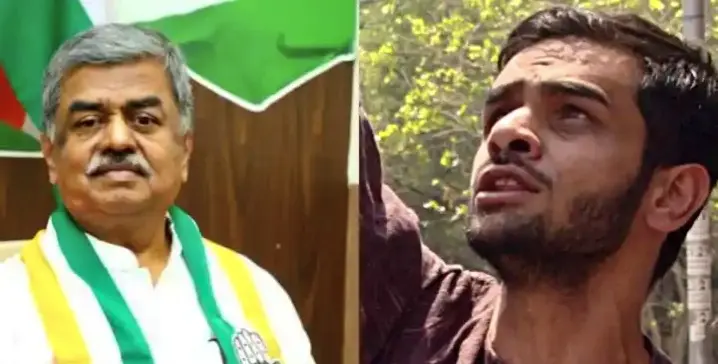
Bengaluru: Karnataka minister and state Congress President B K Hariprasad has sparked a political row by hitting out at the Akhil Bharatiya Vidyarthi Parishad (ABVP) and calling jailed activist Umar Khalid a nationalist.
The ABVP has been demanding the permanent cancellation of a proposed screening of a documentary on Khalid at the National Law School of India University (NLSIU) in Bengaluru.
“Umar Khalid is a nationalist, and ABVP has no right to speak on Umar Khalid because they adore Nathuram Godse. He was anti-national, the first terrorist of the country. They have no moral right or moral ethics to speak on Umar Khalid,” Hariprasad said, as quoted by PTI.
The BJP was quick to latch on with its leader Ashok Gowda calling the Congress “anti-national”.
ABVP Bengaluru had sought the Centre’s intervention to permanently cancel the proposed screening of filmmaker Lalit Vachani’s documentary “Prisoner No. 626710 is Present” at NLSIU.
Organised by the university’s Law and Society Committee, the screening was scheduled for September 14. The organisers later postponed the event, citing security and administrative reasons.
It had submitted representations to Union home minister Amit Shah, Union education minister Pralhad Joshi and Union minister of state for law and justice Arjun Ram Meghwal, seeking their intervention, ABVP Bengaluru said, as reported by News18.
Demanding a high-level inquiry into the NLSIU administration, the organisation alleged that the postponement was a tactic to allow public opposition to die down.
Educational institutions should remain focused on learning and national integrity and should not become platforms for what it described as political propaganda or the glorification of civil unrest, the ABVP argued, raising Khalid’s alleged links to the 2016 JNU controversy, protests against the CAA-NRC and the 2020 Delhi riots.
Khalid, a former JNU student leader, was arrested in September 2020 in connection with the Delhi riots case and has been charged under the Unlawful Activities (Prevention) Act (UAPA) and other laws.
His father, Syed Qasim Rasool Ilyas, opposed attempts to stop such screenings, saying his son had not been convicted by any court. He termed efforts to prevent programmes related to Khalid as “authoritarian” and questioned his prolonged custody without the commencement of trial.