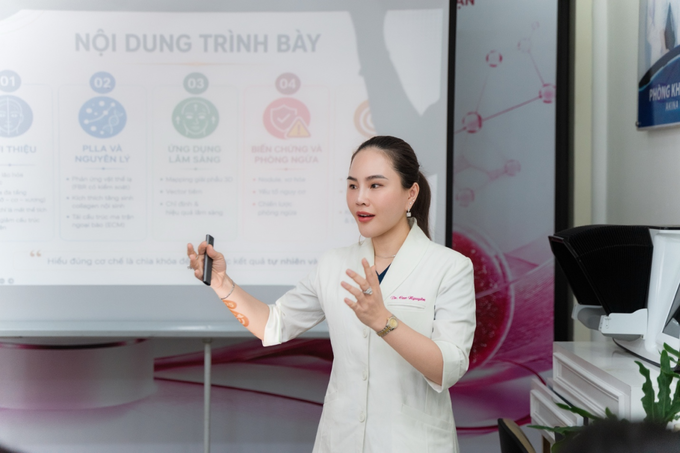
A different approach to structural rejuvenation
Dr. Cao Nguyen said collagen biostimulation requires a different clinical approach from traditional filler procedures, with outcomes influenced by patient selection, tissue plane, product distribution and individualized treatment planning.
“Biostimulation is not simply the placement of material into a hollow area,” she said during her lecture, “PLLA – The New Era of Asian Structural Rejuvenation.”
“It is the deliberate design of a biological response to improve tissue quality and rebuild facial structure according to each patient’s anatomy.”
|
Dr. Cao Nguyen discusses biostimulatory injectables at the AestheFill Master Class. Photo courtesy of the doctor |
Dr. Cao Nguyen described the development of minimally invasive aesthetic medicine in four stages: defect correction, volume restoration, tissue lifting and regenerative aesthetics.
The regenerative approach goes beyond adding volume to address age-related changes in collagen support, tissue quality, elasticity and structural integrity.
Results from collagen biostimulation develop progressively. When appropriately placed, microparticles trigger a controlled tissue response involving macrophages and fibroblast activation, followed by new collagen production and remodeling.
Therefore, photographs taken immediately after injection may not reflect the eventual biological outcome.
Traditional fillers and collagen biostimulation
Traditional hyaluronic acid (HA) fillers primarily restore volume and define contours, with results generally appearing relatively quickly. Treatment typically focuses on specific areas, with outcomes influenced by gel properties, volume and placement.
Collagen biostimulators are designed to stimulate tissue remodeling and improve tissue quality. Results are assessed over weeks or months, with treatment planning based on aging patterns, tissue planes and regenerative goals.
Outcomes can depend on the product, reconstitution, dose, injection plane, distribution and individual tissue response.
Dr. Cao Nguyen said this distinction does not diminish the role of HA fillers. The two approaches can complement each other, depending on whether the goal is immediate contour correction, biological restoration or a combination of both.
AestheFill and PDLLA
AestheFill is an injectable poly-D,L-lactic acid (PDLLA) product in the biodegradable collagen-biostimulator category.
A randomized, evaluator-blinded, multicenter trial published in 2024 reported that injectable PDLLA was non-inferior to an HA comparator for nasolabial fold correction, with a generally acceptable safety profile.
Dr. Cao Nguyen emphasized that biostimulators should be used according to locally approved indications, instructions for use and individual assessments of potential benefits and risks.
 |
|
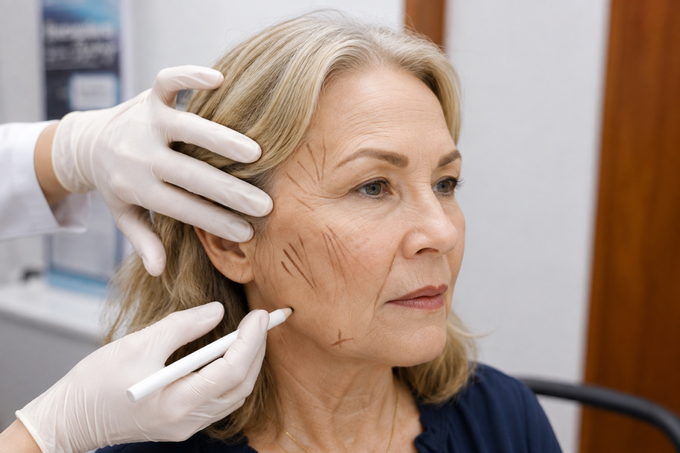
Dr. Cao Nguyen develops an individualized biostimulator injection map. Photo courtesy of the doctor |
Individualized treatment planning
Designer bio-mapping was among the approaches discussed at the master class. Rather than using the same injection points for every patient, physicians assess facial aging, skin quality and structural relationships before mapping areas of volume loss, tissue descent and reduced support.
Treatment depth, injection vectors, product distribution, dose and number of sessions are then adjusted according to individual anatomy and treatment goals.
The approach can be relevant to Asian patients because skeletal morphology, fat distribution, skin thickness and aging patterns vary among individuals.
The master class also discussed two broad treatment strategies. Lifting vectors provide deeper structural support and typically use longer trajectories with fewer entry points. Booster vectors are more superficial and use shorter lines to target texture, elasticity and radiance.
The approaches can be used separately or combined depending on treatment objectives.
Reconstitution and treatment safety
For lyophilized injectable products, reconstitution is part of the treatment process and aims to achieve complete hydration, a uniform suspension and consistent microparticle distribution.
A higher concentration does not necessarily produce greater biostimulation. Outcomes can also depend on total dose, tissue characteristics, suspension uniformity, injection plane, distribution technique and individual biological response.
The master class emphasized safety measures including patient and indication selection; use of authentic, traceable products according to approved instructions; appropriate reconstitution; correct dose and distribution; selection of the appropriate tissue plane and anatomical safety zone; aseptic technique; and follow-up to identify and manage potential adverse events.
 |
|
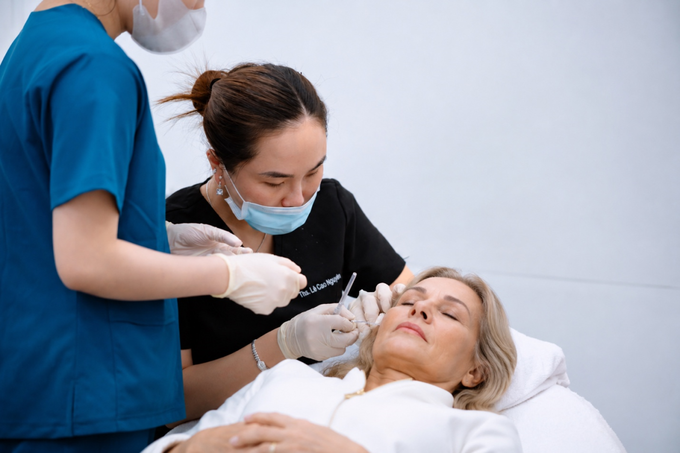
Dr. Cao Nguyen has nearly 15 years of experience in aesthetic dermatology and facial rejuvenation. Photo courtesy of the doctor |
When appropriately indicated, collagen biostimulation may improve firmness, elasticity, texture and tissue quality while supporting gradual volume or contour restoration. The timing and extent of results vary according to factors including age, baseline collagen status, treatment area, product, technique and number of sessions.
Dr. Cao Nguyen is a dermatologist and founder and medical director of Akina Center in Hue and Da Nang. She has nearly 15 years of experience in aesthetic dermatology and holds a medical degree, postgraduate training in dermatology and a Master of Science in Dermatology. She is currently a PhD candidate.
She taught at Hue University of Medicine and Pharmacy from 2012 to 2013.
Her scientific presentations include “Optimizing Lifting and Skin Rejuvenation Outcomes Using Combined HIFU and Radiofrequency Diathermy: A Multilayer Approach in Asian Patients” at AMSC 2026 in Kuala Lumpur and “Efficacy and Safety of Periorbital Rejuvenation Using Calcium Hydroxylapatite” at HSAPS 2025 in Ho Chi Minh City.
Her approach to aesthetic treatment is summarized by the principle: “Do not change a face by overfilling it. Restore its biological potential, structural integrity, and natural harmony.”
For Dr. Cao Nguyen, regenerative aesthetics should focus on restoring appropriate tissues based on individual indications rather than adding excessive volume.
“Rebuild, don’t overfill,” she said, describing the principle as an approach to achieving natural-looking and responsible aesthetic outcomes.
Collagen-biostimulator procedures require an in-person medical assessment, screening for contraindications, anatomical analysis and an individualized treatment plan. Results, number of sessions, response times and potential risks vary among patients.
Hue: 109 Dao Tan Street, Hue City
Da Nang: 03-05 Chu Van An Street, Da Nang City
Hotline: 0787717575
Website: akinacenter.com