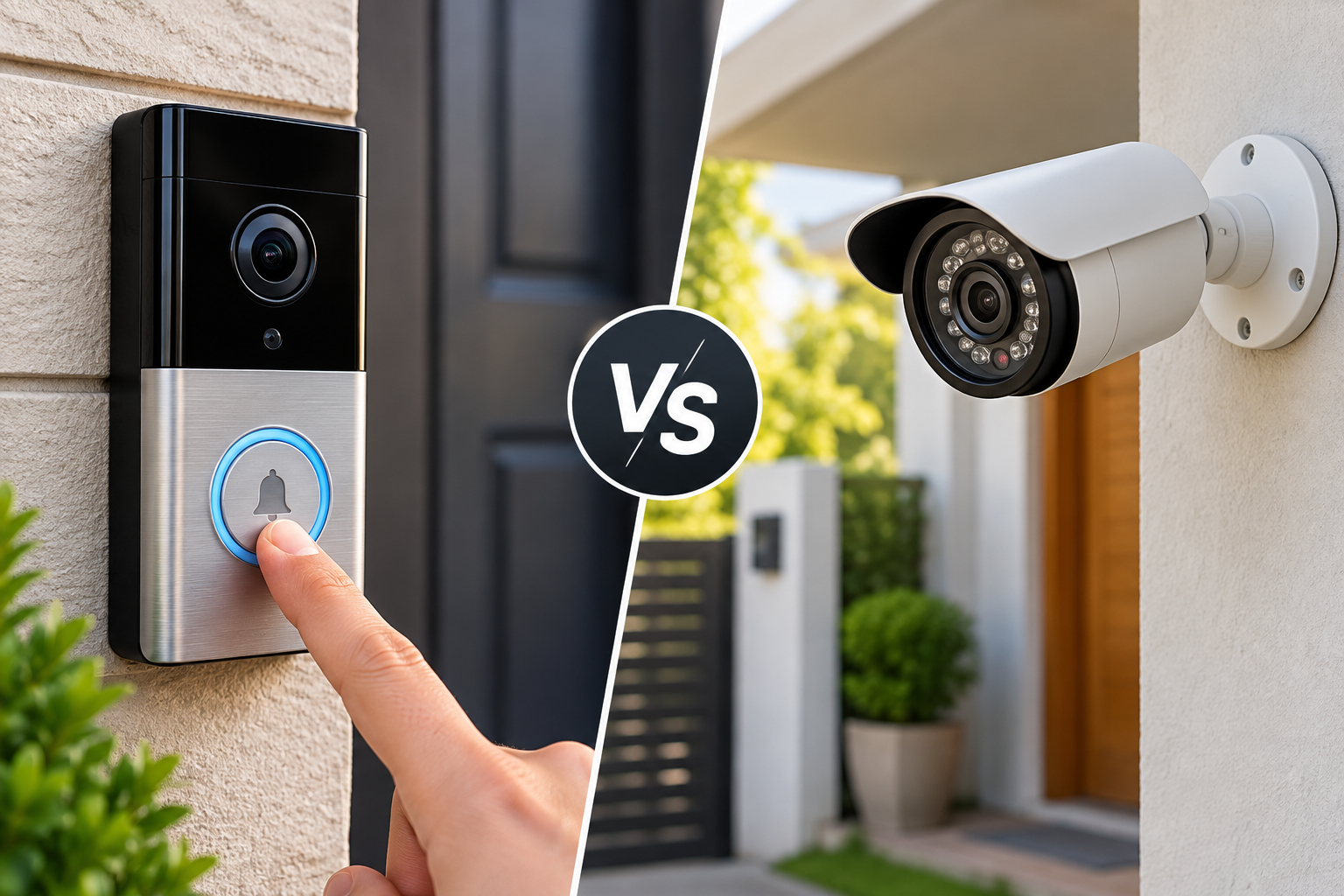
Keeping an eye on the front entrance is an important part of home security, but the right device depends on how much of the property you want to monitor. Traditional CCTV systems are commonly used to watch entrances, gates, driveways and other areas, while video doorbells are designed specifically around the front door.
A video doorbell combines a camera with a doorbell and can send alerts when someone approaches or rings the bell. Many models also offer live viewing and two-way communication, allowing homeowners to speak with visitors without opening the door. CCTV systems, meanwhile, are generally built for broader and often continuous surveillance.
The two technologies serve different purposes. A video doorbell focuses on visitor activity at the entrance, while CCTV is more suitable when wider areas or multiple locations need to be monitored.
How Does a Video Doorbell Work?
A video doorbell combines a doorbell button, camera and security features in a single unit. When someone approaches the entrance or presses the button, the device can send an alert and provide a live view of the area outside.
Many models include two-way audio, allowing homeowners to communicate with visitors using a smartphone or the doorbell itself. This can be useful for deliveries, guests or unexpected visitors.
Depending on the model, recordings can be saved to local storage, a memory card or a cloud service. Some manufacturers may require a subscription for certain storage or advanced features, so buyers should check these details before purchasing.
The main advantage of a video doorbell is its focused design. It is intended to monitor the area immediately around the front entrance rather than the entire property.
Where Video Doorbells Work Well
Video doorbells are particularly useful for front-door monitoring, visitor identification, delivery alerts, remote communication and apartment entrances. Real-time notifications can also make it easier to know when someone arrives.
However, they may not be suitable when you need to monitor distant gates, large driveways or several areas around a property. Continuous recording may also depend on the particular model, storage option or subscription plan. Connectivity requirements such as Wi-Fi can be another consideration.
How Does Traditional CCTV Work?
Traditional CCTV systems use dedicated cameras to record activity in selected areas. Depending on the installation, cameras can be placed near a front door, gate, driveway or other parts of a property.
A conventional setup may use several cameras connected to a DVR or NVR, allowing footage from different locations to be recorded and reviewed. Some modern systems also provide remote access through smartphones and other connected devices.
Unlike a video doorbell, a CCTV camera does not have to be installed directly beside the front door. It can be positioned farther away or at a different angle to provide a broader view of an entrance or surrounding area.
This flexibility makes CCTV useful for homes where several security points need to be monitored.
Where Traditional CCTV Works Well
CCTV is well suited to continuous surveillance, wider entrance coverage, driveways, gates, multiple-camera setups and recording activity across larger homes or properties.
The trade-off is that installation can be more involved, particularly when several cameras, cables, power connections and recording equipment are required. CCTV cameras also do not normally include a doorbell function, and visitor communication depends on whether the specific system supports two-way audio.
Video Doorbell vs CCTV: Which Fits Your Needs?
The better option depends largely on the type of monitoring required.
| Feature | Video Doorbell | Traditional CCTV |
|---|---|---|
| Primary purpose | Front-door visitor monitoring | General security surveillance |
| Coverage | Focused on the doorway | Wider, depending on camera placement |
| Visitor alerts | Available on supported models | Usually requires a connected system |
| Doorbell function | Built in | Usually not included |
| Two-way communication | Common | Available on some systems |
| Continuous recording | Depends on model and storage | Common in dedicated systems |
| Remote viewing | Common | Available with compatible systems |
| Installation | Generally simpler | Can be more involved |
| Storage | Cloud, local or subscription-based, depending on model | DVR/NVR, memory card or cloud, depending on system |
| Best suited for | Visitors at the front door | Wider property surveillance |
For a home where the main concern is knowing who is standing at the entrance, a video doorbell provides a more focused solution. It combines visitor alerts, live viewing and communication in one device.
CCTV becomes more useful when the security requirement extends beyond the doorway. A camera positioned near a gate or driveway, for example, can cover areas that a doorbell may not capture effectively.
Which Is Better for Visitors?
Video doorbells are specifically designed for visitor interaction. The camera and doorbell are integrated, while supported models can send alerts and provide two-way communication.
CCTV can also show someone approaching the property, but its primary purpose is surveillance and recording. Communication may require a compatible camera or additional equipment.
For everyday situations such as receiving deliveries, greeting guests or checking an unexpected visitor, a video doorbell offers a more direct approach.
Which Is Better for Recording?
Traditional CCTV generally has an advantage when continuous recording is the main requirement. Dedicated systems can record footage from one or multiple cameras depending on their configuration and available storage.
Video doorbells can also record activity, but recording capabilities differ between models. Some support local storage, while others use cloud services or offer additional recording features through a subscription.
Anyone looking for long-term or continuous footage should check whether the chosen device supports continuous recording, event-based recording and the preferred storage method.
Which Is Easier to Install?
A video doorbell can be relatively simple to install, particularly when using a model designed for straightforward setup. Wired versions, however, may require an existing electrical connection.
CCTV installation can require more planning because camera positions, cabling, power supplies and recording equipment need to be considered. Installing several cameras can make the process considerably more involved.
For a basic front-door security upgrade, a video doorbell can be a simpler solution. CCTV requires more setup but can provide coverage across multiple areas.
Which One Should You Choose?
The choice ultimately comes down to the type of security coverage you need.
If your priority is monitoring the front door, receiving alerts, identifying visitors and communicating with them remotely, a video doorbell is designed for those tasks.
If you need continuous surveillance, wider coverage or monitoring of areas such as gates, driveways and multiple parts of the property, traditional CCTV is more suited to that requirement.
For everyday front-door monitoring, a video doorbell offers a focused combination of security and visitor interaction. For broader property surveillance, a CCTV system can provide coverage across multiple locations.
Common Security Scenarios
| Security Requirement | Suitable Option |
|---|---|
| Monitoring visitors at the front door | Video Doorbell |
| Delivery alerts | Video Doorbell |
| Remote communication with visitors | Video Doorbell |
| Apartment entrance monitoring | Video Doorbell |
| Monitoring a front gate | Traditional CCTV |
| Monitoring multiple areas | Traditional CCTV |
| Recording activity across a property | Traditional CCTV |
| Large home or property | Traditional CCTV |
| Remote visitor interaction | Video Doorbell |