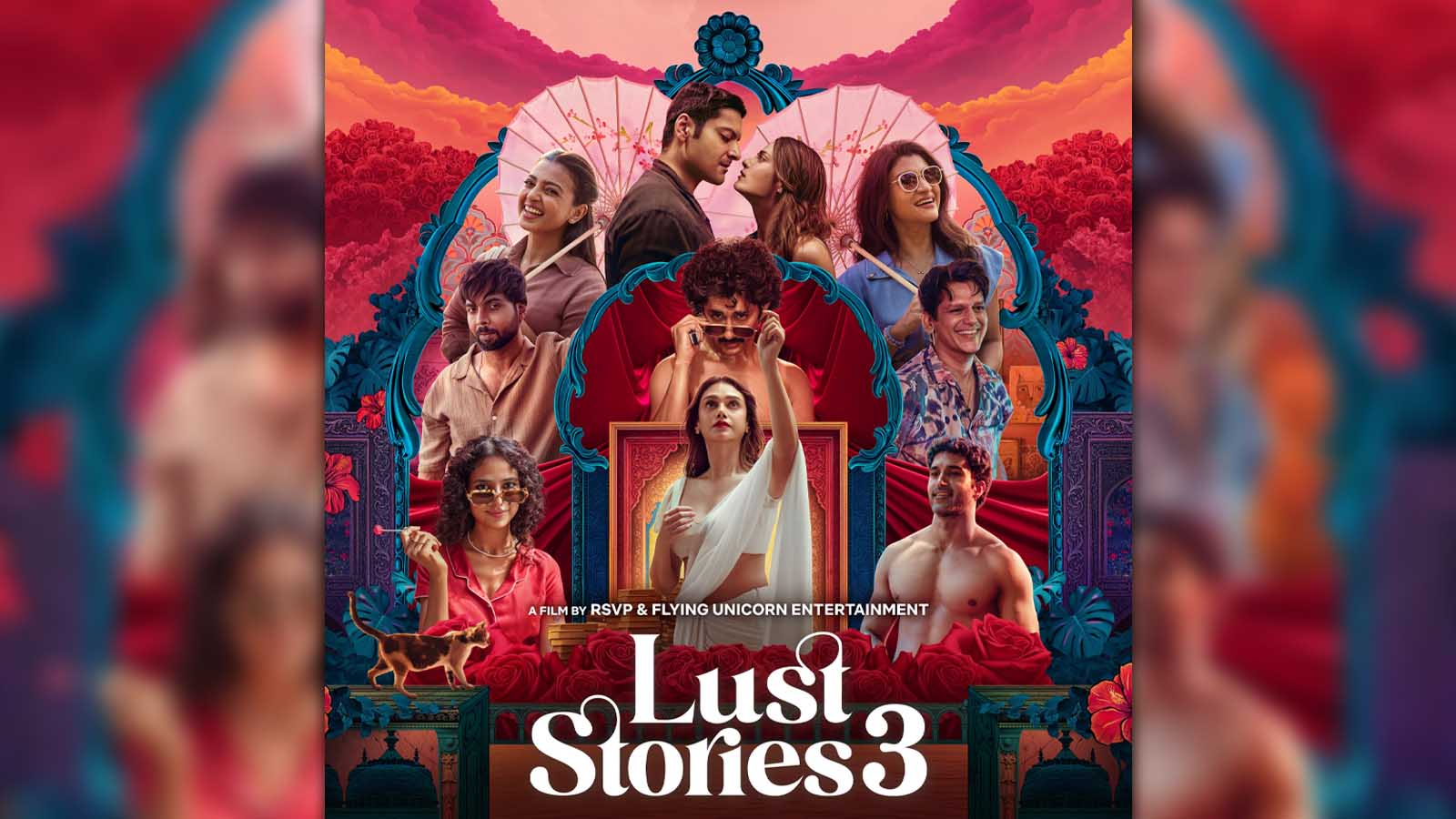
The idea of Lust Stories is appealing. The title sounds like an antidote to ‘love stories’, of which we’ve had far too many. Lust, on the other hand, has for long lived in the shadows. Also appealing is the idea of getting together four filmmakers with their own distinct identity and throwing them a theme. But despite everything going for it on paper, the past anthologies in Bollywood — Bombay Talkies (2013) and Ghost Stories (2020) included — has always turned out to be, at best, wildly inconsistent with one among the bouquet always being a standout (Dibakar Banerjee’s in Ghost Stories and Konkona Sen Sharma’s in the 2023 Lust Stories 2) and, at worst, a mixed bag of misfires. Not a total miss, but never entirely successful either.
And yet, it’s like a bag of treats. You expect each of the films to have their own personality, especially when it brings together filmmakers as different in their craft as Vikramaditya Motwane, Kiran Rao, Shakun Batra and Vishal Bhardwaj.
The one with chemistry
As though setting the tone for the rest of the film, Lust Stories 3 — the latest season in a series which first dropped on Netflix in 2018 — opens with a quartet of players, each a very different individual: Radhika Apte plays Paddy, a Maharashtrian woman who’s best friends with Konkona Sen Sharma’s Shonali, a Bengali woman, neighbours in a housing society in Mumbai; their respective husbands are Vijay Varma’s Hemant and Abhishek Banerjee’s Debu. One of them will propose a risky idea — a feminist flip on Abbas Mustan’s 2001 hit Ajnabee, if you will — that will have its consequences.
Also read: Daayra review: Why Mehgna Gulzar film starring Kareena, Prithviraj Sukumaran fails morality test
Motwane’s segment starts off like a comedy and ends in a quiet tragedy, with the cruel irony of a cautionary tale. Avinash Sampath has written the screenplay. Not all of it works. At first, such a risqué idea feels a bit preposterous in such a recognisable Mumbai milieu. That’s why initially the characters may seem like they are channeling ideas thought up by the makers rather than actually embodying them. You feel a certain dissonance in the intent and the execution.
But in Apte and Sen Sharma, you have a two-hander too irresistible. Their chemistry is crackling. Watching them debate on the merits of the proposal is what sets the engine rolling. We also get some funny one-liners.
The film only gets richer with Varma and Banerjee joining the party. Motwane doesn’t treat the husbands as cut from the same cloth. They react differently when put in a similar situation. Varma gives a controlled performance, reticent for the most part until a Marathi rap song at a nightclub unlocks the good vibes in him. Banerjee makes Debu slightly sneaky.
If there’s another star in this segment, it’s the music by Sneha Khanwalkar (with Yash Sahai sharing the scoring credits). But for all its merits, you can’t help but shake off the nagging feeling that the film doesn’t look as good as it should’ve (it’s shot by Siddharth Diwan).
Which leaves the audience to wonder if individual style is flattened by a Netflix-coded aesthetic. There’s a lot of coloured light, for instance. It makes sense in a spa, or a nightclub, but when it appears in an ambulance, it raises the questions if it’s a visual shorthand for eroticism.
The ones with the twist and the novelty
Rao’s segment has a more striking visual quality (shot by Shreya Dev Dube). A pizza delivery guy (Gurfateh Pirzada) and a girl from a nail salon (Sana Thampi) hook up. It’s lust at first sight. She sucks on an ice lolly, sun-baked and dreamy; he gets off his bike and takes off his helmet, enjoying being looked at. As he approaches her, walking in slow motion, reality intervenes: there’s crow shit on him. The spell breaks. Maybe it’s a sign of things to come?
The segment has some twists up its sleeve. (The screenplay is by Tanaji Dasgupta). A rom-com-ish premise transforms into a comic caper that reveals its noirish characteristics gradually. And if you think of Rao as one with a Western sensibility, you’ll be surprised. She uses tropes we associate with Hindi commercial cinema in a way that’s genuinely surprising and adds complexity. And perhaps confusion. As a result, the film begins to lose you for a considerable stretch, until it pulls you back with one last twist. It has a great parting shot, though — an image that makes bumbling fools of the heroic — that nicely bookends how the film had begun.
Batra’s film, the next one in sequence, is about a couple going through divorce. They don’t seem to get along at all, except the sex is still great. They fight about pretty much everything — most violently over which of them is going to get possession of a painting — but they always end up in bed. It’s toxic, their therapist tells them in a session of couple counselling. And it’s true that both of them treat it as power games.
There’s novelty in the idea that a failing marriage doesn’t automatically mean a sexless one and that great sex doesn’t necessarily mean that a marriage is successful. Sailee (Radhika Madan) and Varun (Ali Fazal) seem to be able to communicate with each other only through their bodies. Surely, that means something for a couple undergoing separation. Batra — always interested in the messiness of relationships; and here sharing the screenwriting credits with three others — uses the sex as a jumping off point to uncover deeper truths, but too often, they feel like cliches (one wishes one could name, but then spoilers).
The more conversational the film becomes — the couple try to talk it out — the more the problems multiply. The writing is a letdown. And although the ending tries to reimagine an alternative to their crisis, it doesn’t feel earned.
The one that goes back in time
Bhardwaj’s film — the final segment in Lust Stories 3 — flips the situation we encounter in the previous one: every sexless marriage is not a broken one. Saira and Badru have chemistry. They are a happily married couple on most counts. It helps that they are played by Aditi Rao Hydari and Siddharth, who are married in real life and (possibly) happy. But unlike the other stories, which take place in the present day, this one is set in 1987 in Hyderabad. The setting allows Bhardwaj to travel back to a time when erotic material was hard to access. Even more so if you were a married woman.
Bhardwaj finds his comfort zone within this world. Ever a lover of literature and language, he finds an excuse to showcase Hyderabadi Hindi, a dialect most of us are alien to, and whose phonetic delights inject the scenes with a certain force. It’s in the realm of language and literature that he locates the occupation of his protagonist: Saira teaches Urdu in a school, and it’s her interactions with the group of girls in the classroom that propel the story forward. Bhardwaj also gives his characters very Bhardwaj quirks. (He shares the screenwriting credit with Utkarshini Vashishtha). Saira’s in-laws are a family of homeopathy doctors. There isn’t a scene where Badru doesn’t mention Nux Vomica. But Badru’s father, played by Gajraj Rao, steals the show without so much as uttering a word, his mouth always full of paan.
The problem with this segment is that despite its twists and turns, not any of it comes as a real surprise. There isn’t a real sense of conflict; and even if it initially seems so, the quick resolutions feel more like wish-fulfilments.
Also read: How a centuries-old song is travelling from Golconda to Cannes and Toronto
It’s difficult to look at Lust Stories 3 as a cohesive whole, despite the segments trying to make cute attempts at planting Easter Eggs that connect them. Maybe there’s a contradiction inherent in the format itself: when you have four filmmakers making a film each under an overarching theme, the result will always be fragmented. The problem, then, is not whether they add up to something larger but whether they are different enough from each other. Whether they are guilty of the same mistakes. Or have the same virtues. Too often, the characters of Lust Stories 3 spell out the subtext. There’s little room for mystery and ambiguity. The films are well-intentioned — maybe too well-intentioned, and not transgressive enough — and all four are interested in women’s desire in different ways. But by and large, the ideas are more interesting than their execution.
Perhaps that is the fatal flaw of the Lust Stories franchise: it keeps giving us filmmakers worth watching, but not always films that are worth remembering.