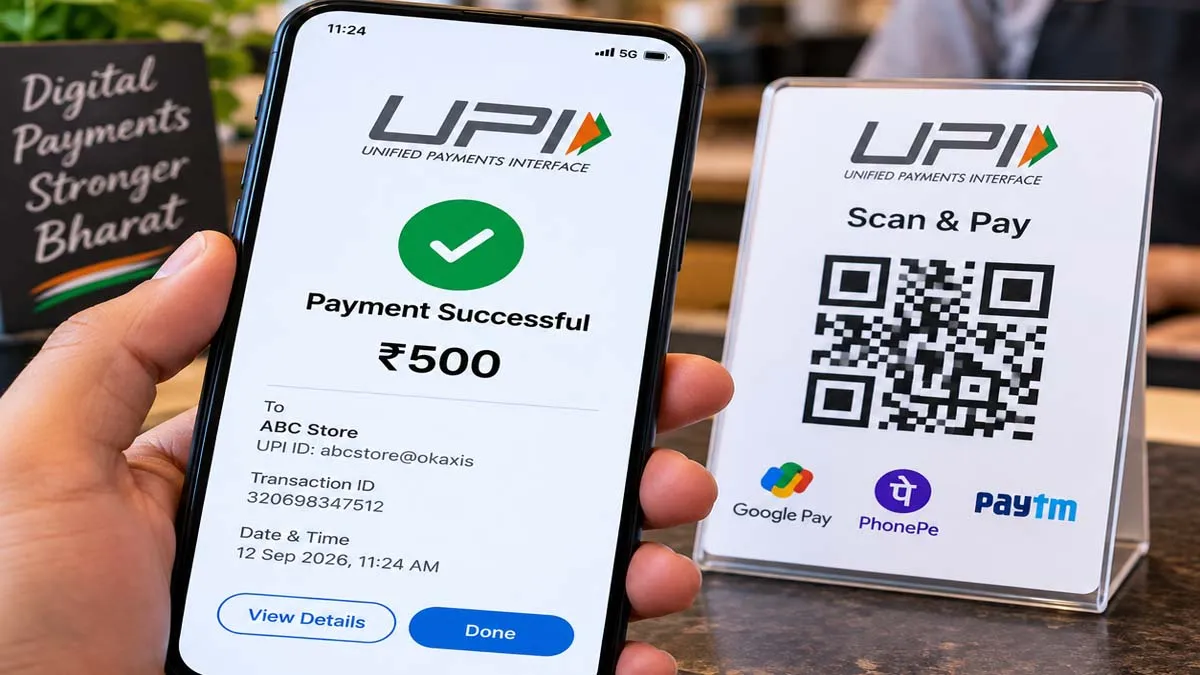
If you also make UPI payments indiscriminately through your smartphone every day, then this news is very important for you. These days, many things are going on in social media and market regarding the new rules of UPI. Let us know in very simple language what effect the new rules coming into effect from October 15, 2026, will have on the common man's pocket and whether you will really have to pay any extra charge or not.
Will common customers have to pay charges for using UPI?
First of all, know that absolutely not! Despite the new MDR rules of UPI coming into effect from October 15, 2026, no separate charge will be levied from general customers for using UPI. Whenever you send money to your friends, relatives or family members, all those P2P transactions will remain completely free as before. Additionally, no UPI app can collect any platform fees or additional charges from its customers.
What is the big difference between P2P and P2M payments?
It is very important to understand that there are mainly two types of transactions in UPI. The first is P2P (Person-to-Person) payment, which means when one person sends money directly to the bank account of another person. For example, sending ₹500, ₹5,000 or ₹1 lakh to your brother, friend or relative. No MDR is levied on all such transactions.
On the other hand, there is P2M (Person-to-Merchant) payment. This happens when you go to a store and buy goods, pay a merchant, or pay for a service. For example, paying for goods at a grocery store is called P2M transaction.
Will any MDR be levied on payments to shopkeepers?
If you make UPI payment up to ₹2,000 to any shop or other merchant, no MDR will be levied on it. That means normal P2M transactions up to a limit of ₹2,000 will be completely secure and without any charges.
But, if you make eligible P2M transactions of more than ₹2,000, an MDR of 0.4 per cent has been capped. However, this fee is applicable only between the merchant and the parties involved in the payment system, and is never permitted to be collected directly from the customer. Additionally, if a transaction is worth ₹75,000 or more, the maximum limit of MDR has been fixed at ₹300 per transaction.
Can the shopkeeper take this charge directly from the customer?
Under the new and stringent rules, no shopkeeper is allowed to pass the burden of MDR directly on the customer and collect UPI charges separately from him. This means that if you make a UPI payment of ₹ 5,000 at a shop, then the shopkeeper cannot ask for a single rupee separately from you in the name of MDR.
What is the relief for small shopkeepers and street vendors?
A special 'P2PM' category has been created for small traders and street vendors. Small merchants whose payments total up to ₹ 1 lakh per month come into their bank accounts through UPI QR code will get the full benefit of 'Zero MDR'. This special discount can also be applicable on any single payment exceeding ₹2,000, provided the merchant fulfills all the required conditions of the P2PM category.
Apart from this, for some selected essential services, a different rate has been kept instead of the normal 0.4 percent MDR. If the payment is more than ₹2,000, only flat MDR of ₹5 will be applicable in categories like Railways, Telecom, Insurance, Fuel and some other utility services. Important services like electricity, water and piped gas have also been kept under this special category.
Will there be any monthly limit on using UPI?
No separate monthly quota or any tiered limit has been imposed on the use of free UPI for the common people. You will be able to easily make P2P payments as per your need without any MDR like before.
As far as UPI's daily limit of ₹1 lakh to ₹5 lakh is concerned, it is completely related to security and fixed transaction limits. This should never be confused with MDR or any new hidden charge limitation. Just because a person's UPI limit is ₹1 lakh or ₹5 lakh does not mean that he will be charged that much by the government.