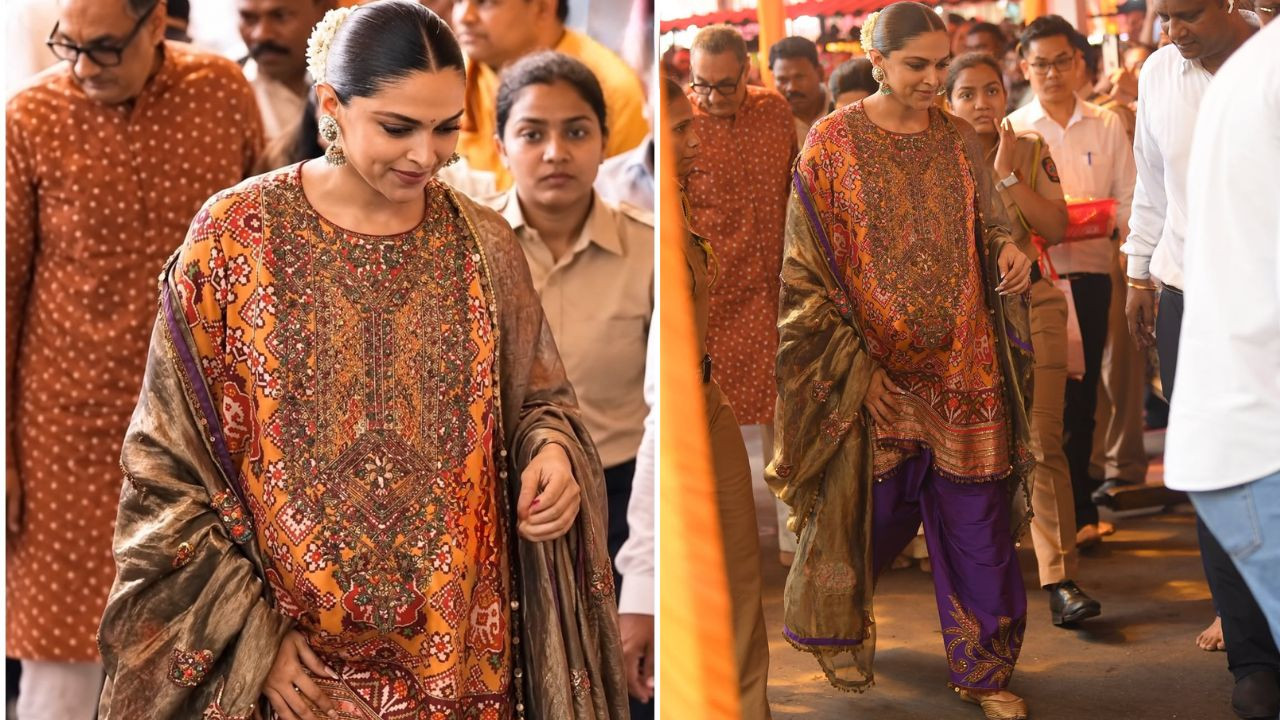
New Delhi: One of Bollywood's most favorite couples, Deepika Padukone and Ranveer Singh are soon going to welcome another little guest in their home. At this special stage of their second pregnancy, this beautiful couple reached the famous Siddhivinayak temple of Mumbai to seek blessings of Bappa. Just like both of them had gone to visit the temple before the birth of their daughter 'Dua' in the year 2024. Mother-to-be Deepika's traditional look during this devotional tour is winning everyone's heart. Flaunting her baby bump with utmost simplicity and elegance, the outfit that Deepika wore is directly related to India's 900-year-old rich textile art and heritage.
Mom-to-be glows in Mayur Girotra's Patola kurta
For the temple darshan, Deepika wore a custom traditional ensemble made by fashion designer Mayur Girotra. Her look was based on silk patola print, which featured bright colors and traditional motifs.
She paired a loose-flowing kurta with purple bottoms and a tissue silk woven dupatta. The dupatta had delicate applique work. This ethnic combination of purple and golden tones further enhanced her mom-to-be glow.
View this post on Instagram
fine zardosi work
The round neckline of this traditional kurta was highlighted with fine golden embroidery of antique zardozi, while the rest of the part had a patola pattern made of a mixture of yellow, red, green and white colors looking very attractive. This style of mixing traditional craft with modern silhouette was giving it a very special and royal feel. Keeping pregnancy fashion in mind, the designer kept the fitting of the kurta very loose and comfortable, so that there is ease of movement and the baby bump can also be flaunted a little. Vibrant colored patterns instead of heavy work gave this ethnic wear a classy finish.
900 years old historical Patola history of Gujarat
This outfit of Deepika Padukone is not just a part of fashion but represents the age-old cultural heritage of Gujarat. The history of Patola weaving is believed to be around 900 years old, having been a status symbol among the royal houses and rich class of Patan especially in the 11th and 12th century. The artisans of the Salvi community of Patan have preserved this wonderful art from generation to generation. The process of making Patola is based on 'Double Ikat' technique, which is very complex and laborious. In this, both the warp and weft threads are tied and dyed as per the design before weaving. It takes a long time from several months to a year for the artisans to prepare a saree or cloth on a handloom.