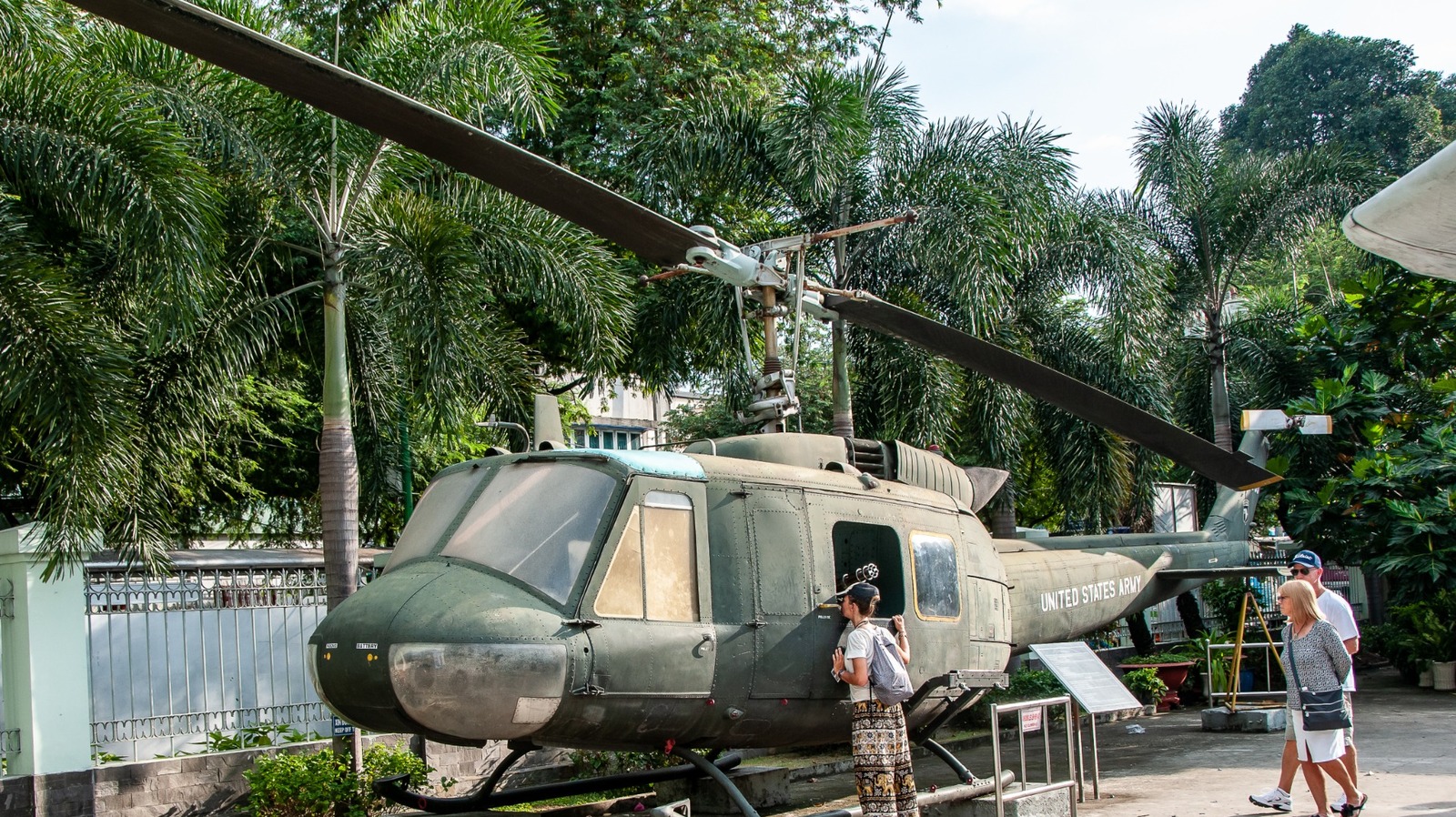
If you’ve ever seen a Vietnam War film or documentary, or even Miss Saigon on Broadway, then you’ve most likely seen a Huey. It’s the compact helicopter with the two-blade rotor that makes that famous chopping “whop-whop” sound. Before the Huey existed, many military helicopters were powered by piston engines, and those early designs were particularly difficult to maintain. The U.S. Army wanted something lighter, more reliable, and versatile enough to serve as both a utility and medical evacuation helicopter.
To meet these requirements, the Army launched a design competition, which the Bell Helicopter Company won. In 1956, Bell’s turbine-powered XH-40 prototype took its first flight. The production aircraft was named the Iroquois HU-1, which is where the nickname “Huey” comes from. In 1962, the HU-1 was redesignated UH-1, but the nickname stuck. The Huey soon became one of the most versatile tools in the U.S. military arsenal. It transported troops, evacuated wounded soldiers, hauled cargo, and even served as a gunship.
Its large cabin openings also made it easy to move people and equipment in and out quickly. That’s why it can seem like Huey helicopters often fly with the doors open. Although the Huey came about partly because the Army wanted a turbine-powered helicopter, it didn’t rely on just one engine throughout its active service. Before the twin-engine setups in later Hueys, it used Lycoming’s T53 and General Electric’s T58. Here’s a look at how the engines that powered one of the most iconic military helicopters in history evolved over the years.
The single-engine Hueys: Lycoming T53 and General Electric T58
The Huey historically became the Army’s workhorse helicopter, so, naturally, the engine doing most of the heavy lifting deserves some spotlight. Right from the first prototype, the Huey ran on Lycoming’s T53. This gas turbine turboshaft was designed by a team led by Dr. Anselm Franz, who had previously been chief designer of the Junkers Jumo 004, one of the most innovative fighter jet engines.
The prototype produced around 700 shaft horsepower, but by the time the T53-L-1 made it into the first production Hueys, that number had climbed to about 860 shaft horsepower. It performed well enough during testing that the U.S. Army contracted for 300 more helicopters. The goal was a helicopter capable of carrying an 800-pound payload and staying in the air for more than two hours, and this model delivered. From there, as Bell released more Huey iterations, the T53 kept getting more powerful. It eventually reached 1,800 shaft horsepower. And around 19,000 T53 engines were produced, racking up over 50 million flight hours.
While the Army’s Hueys ran the T53, the U.S. Air Force asked for a specific modification. It required that its own Hueys be built with General Electric’s T58, an engine it had already bought for part of its helicopter fleet, including the HH-3 Jolly Green Giant, and had in surplus. The T58 started out in the 1,050 shaft horsepower class and eventually climbed to 1,870. General Electric produced an estimated 9,000 T58 and civilian CT58 engines over the course of the run.
The twin-engine Hueys: Pratt & Whitney T400 and General Electric T700
The upgrade to a twin-engine design occurred in 1968 because the Canadian Armed Forces requested a twin-engine helicopter. Bell took on the project, and Pratt & Whitney Canada designed the engines, which were originally called the PT6T-3 Twin-Pac. But the U.S. military also ordered them and came to refer to the engines as the T400-CP-400, or T400 for short. Together, the engine duo put out around 1,800 shaft horsepower. By the end of 1970, the twin-engine Hueys, or more accurately, UH-1Ns, were used in Vietnam with the 20th Special Operations Squadron to conduct reconnaissance and support Special Forces. The Navy and Marine Corps got theirs in 1971.
By 1996, a lot of these units were worn out after decades of service across operations in Vietnam, Grenada, and more. So, the Marines asked Bell to spruce them up. Eventually, the Marines simply ordered Bell to build new aircraft. That became the UH-1Y Venom, which entered service in 2008. The Venom runs two General Electric T700-GE-401C turboshafts, each rated at 1,800 shaft horsepower. It was a big step-up from its predecessor, with a four-blade rotor, upgraded transmission, digital cockpit, greater payload capacity, and considerably more range.
Now, after serving for over sixty years, the U.S. Army has retired the OG Hueys. They’ve also been phased out of the U.S. Marine Corps, the Navy, and the Air Force. The Venom, however, is still very much in service with the Marines.