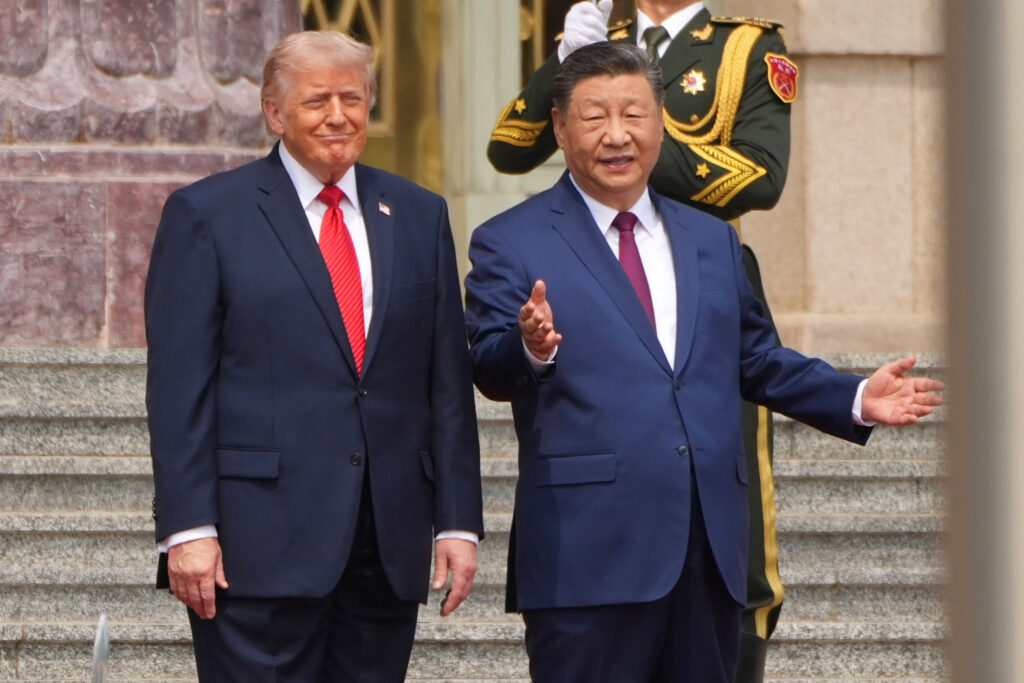
Trump Plans Airport Welcome for Xi as Trade, AI and Iran War Shape State Visit/ TezzBuzz/ WASHINGTON/ J. Mansour/ President Donald Trump will personally greet Chinese President Xi Jinping when he arrives for the first U.S. state visit by a Chinese leader in more than a decade. Talks are expected to cover tariffs, artificial intelligence, rare earth minerals and the economic consequences of the Iran war. China’s vast oil reserves and reduced crude imports have helped prevent global prices from reaching the most severe levels predicted when the conflict began.

Quick Look
- Trump will welcome Xi at Joint Base Andrews on Wednesday.
- The airport greeting is unusual for Trump’s foreign-leader visits.
- Xi and his wife, Peng Liyuan, will attend a White House state dinner.
- Technology leaders including Elon Musk, Jeff Bezos and Sam Altman are invited.
- Tariffs, artificial intelligence and rare earth supplies will be discussed.
- Limited tariff relief on nonstrategic products may be considered.
- Washington is not expected to make major concessions on export controls.
- China accumulated an estimated 1.4 billion barrels of oil by the end of 2025.
- Beijing sharply reduced oil imports after the Iran war began.
- Analysts say that reduction helped moderate global oil prices.
- Trump and Xi remain divided over the war and China’s relationship with Iran.
- Additional disruptions could still drive oil as high as $150 per barrel.

Deep Look
Trump plans personal airport welcome for Xi
WASHINGTON — President Donald Trump will greet Chinese President Xi Jinping at Joint Base Andrews when Xi arrives Wednesday for a high-profile state visit focused on trade, technology and global security.
A presidential airport greeting is unusual because Trump generally receives visiting leaders at the White House. The gesture reflects the importance of Xi’s visit, the first U.S. state visit by a Chinese leader since September 2015.
The central events will begin Thursday, when Trump and first lady Melania Trump welcome Xi and his wife, Peng Liyuan, during an indoor arrival ceremony on the White House State Floor.
Trump and Xi will participate in a military review in the Rose Garden before holding private talks. Melania Trump and Peng Liyuan will attend a separate engagement, although officials did not disclose its details.
State dinner draws prominent technology executives
Trump and the first lady will host Xi, Peng and the Chinese delegation for a state dinner in the East Room on Thursday evening.
Both presidents are scheduled to deliver remarks.
“Thousands of people would love to be at that dinner,” Trump told reporters.
Trump said demand for invitations exceeded the available space and noted that the 1,000-person ballroom being added to the White House would not be completed in time.
“This is a very tough ticket for me,” Trump said. “I’ve told a lot of very good friends of mine, ‘you just can’t come.’”
The guest list includes several prominent executives whose companies have significant interests in technology, artificial intelligence and U.S.-China commerce:
- Amazon founder Jeff Bezos
- Tesla and SpaceX leader Elon Musk
- Google CEO Sundar Pichai
- Dell Technologies CEO Michael Dell
- Nvidia CEO Jensen Huang
- OpenAI CEO Sam Altman
- Citigroup CEO Jane Fraser
- Former Apple CEO Tim Cook
Their attendance reflects the importance of technology policy and commercial relations to the talks.
Xi and Peng scheduled for private White House tea
Xi and Peng are scheduled to return to the White House next Friday for a private tea with the Trumps.
The American president and first lady will then accompany their guests on a tour of the National Archives, which houses the Declaration of Independence, Constitution and other founding documents.
The visit comes as the United States celebrates its 250th anniversary.
Xi is scheduled to depart from Joint Base Andrews after the tour.
Tariff relief may cover limited products
Senior administration officials said Washington and Beijing could agree to reduce tariffs on a narrow category of nonstrategic goods.
The officials, who spoke anonymously under White House briefing rules, said any adjustment would be intended to benefit both countries. They did not identify which products could qualify.
The possible concessions would be limited and are not expected to include major changes to U.S. export controls.
Trump and Xi reached a fragile trade truce during talks in Beijing in May. The upcoming negotiations will test whether that arrangement can be preserved while disagreements continue over technology, energy and national security.
US and China prepare economic talks
Treasury Secretary Scott Bessent is scheduled to meet Chinese Vice Premier He Lifeng in New York before the Trump-Xi summit.
U.S. Trade Representative Jamieson Greer will join the discussions Sunday. China’s Commerce Ministry said He would lead a delegation to the United States from Saturday through Wednesday for economic and trade consultations.
Artificial intelligence is expected to be a major subject during the preliminary negotiations.
Working-level discussions could continue into Monday as officials attempt to identify potential agreements before Trump and Xi meet.
Rare earth minerals remain major source of tension
The leaders are also expected to discuss China’s stockpiles and exports of rare earth minerals.
These materials are essential for products ranging from smartphones and electric vehicles to missiles and fighter aircraft. China’s dominance of rare earth mining and processing gives Beijing significant leverage in its economic relationship with Washington.
U.S. officials said they want China to maintain an acceptable supply of the minerals to global markets.
However, they do not expect Washington to offer reduced American export controls in exchange for increased Chinese shipments.
Beijing has previously used rare earth restrictions to pressure the United States during disputes involving Trump’s tariffs and other economic sanctions.
China’s energy strategy helped moderate oil prices
The state visit takes place six months into the U.S.-Israeli war against Iran, which has disrupted energy shipments and driven Brent crude to around $100 per barrel.
Prices remain significantly above the roughly $69 average recorded in 2025, but they have not reached the most severe levels forecast when the war began.
Energy analysts say China’s strategy is a major reason prices have remained below those worst-case projections.
Beijing accumulated the world’s largest oil stockpile, reaching an estimated 1.4 billion barrels by the end of 2025, according to estimates cited from the U.S. Energy Information Administration.
China drew from those reserves after Iran effectively closed the Strait of Hormuz, allowing Beijing to reduce its purchases from the global market.
“We’ve been free-riding off Beijing in a weird way,” said Rosemary Kelanic, director of the Middle East program at Defense Priorities.
“China’s doing it because they understand that they’re on the train that Trump is driving off a cliff,” Kelanic said. “If oil prices go way up, that hurts the global economy. If it hurts the global economy, it hurts them.”
Chinese imports fell by nearly one-third
China is the world’s second-largest oil consumer and had been Iran’s largest customer.
After the war disrupted supplies, Chinese crude imports averaged approximately 8.1 million barrels per day during the second quarter of 2026. That was nearly 4 million barrels per day—or 32%—below the first-quarter average, according to U.S. data.
Lower Chinese demand left more oil available to other buyers, reducing some upward pressure on global prices.
China’s rapid shift toward electric vehicles and alternative energy sources also reduced its dependence on imported petroleum.
“The Chinese deserve credit,” said retired U.S. Navy Rear Adm. Mark Montgomery, an analyst at the Foundation for Defense of Democracies.
“They did in 10 years what took us 25 years after the 1973 oil crisis to do: really build a kind of strategic petroleum reserve that could allow you to weather this.”
Michael Lynch, president of Strategic Energy and Economic Research, offered a similar assessment.
“It’s remarkable how China managed the market,” Lynch said. “They didn’t panic and by turning to their inventories they kept the price down for everybody.” (Associated Press)
Oil market remains vulnerable to new disruptions
China’s reserves have moderated prices, but analysts warn that the global market remains vulnerable.
Iran-backed attacks prompted Saudi Arabia to shut down a critical pipeline transporting oil across the country to Red Sea ports. The Houthis have also seized two strategic islands near important shipping routes in the southern Red Sea.
Meanwhile, planned Gulf negotiations over reopening the Strait of Hormuz were postponed.
Before meeting Xi, Trump is scheduled to speak Tuesday with leaders of the Gulf Cooperation Council on the sidelines of the U.N. General Assembly.
The group includes:
- Saudi Arabia
- United Arab Emirates
- Qatar
- Bahrain
- Kuwait
- Oman
The meeting is expected to address the Iran war, energy shipments and regional security.
Analysts warn oil could reach $150
Bank of America analysts forecast oil averaging about $83 per barrel during the second half of the year, assuming shipping through the Strait of Hormuz gradually recovers.
Continued restrictions could instead push prices to between $95 and $120 per barrel, they said.
If the conflict causes extensive damage to major energy infrastructure, prices could temporarily climb as high as $150 per barrel.
Brent crude briefly reached $126 in April before retreating. It is currently trading around $100, still well above its 2025 average.
The U.S. Energy Information Administration’s current annual forecast places average Brent crude at approximately $91 for 2026, reflecting the market’s continuing volatility. (U.S. Energy Information Administration)
Trump and Xi remain divided over Iran
The Iran war is expected to feature in Trump and Xi’s discussions, but major diplomatic progress appears difficult because Washington and Beijing hold sharply different positions.
The Trump administration has urged Beijing to use its economic relationship with Tehran to pressure Iran to end the conflict and reopen the Strait of Hormuz.
China has condemned the U.S. military campaign and objected to American threats of secondary sanctions against countries and companies that continue doing business with Iran.
Analysts say China did not build its oil reserves to assist the United States. Beijing’s strategy reflects Xi’s emphasis on national self-reliance and preparations for geopolitical emergencies, including a possible conflict involving Taiwan.
Jonathan Czin, a former CIA analyst now at the Brookings Institution, said China views its performance during the oil disruption as “a vindication of Xi’s last five-year plan and his focus on self-reliance.”
Trump minimizes reports of Chinese assistance to Iran
The administration has warned China against helping Iran’s military campaign.
Trump nevertheless downplayed a report that Chinese entities provided Tehran with satellite images of a Jordanian military base before an Iranian strike that killed three American service members.
“You know, when they say that China spies on us, I say you’re right, and we spy on them too,” Trump said.
Following their May meeting, Trump said Xi agreed that Iran should not obtain a nuclear weapon and that the Strait of Hormuz must reopen. Chinese officials have neither confirmed nor denied Trump’s description of that private discussion.
The White House did not say whether Trump believes China deserves credit for preventing oil prices from reaching the highest levels predicted at the war’s outset.
The state visit gives both leaders an opportunity to manage their economic relationship while confronting persistent disputes over Iran, trade, technology and strategic competition.
More on US News