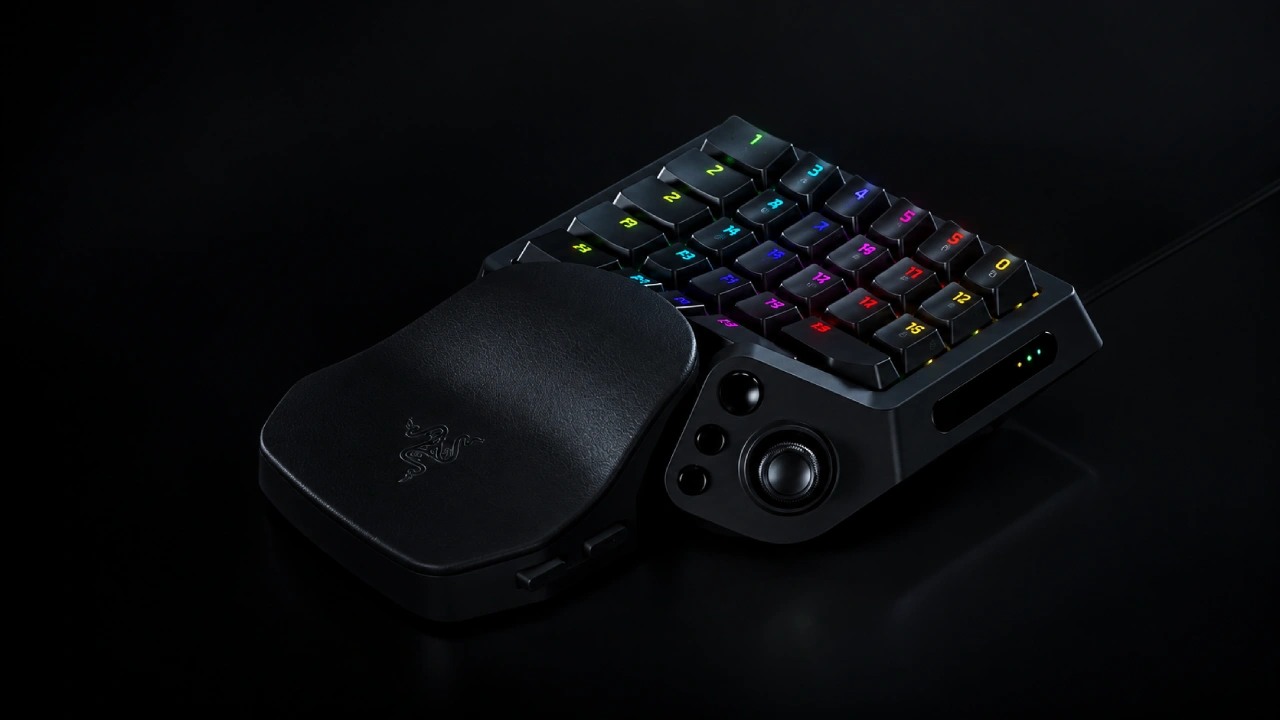
Razer has launched the Tartarus V2 Pro, a one-handed gaming keypad designed for players who want dedicated controls for games that demand frequent inputs. The September 17 launch brings several of Razer’s newer input technologies to the Tartarus line.
Most notably, this is the first Razer gaming keypad to combine Razer Analog Optical Switches Gen-2, true 8,000Hz HyperPolling and a TMR thumbstick. That combination is the main point of the new model rather than a simple increase in the number of programmable inputs.
The Tartarus V2 Pro also has 31 programmable controls, adjustable actuation, Rapid Trigger and a fully adjustable wrist rest. Razer is targeting MMO, FPS and other games where players may want frequently used commands available on one hand.
Razer Tartarus V2 Pro Brings Adjustable Key Response
At the centre of the Tartarus V2 Pro are Razer Analog Optical Switches Gen-2. Each switch has an adjustable actuation range from 0.1mm to 4.0mm, allowing users to choose how far a key needs to travel before an input is registered.
The keypad also supports Rapid Trigger, with sensitivity adjustable down to 0.1mm. Unlike a fixed reset point, Rapid Trigger responds to the movement of the key as it is released. Razer positions this feature for repeated inputs where key response timing matters.
Razer rates the switches for up to 100 million keystrokes and says each switch is individually lubricated and seated in a dense foam layer. These are manufacturer specifications rather than independent durability results.
The adjustable actuation and Rapid Trigger settings give users more ways to configure how the keypad responds, but those specifications alone do not establish better gaming performance. Their usefulness will depend on the game, configuration, and individual player.
31 Programmable Controls for Different Game Setups
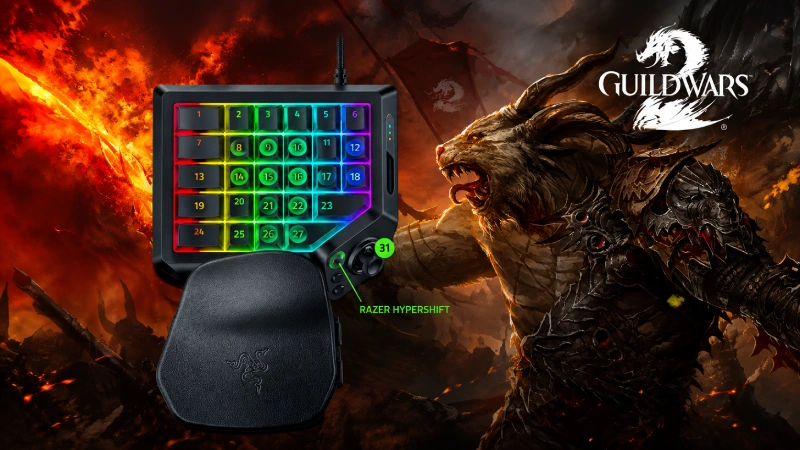
The Tartarus V2 Pro provides 31 programmable controls, which can be configured for different games and control layouts. Razer’s product documentation combines the keypad controls with the thumbstick and dedicated controls within the device’s overall control system.
For MMO games, users can assign abilities, shortcuts, and macros to the available controls. FPS and action games can use the inputs for movement, equipment, communication, or other frequently accessed commands.
Razer Synapse allows users to configure up to 24 keymaps across three onboard profiles. This means separate layouts can be maintained for different games or genres rather than rebuilding the configuration each time.
Actuation and Rapid Trigger settings can also be adjusted directly on the device, while the onboard LED array provides visual feedback.
The TMR Thumbstick Adds Analogue Input
Another defining feature is the full-sized TMR thumbstick. TMR, or tunnel magnetoresistance, sensing provides an analogue input alongside the keypad’s other controls. Razer describes the thumbstick as anti-drift and says it can be used for radial menus and in-game inputs. Three dedicated buttons are positioned around it.
This gives the Tartarus V2 Pro a combination of keyboard-style controls and analogue input. For players who prefer using a mouse for aiming while keeping movement or other analogue functions on the left hand, the configuration provides an alternative to a conventional keyboard-and-mouse arrangement.
The anti-drift description is a Razer specification and should not be treated as independent proof of long-term drift resistance.
8,000Hz HyperPolling Comes to the Tartarus Line
The Tartarus V2 Pro supports true 8,000Hz HyperPolling, allowing the keypad to report inputs to a PC more frequently than a standard 1,000Hz polling rate. Razer says this is the first time its true 8,000Hz HyperPolling technology has been brought to a Tartarus gaming keypad.
The keypad also includes Razer’s Advanced Input Control features: Snap Tap, Snap Flex, Dual-Keypress Priority and Dynamic Keystroke. These features provide additional ways to configure how inputs and simultaneous key presses are handled.
A higher polling rate does not automatically translate into better gameplay for every user. The practical effect depends on the game, PC configuration, and other hardware in the input chain.
The more notable launch development is therefore the combination of these technologies in one Tartarus device. Razer has brought its current switch, polling, and analogue-input technologies together in a format that was previously more focused on programmable keypad controls.
An Adjustable Wrist Rest
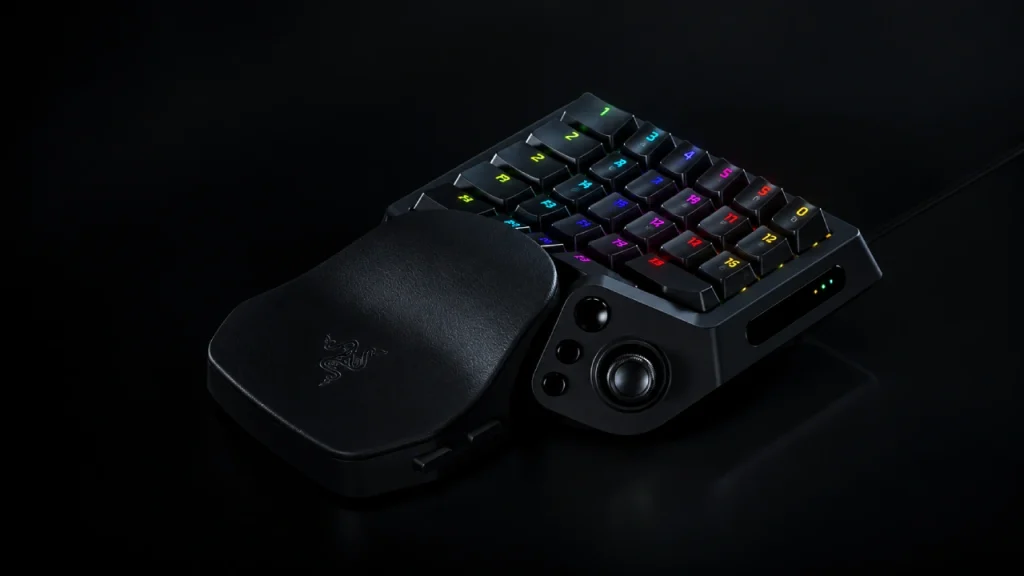
The Tartarus V2 Pro also features a fully adjustable wrist rest. It can slide outward and rotate left or right, allowing users to change its position rather than relying on a single fixed angle.
Razer describes the wrist rest as an ergonomic feature designed for extended gaming sessions. Actual comfort, however, will depend on the user’s hand position, desk setup, and playing habits.
What Sets the Tartarus V2 Pro Apart?
The Tartarus V2 Pro is not intended to replace every function of a traditional keyboard. Its purpose is to concentrate frequently used gaming controls around one hand while adding analogue input and configurable switch behaviour.
The distinction becomes clearer when looking at the combination of features. MMO players can configure multiple abilities and commands, while FPS and action-game players can assign movement and other functions around the thumbstick and keypad controls.
The new model’s defining change is not simply the number of controls. It is the combination of Analog Optical Switches Gen-2, adjustable actuation, Rapid Trigger, true 8,000Hz HyperPolling, and a TMR thumbstick in one Tartarus gaming keypad.
That makes the device particularly relevant to players who specifically want this type of specialised one-handed setup.
Razer Tartarus V2 Pro Price and Availability
The Razer Tartarus V2 Pro is listed at US$199.99 on Razer’s US store. Razer’s official product page currently lists the purchase price.
Pricing varies between markets. Razer’s UK store, for example, lists the keypad at £199.00.
For India, pricing and availability have not been verified at the time of writing. Therefore, the US$199.99 figure should not be treated as an Indian launch price or converted into an expected India price.
Is the Razer Tartarus V2 Pro a Major Change?
The Tartarus V2 Pro brings together several technologies that previously appeared separately across Razer’s gaming hardware.
Its Analog Optical Switches Gen-2 provide 0.1–4.0mm adjustable actuation, while Rapid Trigger can be configured down to 0.1mm. The device also adds true 8,000Hz HyperPolling and a full-sized TMR thumbstick to the Tartarus format.
The $199.99 US price also puts the product into a more specialised segment of Razer’s keypad lineup. Razer’s current US store lists the Tartarus V2 at US$79.99 and the Tartarus Pro at US$129.99, making the V2 Pro a considerably more expensive option.
That difference is relevant because not every player needs adjustable actuation, Rapid Trigger, 8,000Hz polling, or analogue thumbstick input. The Tartarus V2 Pro is aimed at users who specifically want those capabilities in a one-handed gaming keypad.
Final Thoughts
The Razer Tartarus V2 Pro expands the company’s dedicated gaming keypad format with a combination of configurable switches, analogue input and high-frequency polling.
Its 31 programmable controls, Analog Optical Switches Gen-2, 0.1–4.0mm adjustable actuation, Rapid Trigger, TMR thumbstick and 8,000Hz HyperPolling give users several ways to configure the device around different games.
Those specifications do not by themselves establish superior gaming performance. Their practical value will depend on the game, the player’s configuration and the rest of the system.
At US$199.99, the Tartarus V2 Pro is clearly positioned as a specialised option rather than a basic add-on keypad. Its main distinction is the combination of Razer’s newer input technologies in a single one-handed device, rather than simply offering more programmable controls.
(Source)