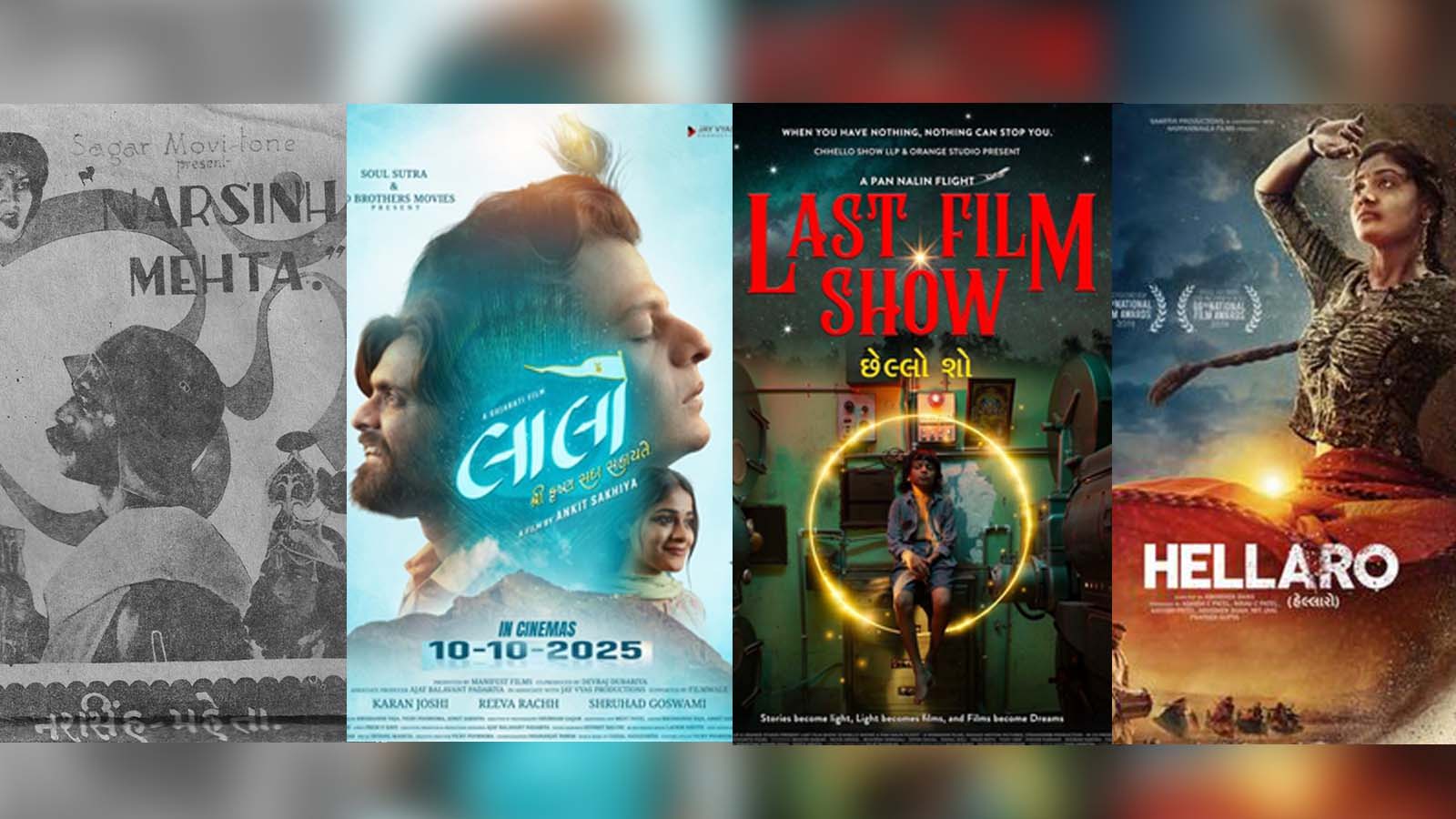
In India, cinema and conversations around it have largely revolved around the Hindi film industry. The discourse on regional cinema is often restricted to megahits or critically acclaimed films coming from down south — the Tamil, Malayalam, Kannada and Telugu industries — or to the works of Bengali icons like Satyajit Ray, Ritwik Ghatak, Mrinal Sen, Tapan Sinha, or in later years, Goutam Ghose, Aparna Sen and Rituparno Ghosh.
And yet, for nearly a century, another regional film industry has been quietly creating cinema but been mostly relegated to the shadows, regarded for decades as Bollywood’s ‘poor cousin’. Now, as a prestigious film award chooses to make the state its destination of ceremonies this year, the lights are finally shining bright on the Gujarat film industry, popularly known as Dhollywood.
Earlier this month, it was announced that the National Film Awards ceremony will be held in Gujarat this year, on September 22. It’s a rare honour; for years Delhi has been the venue of the awards ceremony (though it has been held elsewhere at least once before). But can the Gujarat film industry gain from the reflected glory?
Powerhouse talents, but…
According to most available records, the first Gujarati ‘talkie’ was Narsinh Mehta, a biographical film that released in 1932. The decades since have seen uneven on a high at times, but also, often struggling to find its place in the Indian cinemascape.
Ironically, however, Gujarati stories, or content centred around Gujarati life and families, have been the toast of primetime television for years. Think Mr Yogi in the Doordarshan era — the story of an NRI in India to look for a bride. Based on the Gujarati novel Kimball Ravenswood by Madhu Rye and directed by Ketan Mehta, it had the late Mohan Gokhale in the lead (ironically, the 2009 film What’s Your Rashee based on the same novel, failed to make a mark).
Also read: How a centuries-old song is travelling from Golconda to Cannes and Toronto
In the '90s, television series such as Saas Bhi Kabhi Bahu Thi, Baa Bahu Aur Baby, Khichdi and Anupama mainstreamed Gujarati culture.
The state has also given the country powerful actors such as Satish Shah, Ketaki Dave and, more recently, Pratik Gandhi, to name a few. Yet, the home film industry enjoyed limited reach beyond the Gujarati-speaking audience.
Screenwriter and lyricist Niren Bhatt, known for hits such as Taarak Mehta Ka Ooltah Chashmah, as well as the recent Bollywood hits Munjya (2024) and Stree 2 (2024), agrees that despite the popularity of the series centred on Gujarati life, especially amongst the diaspora, it has never translated into growth for the industry. He points to two reasons: proximity to the Mumbai film industry and Hindi content having the language advantage over Gujarati.
“Whoever becomes successful in the industry immediately thinks of going to Mumbai and making Hindi films, because Gujaratis are well-versed in Hindi. Unlike the flourishing industry of the South, which has a strong base and doesn’t feel the need to compete with Hindi, Gujaratis do. Also, many within the Gujarati industry look at the Hindi film industry (for success), where the opportunities are a lot more, and where they can build a stronger base amongst North Indian audiences,” explains Bhatt.
He adds: “However, the recent successes of several films — the critically acclaimed, National Award-winning Hellaro in 2019, my own Gujarati hit Bey Yaar (2014), which was adapted into Hindi as Bala (2019 film starring Aushmann Khurrana about a balding young man), followed by the recent success of Laalo (2025), which broke box office records — are encouraging for the industry, and one hopes it translates into a bigger and better canvas.”
National Award-winning filmmaker Pan Nalin, whose semi-autobiographical Gujarati film Chhello Show (The Last Film Show, 2021) was also India’s official entry to the Oscars, echoes this. While impressed with recent trends in storytelling and treatment, he sees the industry as still being “way behind” for three reasons. “For me, half of the Gujarati movie industry seems to be competing with Gujarati theatre rather than Indian cinema. Despite there being no dearth of talent in terms of filmmakers and actors, the need of the hour is good distributors and theatre owners. Then you need to pique and evoke audience curiosity — sadly, the mindset is ‘how different can a Gujarati film really be’. At a time when industries across the board are experiencing saturation in terms of content, we need bolder storytelling. Gujaratis across the world have grown in numbers — where are the stories about them, their migrant experience, rebuilding themselves away from home? Such stories resonate, and script success.”
The “myopic mindset of distributors”, who “shy away from taking risks and follow a conservative approach”, is another obstacle, he says. “Many times when distributors tell me audiences won’t watch this film, I leave their office. You can argue with my point of view, but if you question a filmmaker, asking why audiences will watch so-and-so film and not another, that is very wrong.”
Nalin adds: “We need conviction and the ability to take risks — we need word-of-mouth, since we don’t have ten-crore budgets. As well as support from exhibitors to run the films, especially small ones, for at least three weeks and let the audience decide and not the distributor. The successes of Laalo and the recent Hanuman Ansh (2026 Hindi film) are testimony”.
Ready for change?
Jay Vyas, producer of the 2025 hit devotional film Laalo: Krishna Sada Sahaayate, describes the trajectory of Gujarati cinema as a study in paradoxes: while it may not have received national attention, its stories and talent have contributed generously to Indian cinema for decades.
From the successes of films like OMG – Oh My God! (2012), 102 Not Out (2018), Aankhen (2002), Ittefaq (2017) and, more recently, Shaitaan (2024) — all adaptations of Gujarati films brought to a national audience — to Gujarati talent, from actors like the late Sanjeev Kumar, Paresh Rawal, Boman Irani, Asha Parekh, Aruna Irani, Ratna Pathak Shah and Supriya Pathak, to filmmakers like Sanjay Leela Bhansali and Mahesh Bhatt, the state and industry’s contribution to Indian cinema runs deep.
Vyas says he now notices a perceptible shift in the canvas. “What made Laalo different was its simplicity. At its heart, it is the story of an ordinary man dealing with guilt, faith, family and redemption. The spiritual element and the presence of Krishna (the Hindu deity) are deeply rooted in our cultural landscape, but the emotions are universal. For me, the bigger achievement of Laalo is not simply the box office — it has changed the conversation around what a Gujarati film can achieve. It has shown producers and storytellers that audiences are willing to embrace Gujarati stories on a much larger scale when the storytelling is honest and the cinematic experience is strong.”
He adds: “I think the Gujarati storyteller has also changed. Earlier, there was often a tendency to write for what we assumed the Gujarati audience wanted. Today, storytellers are writing from their own experiences and cultural roots, but thinking about a much wider audience — that is a very important shift. The industry is moving from asking ‘how big can a Gujarati film become within Gujarat?’ to asking ‘how far can a Gujarati story travel?’ I also think the perception of Gujarati cinema is changing. It is no longer restricted to a particular formula or genre — we are seeing stories across comedy, thriller, drama, mythology, social subjects and family entertainment, with significantly better production values.”
Vyas underlines that Gujarati cinema doesn’t need to become Hindi cinema to gain national recognition. “It needs to become confidently Gujarati, while telling stories that are emotionally universal. Once language stops being perceived as a limitation and starts becoming the identity of the story, I believe the national opportunity becomes much larger.”
Though Bhatt is in agreement on the changing landscape of Gujarati cinema, he says a concern remains the poor compensation and remuneration given to writers.
“The best writer in the industry gets paid ten times less than the worst actor in the industry. Writers and directors do their work out of passion, but it’s only when they get proper compensation and a sense of belonging that creativity can truly flourish,” he says.
Also read: Uttam Kumar at 100: The man behind the ‘hero’ who put super in stardom for the Bengali audience
As Gujarat gears up to welcome the National Film Awards 2026 brigade, filmmakers feel that Instagrammable reels and media focus won’t necessarily translate into box office.
“There is no recognition amongst Gujarati audiences. Even in the past, a few films won National Awards but had hardly any box office. For Chhello Show, I had far better box office in Kerala and Tamil Nadu than in Gujarat. The President praised the child artiste of the film, who went on to win awards abroad; the film went to the Oscars and won (two) National Awards, but didn’t get any acknowledgement from Gujarat or any of its state ministers,” claims Pan Nalin.
Vyas feels, however, that the National Film Awards being presented in Gujarat, on September 22, is symbolically important. “I would see this as more than just an event in Gujarat — it is an opportunity to remind the country that Gujarati cinema has a history, an identity and a growing contemporary voice. However, one event cannot change the national perception of an industry. For sustained national presence, we need a combination of strong storytelling, better production values, professional marketing, wider distribution and, most importantly, stories that travel emotionally beyond the language. We also need to stop thinking of regional cinema as a smaller version of Hindi cinema. Gujarati cinema should find its own identity, and then take that identity to the rest of India,” he says.
Nearly a decade after the industry first said ‘action’, is Gujarati cinema finally ready to claim its place in the landscape of Indian cinema?