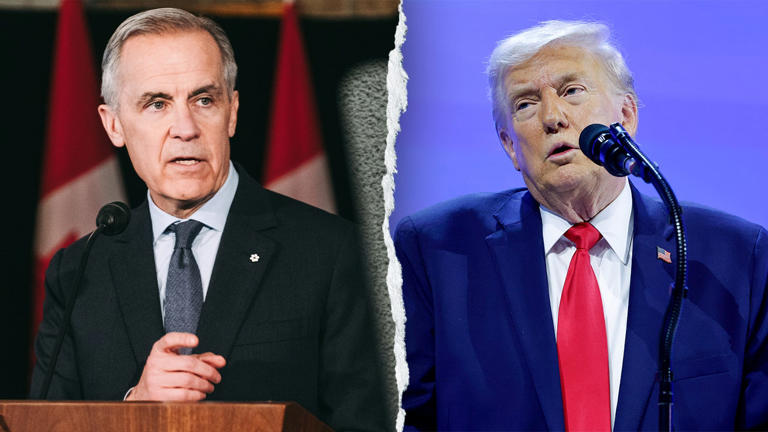
Trump Shattered Canada’s Old US Relationship. Carney is Building New One in Europe/ TezzBuzz/ WASHINGTON/ J. Mansour/ Prime Minister Mark Carney is pursuing closer economic and security ties with Europe as Canada reduces its longstanding dependence on the United States. The shift follows President Donald Trump’s tariffs, demands for economic concessions and repeated challenges to Canadian sovereignty.
Europe cannot quickly replace the U.S. market, but Carney wants to double Canada’s non-U.S. trade over the next decade.
Quick Look
- About 70% of Canadian exports go to the United States.
- Carney says Canada relied too heavily on one economic partner.
- He supports a proposed EU “associate membership” arrangement.
- Canada is not seeking full European Union membership.
- The proposed status does not currently exist under EU treaties.
- Canada-U.S. trade negotiations have been suspended since August.
- Trump threatened additional tariffs over Canada’s closer European ties.
- Carney wants to double non-U.S. trade within a decade.
- Canada is pursuing a free-trade agreement with India.
- A Canada-EU summit is scheduled for Oct. 29-30 in Montreal.

Deep Look
Carney seeks a post-dependence strategy
For nearly four decades, Canada structured much of its economy around increasingly close integration with the United States.
The 1989 Canada-U.S. Free Trade Agreement and the subsequent North American Free Trade Agreement produced extensive cross-border supply chains involving automobiles, energy and manufacturing.
That integration brought significant economic benefits but left Canada vulnerable when President Donald Trump used access to the U.S. market as leverage through tariffs, investment demands and calls for production to move south.
“There is now a price to be paid for access to the United States market,” Carney said, pointing to tariffs, required U.S. investments and demands for changes to Canadian domestic policy.
Rather than waiting for a future U.S. administration to restore the previous relationship, Carney is seeking additional markets and partnerships. The Associated Press
Europe emerges as Canada’s principal alternative
Carney has embraced European Commission President Ursula von der Leyen’s proposal for Canada to become the European Union’s first associate member.
The arrangement would not constitute full EU membership. Carney has instead described it as a way to deepen cooperation in trade, defense, energy, critical minerals, artificial intelligence, research, space and financial services.
“Canada and Europe will build an alliance for the future that will strengthen our collective resilience so we can live our lives as we choose based on the values that we share,” Carney said alongside French President Emmanuel Macron.
The proposed partnership will be discussed further at a Canada-EU summit scheduled for Oct. 29-30 in Montreal.
‘Associate membership’ remains undefined
The concept faces a fundamental complication: EU associate membership does not currently exist as a formal status under the bloc’s treaties.
Creating such a relationship would require negotiations over its powers, obligations and institutional structure. Any formal arrangement could also require approval from all 27 EU member states.
Some European governments have expressed openness to discussing a new partnership model, although questions remain about the terminology and what practical advantages Canada would receive.
Carney has made clear that Canada is not seeking full membership or surrendering control over its domestic decisions. AP explainer on the proposal
Diplomatic schedule reflects urgency
Carney has pursued the diversification strategy through an intense series of diplomatic and investment meetings.
He began the week in Toronto by hosting major international investors before traveling to Strasbourg for von der Leyen’s State of the European Union address.
He then went to Liverpool to meet Britain’s new prime ministerreturned to Strasbourg to address the European Parliament and met Macron in Saint-Pierre-et-Miquelon, a French territory near Newfoundland.
Carney returned to Ottawa for talks with Norwegian Prime Minister Jonas Gahr Støre before preparing to open a new parliamentary session and travel to New York for the U.N. General Assembly.
Støre supported Carney’s argument against economic coercion, saying tariffs should not become “a weapon to be used against countries, because we will all end up losers.”
Trump warns closer EU ties could be hostile
Trump has suggested that an enhanced Canada-EU relationship could constitute a “hostile act.”
He also threatened “very heavy tariffs” against Europe if he concluded that the arrangement was designed to harm American interests.
Carney has framed the European initiative as a strategy for Canadian economic resilience rather than an effort to isolate the United States.
At the World Economic Forum in January, he said “middle powers must act together,” warning that “if you’re not at the table, you’re on the menu.”
Canada could become an important test of whether medium-sized economies can collectively reduce their vulnerability to pressure from larger powers.
US market cannot be replaced quickly
Despite Carney’s ambitions, Europe cannot immediately replace the scale and proximity of the American market.
Approximately 70% of Canadian exports go to the United States. Geography, integrated infrastructure and decades of cross-border investment make the relationship difficult to unwind.
“It was easy business, but it meant we relied too much on one economic partner,” Carney said. “That time is over.”
Canada walked away from bilateral trade negotiations in August rather than accept terms Carney said Ottawa could not tolerate. Those talks remain suspended.
Potash becomes another source of pressure
Trump underscored Canada’s economic exposure by announcing that the United States was working on a deal to purchase potash from Belarus at prices he said would be “substantially less” than those charged by Canada.
Potash is an important fertilizer ingredient, and the United States depends heavily on Canadian supplies. According to U.S. Geological Survey figures cited by AP, Canada accounts for 79% of American potash imports.
A shift toward Belarusian supplies could affect a strategically important Canadian export, although the announcement did not establish how much potash would be purchased or when such a deal might begin.
Canada plans broader trade expansion
Carney wants Canada to double its non-U.S. trade during the next decade.
His government is seeking a free-trade agreement with India by the end of the year and promoting Canada’s existing tariff-free access to markets containing approximately 1.5 billion consumers.
Carney has said that figure could double within six months if negotiations succeed.
Dominic Barton, the chair of Invest in Canada and a former global head of McKinsey & Co., said diversification does not mean ending commerce with the United States.
“We can’t complacently count on it,” Barton said. “It’s not about, let’s not do stuff with the U.S. It’s let’s crank the non-U.S. Let’s be way more ambitious on that side.”
“We are not very global,” Barton added, describing Trump’s pressure as a “jolt” that Canada could use to develop more companies capable of competing internationally.
Canada presents stability as an investment advantage
Carney’s government is promoting Canada as a predictable destination for global investment at a time when tariffs and policy uncertainty have raised questions about the United States.
“The most sought-after commodity today is trust,” Finance Minister François-Philippe Champagne said. “The world has changed and America has changed. And I think the world has taken notice.”
Canada’s pitch emphasizes political stability, the rule of law and predictable commercial policy.
“Maybe in 20 years, we’ll thank Trump for shaking us out of our complacency,” Barton said. “Let’s use the moment.”
Former Conservative leader endorses diversification
Former Conservative Prime Minister Stephen Harper said the Canadian government “had no choice but to take this path.”
Harper described the change as particularly difficult because he had long admired the United States and regarded close bilateral relations as “among this country’s most precious assets.”
He argued that the Trump administration treated economic integration as incompatible with Canada exercising independent sovereignty.
“Thus, to maintain that sovereignty, we must pursue diminished reliance on the United States,” Harper said. “I do find this all very sad, just as equally necessary.”
The strategy has broad political significance, but its success will depend on whether Canada can convert diplomatic agreements into substantial new trade and investment flows.
More on US News