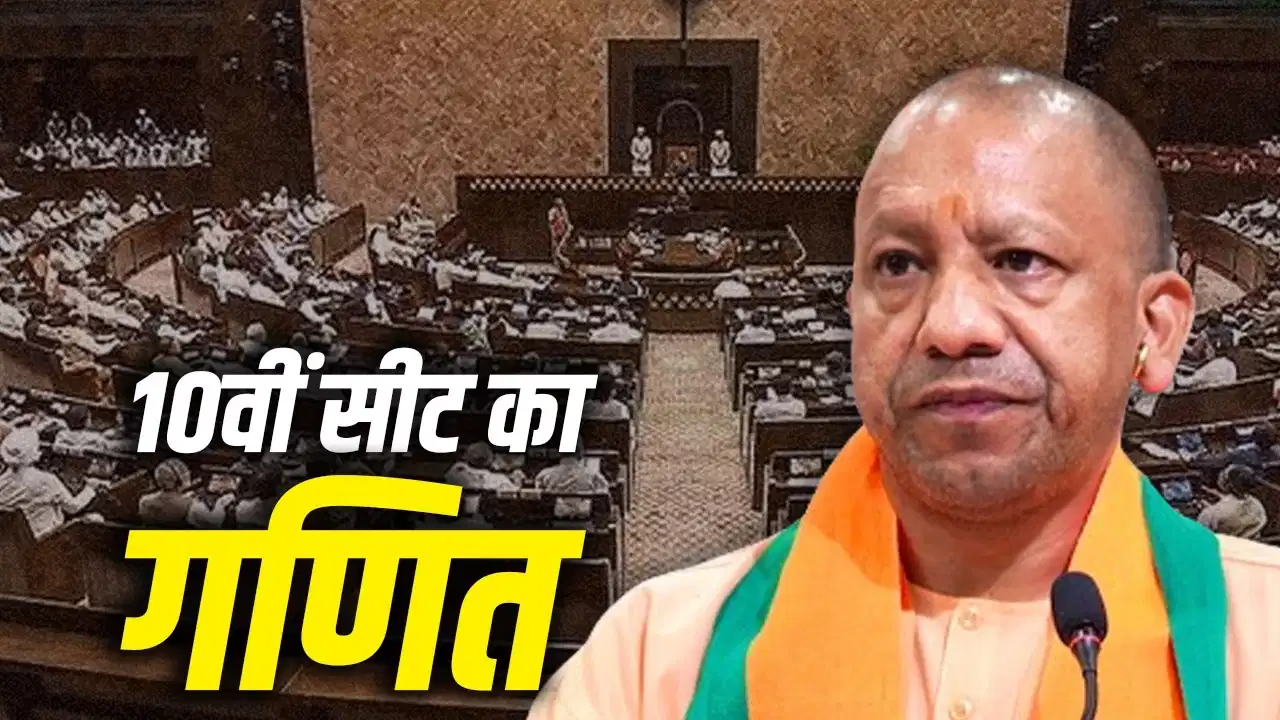
Voting for 10 Rajya Sabha seats of Uttar Pradesh will be held on October 16. Based on the current assembly numbers, NDA is in a position to win seven seats and SP two seats. After this, additional votes and support from both the camps can play an important role for the remaining 10th seat.
Tezzbuzz Desk- Before the assembly elections in Uttar Pradesh, political activities have intensified regarding the Rajya Sabha elections. Voting for 10 Rajya Sabha seats in the state will be held on October 16 and the results will also be declared on the same day. According to the schedule of the Election Commission, the election process will start from September 29. The last date for filing nominations is October 6, scrutiny of nomination papers will take place on October 7 and candidates will be able to withdraw their names till October 9.
Based on the current assembly numbers, the mathematics of Rajya Sabha elections seems quite clear. The Bharatiya Janata Party-led National Democratic Alliance (NDA) seems to be getting seven seats, while the Samajwadi Party is in a position to win two seats. After this, one seat is left, about which there is the most discussion. To win a Rajya Sabha seat, 37 first preference votes will be required.
At present, out of 10 Rajya Sabha seats in Uttar Pradesh, eight are with BJP, one with Samajwadi Party and one with Bahujan Samaj Party. BJP's current Rajya Sabha members include Hardeep Singh Puri, Arun Singh, Neeraj Shekhar, Brijlal, Seema Dwivedi, Geeta Shakya, BL Verma and Dinesh Sharma. Ram Gopal Yadav from SP and Ramji Gautam from BSP are Rajya Sabha members. Although Dinesh Sharma has resigned from Rajya Sabha. He has been appointed the Lieutenant Governor of Andaman and Nicobar Islands.
Out of total 403 seats in Uttar Pradesh Assembly, six seats are vacant at present. In such a situation, the effective assembly number remains 397. On the basis of this number, the quota of 37 votes for one seat of Rajya Sabha is formed. BJP has 256 MLAs. His allies are 13 MLAs from Apna Dal (Sonelal), 9 from Rashtriya Lok Dal, 6 from Suheldev Bharatiya Samaj Party and 5 from Nishad Party. By including these allies, NDA has 289 MLAs. Apart from this, two MLAs of Jansatta Dal Loktantrik can go in support of NDA. Three independent MLAs are also with BJP. In this way this number can reach 294.
As per 37 votes for one seat, a total of 259 votes are required for seven seats. Since NDA has 289 MLAs, about 30 votes are left after making seven candidates victorious. If we get the support of two MLAs of Jansatta Dal Loktantrik and three independents, then after winning seven seats, about 35 votes will be left. In such a situation, NDA may need to garner some additional support compared to the 37 votes required for the eighth seat.
Samajwadi Party has 101 MLAs, while Congress has two MLAs. With the support of Congress, the opposition camp has a total of 103 MLAs. 74 votes will be required for two Rajya Sabha seats. According to this, even after winning two seats, SP and its allies may still have 29 additional votes. However, the equation will be different for the third seat and garnering additional votes will be important.
This election is challenging for Bahujan Samaj Party. The tenure of the party's Rajya Sabha member Ramji Gautam is ending, but BSP does not have a single MLA in the current assembly. In such a situation, it is not possible for BSP to achieve the figure of 37 first preference votes on its own. Based on the current numerical strength, it seems difficult to save his Rajya Sabha seat.
Now most of the attention is on the 10th seat. NDA appears to have sufficient numbers for seven seats, while SP can gather the required numbers for two seats. In such a situation, additional votes from both camps, support of allies and distribution of votes among the candidates can be important on the remaining seats. In Rajya Sabha elections, MLAs vote for candidates on the basis of preference, so the number of candidates and distribution of votes can affect the final result.
Uttar Pradesh also has a history of cross voting during Rajya Sabha elections. There were incidents of some SP MLAs switching sides and voting in the 2024 Rajya Sabha elections. In the current assembly mathematics, NDA has about 35 additional votes and SP has 29 additional votes. In such a situation, the strategy of both the camps, additional support and actual distribution of votes during voting will be important for the 10th seat.