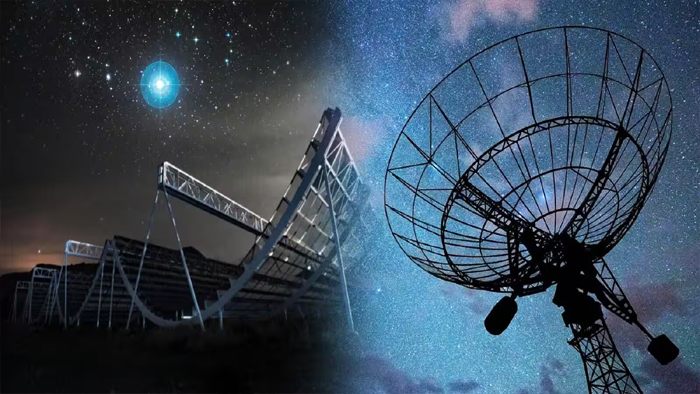
Desk. For the first time, radio signals have been directly detected from a giant gas planet 64 light-years away in space. Scientists have found the source of these signals to be the planet Beta Pictoris b rather than its parent star. This achievement is significant because the radio waves not only recorded the existence of this distant world in a new way, but also gave the first direct glimpse of its powerful magnetic field. The signals are not a message from an alien civilization, but are generated by a natural aurora process linked to the planet's magnetic field.
According to the report, this research was done by Kevin N. Ortiz Ceballos and its findings have been published in a research paper published on Archive. Planets orbiting other stars outside our solar system are called outer planets or exoplanets. Since the discovery of these planets began in the 1990s, scientists have been trying to find out what the atmosphere, internal structure and magnetic fields of these distant worlds are like. Even before this, radio signals have been recorded from outer planetary systems, but scientists could not determine whether these signals were coming from the planet or from its parent star. In the case of Beta Pictoris B, for the first time there has been success in directly linking the source of the signal to the position of the planet.
Scientists studied the Beta Pictoris planetary system with South Africa's MeerKAT radio telescope. During this time they received extremely weak but repeatedly repeating radio signals. Initially it was not clear whether the signals were coming from the planet or its star. To confirm this, the researchers determined the position of the sources visible in the radio images relative to very distant quasars. Quasars can serve as stable reference points in such astronomical measurements. Scientists then match the radio signals with the exact positions of the star and planet. The location of the signal was found to match the position of the Beta Pictoris star, rather than its planet Beta Pictoris b. On this basis, researchers concluded to link radio emissions directly to the planet.
According to scientists, there is no artificial message behind these radio signals. It is a natural astronomical process associated with the planet's powerful magnetic field. When high-energy charged particles move along the planet's magnetic field lines and collide or interact with its upper atmosphere, energy is released. It is through this process that the polar light i.e. aurora is produced. A similar process occurs on Earth too. The northern lights visible in the northern polar regions are a famous example. In the case of Beta Pictoris B, there is evidence that similar auroral activity produces radio waves.
The most important aspect of this discovery is related to the magnetic field of the planet. Scientists have estimated that the strength of Beta Pictoris b's magnetic field in the region where the radio waves are being generated is at least 1,250 gauss. This is much stronger than Jupiter's magnetic field. According to researchers, this is the first direct measurement of the strength of the magnetic field of an outer planet. Before this, scientists had to rely mainly on theoretical models and indirect signals about the magnetic fields of outer planets. Now the way can be opened to directly study these areas through radio emissions.
Beta Pictoris b is a giant gas giant planet and part of a relatively young planetary system. The energy left during formation and intense internal activities within young and giant planets can generate powerful magnetic fields. According to the researchers, the strength of the magnetic field revealed on the basis of radio signals received from this planet is in line with the theoretical predictions made about the strength of the magnetic field in young and giant planets. This could help scientists understand how magnetic fields form within such planets and what role they play in their formation and evolution.
Till now, to discover and study the outer planets, scientists have mainly used the signals related to changes in the light of their stars, the orbital motion of the planet and the atmosphere of the planets. Radio astronomy can add a new dimension to this. If similar radio signals can be recorded from other giant exoplanets, scientists will be able to compare the magnetic fields of different planets. This can help understand the internal structure, formation and evolution of planets. In particular, a planet's magnetic field affects its interaction with the cosmic environment around it. Therefore, the study of radio emissions not only provides information about the magnetic field of the planet, but can also be useful in understanding the cosmic environment around it.
It is natural to raise the question of the possibility of life or alien civilization in outer space as soon as we hear radio signals. But the signals from Beta Pictoris B are not evidence of any such civilization or intelligent life. These signals are produced by the natural auroral process. Nevertheless this discovery is important from scientific point of view. For the first time, radio emissions from an exoplanet have been isolated from its star and linked directly to the planet. Also, this process has given scientists the opportunity to measure the powerful magnetic field of that planet. That is, this gas giant planet located 64 light years away is not sending any message to humans, but its 'radio voice' has definitely given scientists the first direct glimpse of its invisible magnetic world.