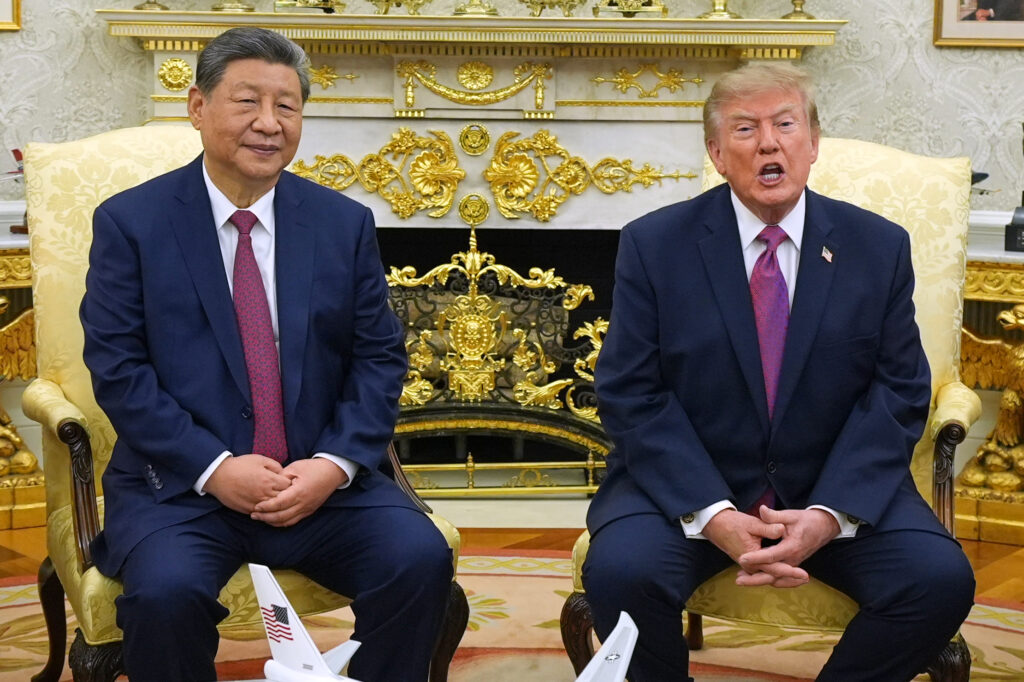
Trump Presses Xi to End Chinese Support for Iran During Washington Summit/ TezzBuzz/ WASHINGTON/ J. Mansour/ President Donald Trump asked Chinese President Xi Jinping to stop providing direct or indirect assistance to Iran during their Washington talks. U.S. officials are concerned that Chinese technology, military equipment and commercial satellite imagery have strengthened Iran’s ability to target American forces. The pressure comes as Qatar mediates a new Iranian proposal to reopen the Strait of Hormuz and resume nuclear negotiations within seven days.
Quick Look
- Trump directly asked Xi to stop supporting Iran.
- Washington warned against Chinese intelligence, equipment or indirect assistance.
- U.S. officials suspect China supplied air-defense systems and drone components.
- Iran reportedly used Chinese satellite imagery to target American military assets.
- The U.S. military changed procedures to protect ships from detection.
- Ambassador David Perdue said China has reduced some activities.
- Xi urged Trump to return to diplomacy and the June agreement.
- Iran offered to reopen the Strait of Hormuz within one week.
- Tehran wants the blockade lifted and oil sanctions removed.
- Qatar is mediating indirect negotiations between Washington and Tehran.

Deep Look
Trump asks Xi to halt support for Iran
WASHINGTON — President Donald Trump asked Chinese President Xi Jinping to stop any assistance to Iran during their talks in Washington, according to U.S. Ambassador to China David Perdue.
The request came as Trump attempts to isolate Tehran economically and militarily during the continuing war.
China’s financial, intelligence and military ties with Iran have complicated the administration’s effort to pressure Tehran into accepting American terms for ending the conflict and limiting its nuclear program.
Washington is conducting an extensive economic campaign against Iran, including secondary sanctions targeting countries and companies that continue doing business with Tehran.
Without cooperation from China, one of Iran’s most important economic partners, the administration’s pressure campaign is likely to remain only partially effective.
US warns China against direct or indirect assistance
Perdue said Washington had repeatedly warned Beijing that any form of support for Iran would be unacceptable.
“We have made it very clear to them weeks ago that any help that they would give Iran, whether it be direct or indirect, whether it be intelligence or parts or military equipment was totally unacceptable. President Trump made that very clear again yesterday,” Perdue told CNBC on Friday.
The warning covers military hardware, intelligence, replacement parts and other assistance that could strengthen Iran’s ability to continue fighting.
Perdue said the United States had also informed China that Washington considers Iran and Taiwan separate issues.
The administration does not want Beijing to link cooperation over Iran to American arms sales or political policy involving the self-governed island.
US sees signs China responded to warning
Perdue said American officials had identified evidence that Beijing responded to Washington’s concerns.
“We have seen evidence that they have listened to us. They pulled some things down. We have evidence they pay attention when President Trump speaks about Iran,” he said.
He did not specify what China had withdrawn or suspended.
It also remains unclear whether Beijing agreed to stop all military, commercial or intelligence activity that could benefit Iran.
Officials concerned about air defenses and drones
U.S. officials have been concerned since the beginning of the war that China may be supplying Iran with air-defense systems and components used to manufacture drones.
Those capabilities could help Iran defend its territory against American and Israeli airstrikes while maintaining its ability to launch attacks across the Middle East.
Washington has not publicly disclosed the full evidence supporting those concerns.
Chinese technology can also reach Iran through commercial businesses or third countries, making it difficult to distinguish direct government assistance from private-sector transactions.
Chinese satellite imagery reportedly helped Iran
In recent weeks, Iran has reportedly used high-resolution images collected by Chinese commercial satellites.
U.S. officials believe those images helped Tehran identify and target American bases in the Middle East, aircraft carriers and other Navy ships operating in the Persian Gulf and Arabian Sea.
The discovery prompted the U.S. military to change operational procedures, according to an American official.
Those adjustments were designed to make it more difficult for Iranian forces to locate, track and target Navy vessels.
Commercial satellite imagery has become a growing security concern because it can provide governments and military forces with information that was once available only through state intelligence systems.
Xi urges return to diplomacy
China presented a different account of the Trump-Xi discussion.
According to Chinese state media, Xi encouraged Trump to reduce tensions with Iran by returning to the memorandum of understanding reached in June and negotiating a nuclear agreement.
“China has encouraged relevant parties to stay committed to peaceful solutions and maintain the momentum of talks,” Xi told Trump.
Beijing has opposed the U.S. and Israeli military campaign against Iran and has repeatedly called for a diplomatic resolution.
China also has a strong economic interest in reopening regional shipping routes because it imports significant quantities of oil from the Persian Gulf.
Trump-Xi talks follow indirect Iran negotiations
The discussion between Trump and Xi came one day after U.S. envoys Steve Witkoff and Jared Kushner participated in another round of indirect negotiations with Iranian Foreign Minister Abbas Araghchi.
The talks occurred on the sidelines of the U.N. General Assembly in New York.
Qatari officials carried messages between the American and Iranian delegations because the two governments do not maintain normal diplomatic relations.
Sources familiar with the meeting said Araghchi presented Iran’s conditions for reopening the Strait of Hormuz and restarting negotiations over Tehran’s nuclear program.
“It was the same terms the Iranians spoke about publicly before the meeting,” one source said.
Iran offers to reopen Hormuz within seven days
Iran proposed reopening the Strait of Hormuz and resuming nuclear negotiations within one week if Washington meets several conditions.
Tehran wants the United States to lift its naval blockaderemove sanctions affecting Iranian oil sales and restore a ceasefire throughout the region.
The proposed ceasefire would cover conflicts involving Iran and its regional allies.
The Strait of Hormuz is one of the world’s most important energy corridors. Restrictions on shipping have contributed to higher global oil and gasoline prices.
US rejects Iran’s authority over strait
American negotiators told Iranian officials that Tehran does not control the Strait of Hormuz and therefore cannot impose conditions for its reopening.
The United States argues that the waterway is an international shipping route rather than Iranian territory.
Dozens of oil tankers continue moving through the strait each day under American military protection.
Those ships are transporting millions of barrels of oil to global markets.
The volume remains significantly below prewar levels, but the protected shipments have helped reduce some pressure on energy supplies and oil prices.
Qatar waits for Trump’s response
Qatari Prime Minister Sheikh Mohammed bin Abdulrahman Al Thani met Iranian President Masoud Pezeshkian in New York on Thursday to discuss the diplomatic initiative.
Qatar has emerged as the central mediator between Washington and Tehran.
A source familiar with the negotiations said Qatar and Iran were awaiting Trump’s response to Tehran’s proposal.
“It is still early to know where it is going, but there are some positive movements,” the source said.
Any agreement would need to address the naval blockade, oil sanctions, regional ceasefire conditions, nuclear inspections and the future of Iran’s uranium-enrichment program.
Trump must also decide whether a diplomatic agreement offers more strategic and economic benefits than continuing the military and financial pressure campaign.
More on US News