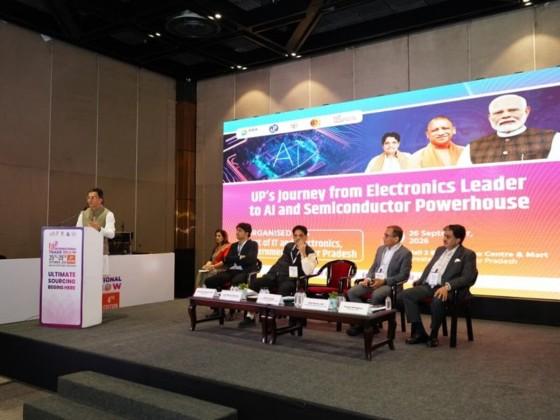
Union Minister of State for Commerce and Industry Jitin Prasada announced on Saturday that India successfully concluded its long-pending free trade agreement (FTA) with the European Union on equal terms after nearly 17 years of talks, highlighting technology transfer, local manufacturing, and artificial intelligence (AI) as pivotal for the country’s industrial progress.
Addressing the Uttar Pradesh International Trade Show (UPITS), Prasada described the India-EU FTA as a significant government achievement, noting earlier negotiations had faced prolonged challenges.
“The EU FTA was in talks for 17 years. They were not ready to have a conversation with us. Our government was able to strike a deal on equal terms,” he remarked.
India and the European Union concluded their trade pact negotiations on January 27, 2026. The discussions, initiated in 2007, had stalled for several years before resuming in 2022.
This month, the agreement advanced further as the European Commission submitted it to the EU Council for authorisation to sign and conclude the deal.
emphasized India’s shifting stance on foreign investment, stating that international companies are now expected to contribute actively to domestic manufacturing and technological development rather than solely viewing India as a consumer market.
He explained that foreign firms looking to expand in India would be encouraged to form joint ventures and facilitate technology transfers, boosting local industry and manufacturing ecosystems.
The minister also stressed the need for enhancing product quality, urging Indian manufacturers to meet global standards to expand their international market presence.
“We need to ensure quality and the global market is waiting for us,” he asserted.
Prasada highlighted artificial intelligence’s transformative potential for India’s manufacturing sector, especially benefiting micro, small and medium enterprises (MSMEs) by increasing productivity and reducing costs.
He pointed out Uttar Pradesh’s emergence as a key hub for data centres and AI-driven technologies, noting investments from companies like Samsung and Yotta in the state, and said broader AI adoption could boost competitiveness across industries.