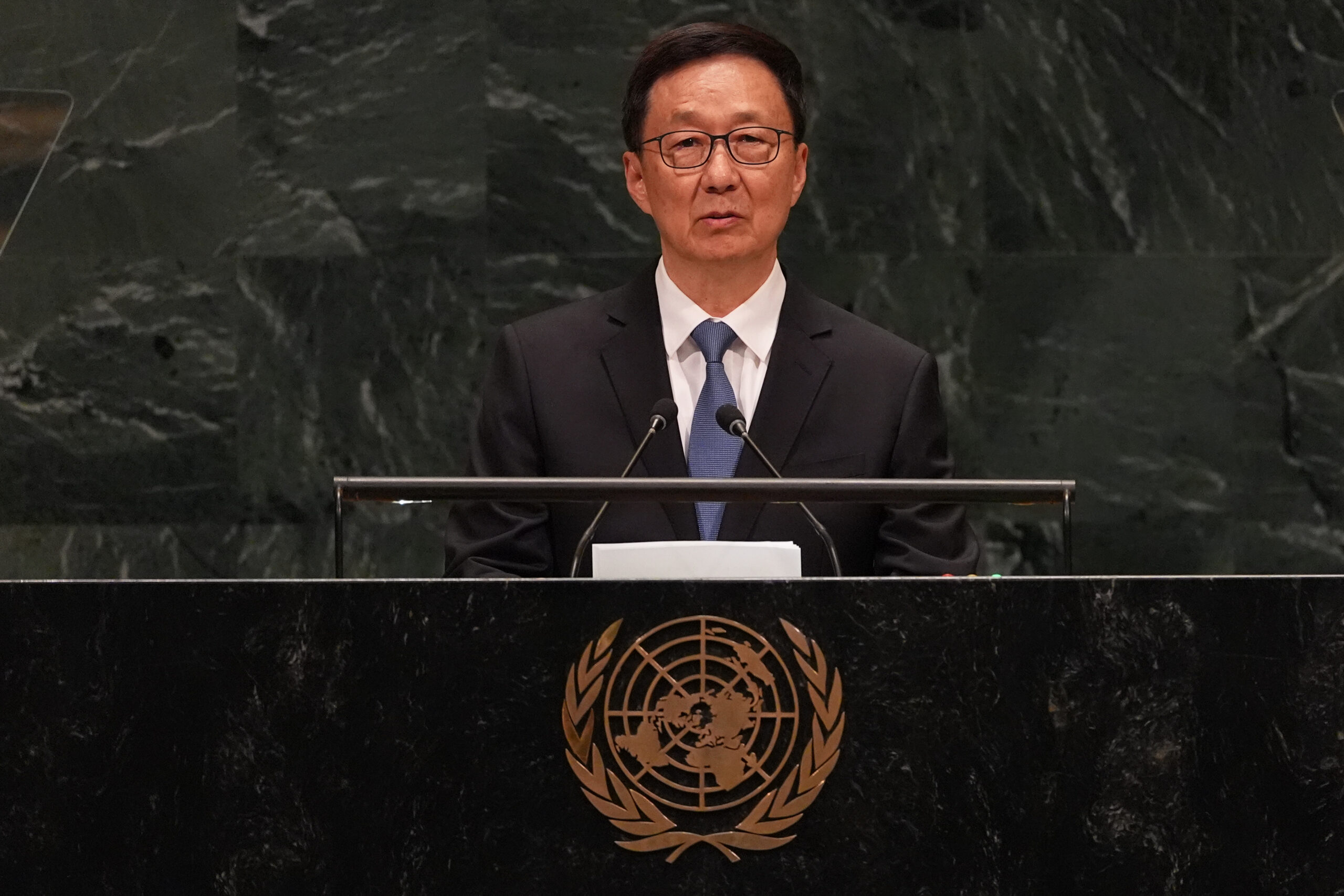
China Uses UN Speech to Promote Development, Multilateralism & Global Cooperation/ TezzBuzz/ WASHINGTON/ J. Mansour/ Chinese Vice President Han Zheng used his U.N. General Assembly speech to promote economic development and multilateral cooperation as solutions to global instability. He warned that protectionism benefits no country and cautiously criticized military actions that bypass the U.N. Security Council. Han addressed the Iran war and artificial intelligence but made no direct reference to Taiwan following Xi Jinping’s summit with President Donald Trump.
Quick Look
- Vice President Han Zheng represented China at the U.N.
- His speech followed Xi Jinping’s state visit with Trump.
- Han placed economic development at the center of China’s message.
- He said protectionism “produces no winners.”
- Han opposed military actions that bypass Security Council approval.
- He called for the sovereignty of Middle Eastern countries to be respected.
- Taiwan was notably absent from the address.
- Han promoted China’s Belt and Road Initiative.
- He also called for greater influence for Global South countries.
- China has Belt and Road projects with three-quarters of the world’s nations.
Deep Look
China returns to familiar themes at the UN
NEW YORK — Chinese Vice President Han Zheng used his address to the U.N. General Assembly on Saturday to emphasize economic development, multilateralism and international cooperation.
His speech came one day after Chinese President Xi Jinping concluded a high-profile state visit with President Donald Trump in Washington.
Xi’s visit included formal talks, a state dinner and a trip to the National Archives.
After the extensive attention surrounding the Trump-Xi summit, Han’s address offered few surprises and largely repeated China’s established diplomatic positions.
Han highlights China’s economic record
Han presented China’s economic and political system as a model of successful national development.
“China has created two miracles at home, namely fast economic roles and long-term social stability,” Han said.
His wording appeared to refer to rapid economic growth and the Chinese government’s ability to maintain social order.
China frequently uses international forums to emphasize its economic transformation and argue that its development has benefited the broader world.
Protectionism draws Han’s strongest warning
Han’s most pointed comments focused on trade restrictions and protectionism.
China and the United States have been engaged in a tariff conflict for more than a year.
The dispute has moderated as the Trump administration delayed some measures, courts reviewed others and Trump adopted a warmer public approach toward Xi.
“Both history and reality prove that countries can hardly achieve development without an open and cooperative international environment,” Han said. “Protectionism produces no winners.”
His remarks reinforced Beijing’s criticism of American tariffs and export controls, particularly those involving technology, semiconductors and Chinese goods.
Taiwan absent from the address
Han did not directly mention Taiwan, an unusual omission from a major Chinese speech at the United Nations.
Beijing considers the self-governing democratic island part of China and has vowed to bring it under its control, using force if necessary.
The United States supplies defensive weapons to Taiwan, making the island one of the most dangerous points of disagreement between Washington and Beijing.
Xi discussed Taiwan during his Washington meetings with Trump, but Han avoided the subject in his public U.N. address.
The omission could reflect an effort to maintain the cooperative tone established during the state visit.
Development placed at center of global agenda
Han argued that global institutions and international cooperation should place economic development among their highest priorities.
China has long maintained that raising living standards and expanding infrastructure can reduce conflict and promote stability.
Beijing frequently presents development as a foundation for peace, especially in economically struggling countries.
That position allows China to promote investment and trade as alternatives to Western policies focused on sanctions, political reforms or military intervention.
Belt and Road expands China’s influence
Han highlighted the Belt and Road Initiative, China’s signature international development program.
The initiative finances and constructs ports, railways, roads, energy projects and digital infrastructure in countries around the world.
Han said China has worked with three-quarters of the world’s nations through Belt and Road projects.
Beijing presents the program as a mutually beneficial development partnership.
Critics argue that it expands China’s political influence, gives Beijing control over strategically important infrastructure and leaves some countries with unsustainable debts.
China promotes multilateralism
Han described multilateral cooperation as essential to international stability.
“Multilateralism is a choice made by humanity after going through scourges,” he said. “We should settle the differences and disputes through dialogue and consultation, and oppose unilateral military actions that violate the U.N. charter and circumvent Security Council authorization.”
The comments appeared aimed partly at the United States and Israel over their war with Iran.
China has criticized military actions undertaken without authorization from the U.N. Security Council.
However, Beijing’s support for multilateralism has not always been reflected consistently in its own foreign relations.
‘Internal affairs’ remain central to Chinese policy
China frequently warns foreign governments not to interfere in what it considers its internal affairs.
That position applies to Xinjiang, Tibet, Hong Kong and Taiwan.
The policy reflects China’s longstanding concern with maintaining political control over regions located far from Beijing and along the country’s territorial boundaries.
Beijing argues that disputes involving those regions concern Chinese sovereignty rather than international politics or human rights.
Han addressed the U.S.-Israeli war with Iran in measured terms.
“China holds that the sovereignty and security of countries in the Middle East, including the Gulf, should be respected,” he said.
China has opposed attacks on Iran and urged the parties to return to diplomacy.
Beijing also has significant economic interests in the region because it imports large quantities of oil through the Persian Gulf and Strait of Hormuz.
China invokes postwar international system
“We should safeguard the postwar international order,” Han said.
He also called on countries to “reject the Cold War mindset and block confrontation.”
The two ideas can appear to conflict because the post-World War II international system was heavily shaped by Cold War institutions and rivalries.
China often uses both phrases to defend the role of the United Nations while criticizing American alliances and efforts to contain Beijing.
Han calls for stronger Global South
The Chinese vice president also advocated greater power and influence for the Global South.
The term generally refers to emerging and economically developing nations, many of them in Africa, Asia, Latin America and the Southern Hemisphere.
China has attempted to position itself as a leading voice for these countries, despite being the world’s second-largest economy and a major global power.
India and other large nations have made similar efforts to represent the Global South in international institutions.
Xi’s absence was not unprecedented
Xi’s absence from the U.N. podium attracted discussion because he was already in the United States during the General Assembly.
However, Chinese presidents have not routinely attended the annual gathering.
Wang Zichen, deputy secretary-general of the Beijing-based Center for China and Globalization, said there has never been “a convention” requiring China’s president to participate.
Former Presidents Jiang Zemin and Hu Jintao attended major U.N. meetings selectively.
Xi last addressed the General Assembly virtually in 2021 during the COVID-19 pandemic.
Senior officials regularly represent China
Premier Li Qiang delivered China’s speech last year.
Senior diplomat Wang Yi has represented Beijing several times in different roles and accompanied Xi during the latest Washington visit.
Han previously addressed the General Assembly in 2023.
“Both the premier and the vice president are sufficiently senior representatives that I would be cautious about interpreting the choice between them as a diplomatic signal in itself,” Wang said.
He added that China continues to portray the United Nations as a vital global organization.
“It would be difficult to argue from the level of representation alone that China is becoming less interested in the U.N.,” he said.
Han urges respect among cultures
Unlike Li’s more personal address the previous year, Han remained closely focused on official policy themes.
His most expressive language came during his discussion of multicultural cooperation.
“Diversity has created splendor in the world,” Han said. “Condescension and the self-centered mindset have no place in the interactions among different cultures. Promoting mutual trust, mutual respect, solidarity and harmonious coexistence is the right approach to take.”
The speech reinforced China’s preferred image of itself as a defender of development, sovereignty and multilateral institutions, even as its strategic competition with the United States continues.
For more world news