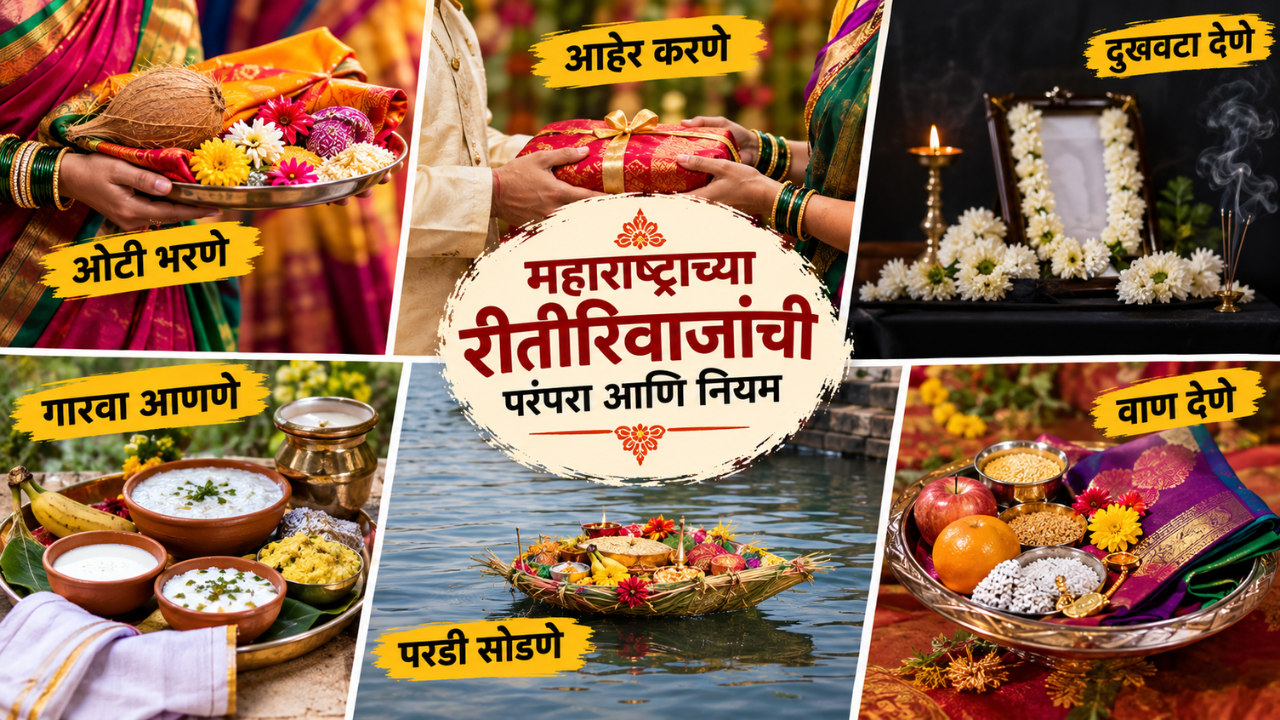
- The practices of paying OT and giving vaan are mainly done to express respect and affection on auspicious occasions.
- The social sentiment of supporting the family is particularly evident in mourning and mourning traditions.
- The practice of casting off is associated with water sources and changes in its pattern according to local beliefs.
In many families in Maharashtra, some special customs are observed even today on weddings, festivals, ceremonies and occasions of joy and sorrow. OT filling, to tease, hurt, sleet, Weaning and giving varieties Some of these practices are not only based on religious beliefs, but also to preserve relationships, preserve traditions, show respect and support the family as the case may be. Although there are no rules for these practices, different practices are customary in different areas. But these customs may vary according to village-village, region-region, caste-community and family tradition.
OT filling
It is a practice mainly connected with the honor of Suvasini. Rice, halkund, coconut, fruits, ore or cloth or feathers of cloth and in some places also dakshina are served in OT. There is a tradition in many families that a married girl fills her mother's belly in more months. Apart from this, on Fridays in the month of Shravan, women also perform the OT program by organizing Haldi Kunkva at their homes. Usually, the tradition of filling OT can be seen everywhere in Maharashtra. From small haldi kunkvas to grand wedding ceremonies, the practice of OT is still prevalent even today. In many places Suvasinina is given a whole ot like coconut, cloth, rice or wheat, gajra to rub in her hair as above. In which coconut is considered auspicious for conception. In many places it is also a tradition to give clothes or pieces of clothes and rice or wheat to virgins and widows.
In Western Maharashtra, Sangli, Satara, Kolhapur areas are also full of vineyards. Five or seven perfumers get together and apply turmeric powder to five vines. A sari is worn on one of the trees. The finished bunches of grapes are placed in each person's stomach. In many parts of Maharashtra, the banks of the river are also filled and it is customary to fill the bank of the river by wearing a saree and applying turmeric kunku.
to tease
Honoring a relative or a close person on an auspicious occasion by giving gifts, cash, or useful things is called khājā. There are many places where the bridegroom, his parents or close relatives are gifted at the wedding ceremony. In Maharashtra, the custom of gifting is mainly sari-oti for women and towel cap and clothes for men. In some places, it is customary to give shawl shrifal i.e. shawl and coconut to men. In many places, it is also customary to tie a feta as a mark of respect. A closed wallet or envelope is also a popular practice when giving cash as a gift. Now as time is changing, gifting has taken the form of surprise. It values affection and relationship more than the high cost of things. In many places in Maharashtra, even after the construction of borewells and wells, they are offered a saree.
Vastu Shastra Married Daughter: Giving things to the girl from behind? Be sure to read this before giving 'these' 5 things
hurt
It is a way of expressing condolences to the family members in case of bereavement at the home of relatives or friends, neighbors. The main social sentiment behind it is to go to the home of the deceased to console the family, pay their respects silently and if possible help them in their time of need. Because of causing grief in the family of the deceased and also in some places, cooking is not done in that house for some days, auspicious occasion is not celebrated. During such times, in many rural places, relatives or friends would take food, tea, etc. to the house of the deceased. After the death of a person, his family does not celebrate festivals like Diwali for a period of one year; during this time relatives, friends and family give him snacks etc. It is also called 'Carrying Diwali'. This is a kind of pain. In some rural areas of Maharashtra, there is still a tradition that the neighbors and relatives take breakfast and dinner to the house of the deceased every day for 13 to 15 days. And they sit and eat with the bereaved families to comfort them. Many rural places have this admirable and unique tradition of love and comfort, which is disappearing in the hustle and bustle of urban life. In some places, as a ritual of mourning, a towel hat and a full dress and a sari bodice are also worn.
sleet
This practice prevalent in rural Maharashtra is bringing garva or carrying garva. Just like the meaning of the word, it basically means to create a chill in the atmosphere, body and mind. In many places, the custom of carrying garva is followed on auspicious occasions. Before the wedding ceremony, there is a practice of giving garva from the groom to the best man and from the best man to the bride. Foods that cool the body are often served in the wedding reception. Like curd rice, banana, ambil, mung bean products e. It still has a wide variety of ingredients.
Apart from the marriage ceremony, there is a very traditional method of taking garva to the Bhoomi Pooja of the house, Pani Pooja of the bore or well, Chakat Pooja and Vastushani too. This garam usually contains ambil, fruits, puran pods, curd rice etc. It is a tradition to carry. It is believed that the mud for the construction of the house should be brought by the sisters or atyas. Curd rice etc. is sprinkled around the structure while constructing the structure; It is believed that this pacifies the Vastu and causes no problems.
Pitru Paksha: To perform Shraddha or not? A different meaning of Pitrupaksha beyond superstition and faith
leaving behind
This practice of leaving Pardi is also more common in rural areas. These wastes are released at water sources. Sediment is released in water bodies such as wells, streams, rivers, lakes, farms, borewells. Wheat, sorghum plates or chips (dried plants on which wheat and sorghum are grown) are tied with pentagonal or octagonal twine. An offering of puran hives, seven bananas, seven betel nuts, seven cloves, seven halkunds, seven lamps, seven sheaves of wheat are placed on it as prasad. It is believed that seven asaras i.e. seven deities reside in water sources. The concept of leaving the veil is also to appease those Asaras i.e. Gods or to prevent anyone from dying in that water source. This Pardi river is released to the well. In some places, it is also taken as an offering on that pardi. Coconuts are also broken into water sources. In some places, it is also customary to leave the Pardi to get rid of illness and pain. According to some beliefs, only men can leave this pardi in Panasthali.
giving variety
This practice of giving vaan is especially prevalent among brides and newlyweds on Haldi-Kunku, Makar Sankrant or other religious occasions. Mutual wishes are expressed by giving fruits, grains, good fortune or utility items. In more months, Brahmins are given a plate containing anarase, niranjane, battashe etc. Silver and gold items are gifted to son-in-law especially during Makar Sankranti. The son-in-law is also given tilgul in a silver bowl on Sankranti and halwa ornaments to the daughter-in-law. In some traditions, the method of giving vaana is to take the tip of the padara as a base. There is also a tradition of giving a gold leaf of Apta to the son-in-law as a gift during Dussehra.
One thing is important to remember when looking at all these customs—customs are part of belief and culture; They are not necessarily observed in every house in every area in exactly the same way. Hence, the ritual is performed by understanding the family tradition, local customs and the context of the occasion