The NDA government must address the fundamental question of whether the new rural job scheme is inherently restrictive
Published Date – 27 September 2026, 11:57 PM
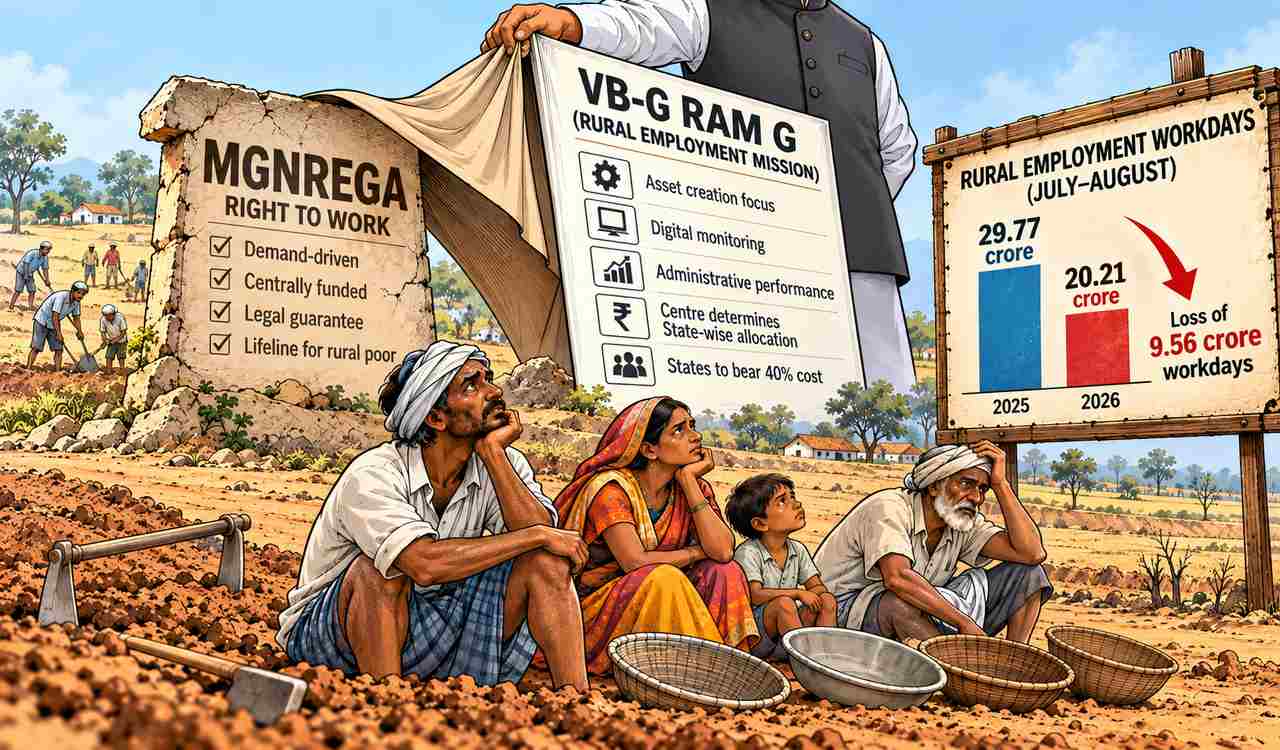
The fears over the future of the rights-based guarantee law are coming true. When the NDA government introduced the Viksit Bharat Guarantee for Rozgar and Ajeevika Mission (Gramin) (VB-G RAM G) Actreplacing Mahatma Gandhi National Rural Employment Guarantee Act (MGNREGA), there were widespread concerns that it would only result in imposing an additional burden on the States and snatching away the rights of millions of poor people. The latest data reveals a grim picture. There was a loss of 9.56 crore workdays of rural employment in July-August this year compared to the corresponding period last year. Citing the Rural Development Ministry’s data, the Samyukt Kisan Morcha (SKM), a farmers’ body, has raised legitimate questions regarding the scheme. It has pointed out that 20.21 crore person-days of work were generated during the July-August period as against 29.77 crore in 2025. These figures counter the Centre’s claims that the newly rolled out rural employment scheme is an enhanced version of MGNREGA. While the MGNREGA, formulated by the UPA government, was a rights-based law that legally entitled rural households to demand work, the VB-G RAM G shifts towards a centrally designed mission emphasising asset creation, digital monitoring, and administrative performance. Under the revamped scheme, the Centre will determine the State-wise normative allocation for each financial year, based on “objective parameters” as may be prescribed by the central government itself. Any expenditure incurred by a State in excess of its allocation will be borne entirely by the State government.
Given the sharp decline in the workdays, the Centre cannot wash its hands of the matter. It must address the fundamental question of whether the new rural job scheme is inherently restrictive. It must seriously introspect whether it was a prudent move to shift the focus from a centrally-funded, demand-driven model to one where most States must now contribute 40% of the cost. Although a temporary pause in work during the sowing season, delays in transitioning from the erstwhile scheme and lower migration of labourers are plausible contributory factors, they alone cannot explain such a huge dip in employment generation. Experts warn that something is fundamentally amiss here. The argument that a growing economy no longer requires an employment guarantee to combat rural joblessness is specious. The scheme is a lifeline for millions of Indians. Despite certain flaws in implementation, the earlier scheme had served as a beacon of hope for the rural poor. A legal framework for employment guarantee is meant to free them from dependence on the state’s discretion. If it is strictly budget-driven, cracks are bound to show. In such a situation, a robust watchdog and accountability provisions are essential. The government argues that the new scheme will improve efficiency and productivity, but critics point out that a legally enforceable guarantee is gradually being replaced by a programme whose success depends on administrative discretion.