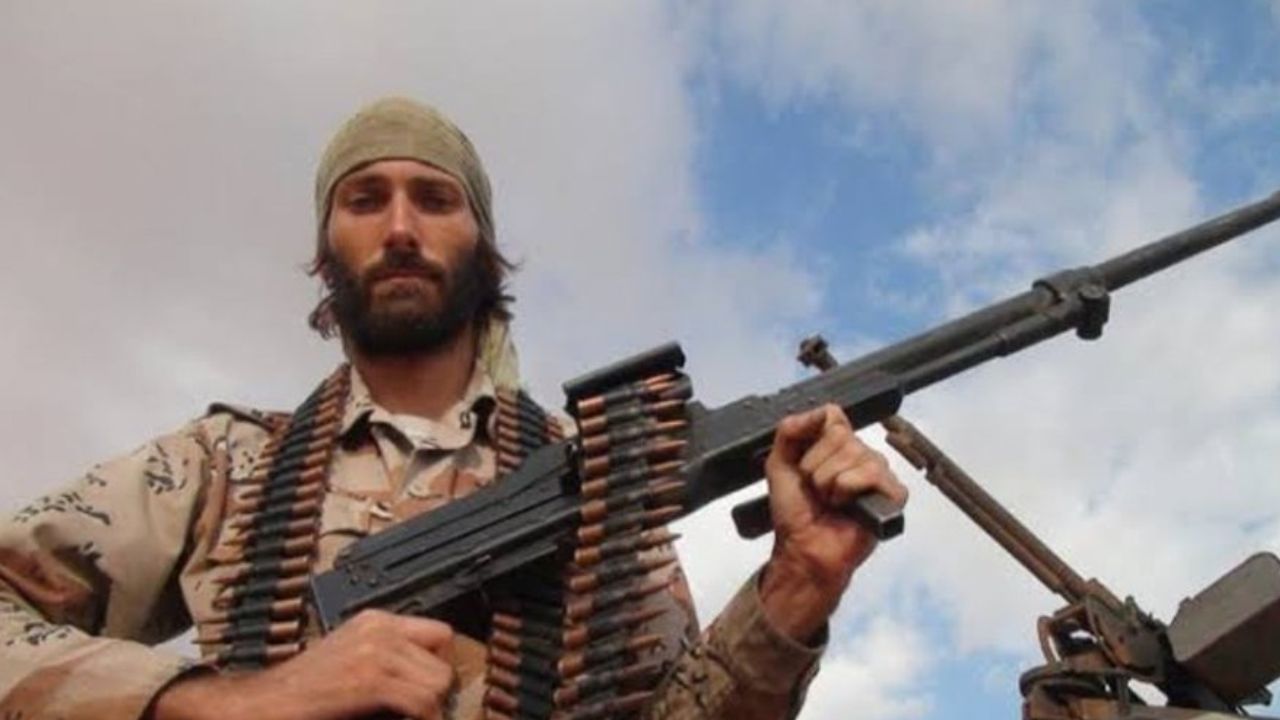
There is a political storm over the release of American citizen Matthew Aaron VanDyke and six Ukrainian citizens from Delhi's Tihar Jail and sending them back to their country. Many analysts, including the main opposition party Congress, not only criticized the move but also put the central government in the dock.
As the developments in the VanDyke case changed so rapidly in the last one month, there was also talk of American pressure. It was also surprising when the car of the foreign embassy reached outside Tihar Jail to pick up Van Dyke. People say that this incident shows how great an asset VanDyke was for America.
Also read: What is the reason for the war in Ethiopia, how can it turn into a regional conflict?
VanDyke and his six Ukrainian associates have been given one month's time by the special NI court at Rouse Avenue in Delhi to meet their families in Ukraine and the US. Everyone has got default bail. Some conditions and formalities have to be followed. If necessary, you will have to appear through video conferencing.
But now the question arises whether VanDyke and his companions will return to India after a month. Most people believe that these people will never come to India again. They have probably been seen for the last time in India. VanDyke has already left for America on Friday, but has booked a ticket to return to India on October 21. It remains to be seen whether VanDyke returns to India or not.
Did India bow down to America and demonstrate its soft stance?
In the VanDyke episode, strategic thinker and author Dr. Brahma Chellaney questioned the manner in which India backed down under pressure. He said India often fails to hold accountable powerful foreign interests. He also criticized India's soft stance.
'India retreats when pressure increases'
Brahma Chellaney writes, 'India is a perennial moderate state. The decision to quietly allow US secret agent Matthew VanDyke and six Ukrainian drone experts to leave India is not just an isolated legal reversal. This is part of a long and uneasy tradition in which New Delhi cites its tough criminal laws and then backs down when geopolitical pressure increases.
Marco Rubio had raised the issue with New Delhi: Brahma Chellaney
Brahma Chellani says that US Secretary of State Marco Rubio had raised the issue of VanDyke with India. Only after this the UAPA was removed against him. Brahma Chellani further writes, VanDyke, a veteran of secret wars in the Middle East and Ukraine, was arrested in March along with six military-trained Ukrainian associates. According to Indian court documents, the group was part of a larger international network that smuggled drones into India and then sent them to Myanmar. The National Investigation Agency (NIA) initially cited the Unlawful Activities (Prevention) Act. Then came a period of dramatic retreat.
He further wrote, 'The NIA withdrew UAPA charges after US Secretary of State Marco Rubio personally raised the issue of VanDyke's detention with New Delhi. VanDyke and all six Ukrainians have now been released on bail and allowed to return home.
Many incidents are mentioned in the VanDyke case.
Brahma Chellaney criticized the government's soft stance. “This incident is reminiscent of a familiar pattern,” he said. From the Bhopal gas scandal and the Purulia arms scandal to the Enrica Lexie Italian marine case and the escape of Ottavio Quattrocchi in the Bofors scandal, India has time and again seen high-level criminal proceedings against foreign nationals or entities watered down, dropped or trivialized under diplomatic or strategic pressure. Different cases, different Indian governments, but the question remains: Why is India such a soft country that it often fails to enforce accountability when powerful foreign interests are involved?'
How did the events change from 8th to 24th September?
VanDyke was arrested at Kolkata airport under Section 18 of the UAPA, which deals with conspiracy, advocating, aiding or abetting the commission of a terrorist act. Six Ukrainian nationals, Hruba Petro, Taras Slivyak, Ivan Suchmanovsky, Marian Stefankiv, Maxim Honcharuk and Viktor Kaminsky were arrested at Delhi and Lucknow airports on the same day.
American citizen Matthew VanDyke was arrested by the NIA from Kolkata Airport on March 13. On the same day, six of his Ukrainian associates were also caught from Delhi and Lucknow airports. Then he was arrested under Section 18 of UAPA. They were accused of conspiring to commit a terrorist act.
On September 8, NIA filed the chargesheet in the court. The section of UAPA was removed in the charge sheet. Instead, a charge sheet was filed under the Immigration and Foreigners Act. Foreigners Regional Registration Office imposed a fine of Rs 5.5 lakh on all. On September 18, VanDyke and his associates were granted default bail by the special NIA court at Rouse Avenue. On 24 September, he was released from Tihar Jail in Delhi.
These Ukrainian citizens got relief
- Hurba Petro
- taras sliviak
- ivan sukmanovsky
- Marian Stefankiw
- Maxim Honcharuk
- Victor Kaminsky
What is the VanDyke Myanmar Connection?
VanDyke and his associates are accused of going to Mizoram without a permit and entering Myanmar from there after coming to India on tourist visa. Here these seven people trained the rebels at Camp Victoria, the headquarters of the Chin National Army located in Chin State. Information about drone flying, drone warfare, jamming technology was also provided. The Chin Army is waging a war against the Myanmar National Army. After giving training, all these people were planning to escape through India again. But he was arrested at the airport itself.
Why so much uproar over VanDyke's name?
Apart from social media and mainstream media, only VanDyke's name is being discussed the most among analysts. VanDyke's role in different conflicts led people to consider his release.
Matthew VanDyke has been involved in many conflicts around the world. He is a former journalist and documentary filmmaker. He first came into limelight in 2011 when he became part of the rebellion against Gaddafi's regime in Libya. Gaddafi's forces had captured him. Was released after several months of imprisonment. He founded the Sons of Liberty International. This organization provides weapons, training and advice to rebel groups around the world. VanDyke was a war correspondent deployed with the US Army to Iraq in 2009 and Afghanistan in 2010.
Also read: Colombia angry at Iran, breaks diplomatic relations; Is Israel the reason?
Traveled alone by bike through Arab countries from 2007 to 2009. In 2010, he took a bike trip through violence-hit areas. Became a combatant and prisoner of war in the Libyan war in 2011. Has been extremely active in the Arab Spring, Libyan Civil War, Syrian Civil War, North Africa, Middle East, Iran and Afghanistan. In the internet world, VanDyke is recognized as a mercenary who instigated rebellion and carried out a coup.
When India let Anderson go
In the year 1984, a terrible gas tragedy occurred in Bhopal, the capital of Madhya Pradesh. About 15 thousand people lost their lives. Four days after the accident, i.e. on 7th December, Warren Anderson, Chairman of Union Carbide, the company responsible for the accident, was deported from India on bail.
The special thing is that the accused of thousands of deaths was sent from Bhopal to Delhi in a government plane. This was later revealed by Moti Singh, who was the Bhopal Collector at that time. Anderson had promised to come to India when called by the court and police. But till date he has not come to India again. In 2014, he breathed his last in America.
Italian Marine Case
On 15 February 2012, Italian oil tanker Enrica Lexie reached Kerala coast. Two Italian marines aboard it opened fire on an Indian boat. Two fishermen lost their lives in this. India arrested Italian marines Massimiliano Latorre and Salvatore Girone. Case initiated against him. In 2012 itself, both of them got permission to go to Italy temporarily.
Later the matter reached the Permanent Court of Arbitration. The International Arbitration termed India's action wrong. But ordered to pay compensation of Rs 10 crore to Italy. After accepting the compensation, the Supreme Court ended the case in 2011.