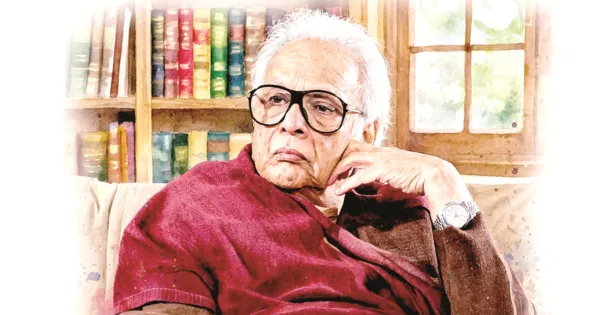
'We are in a foreign country, the moon must have risen in the country…' – The concern for one's country while living in a foreign country, the imagination of conveying the message like Kalidas's 'Meghdoot' and giving place to the ideals of equality in life, were the hallmarks of Rahi Masoom Raza's creative world. In his pen, India was not just a geography, but a living world made up of shared culture, relationships and memories. His creative journey from Sanskrit to Urdu and from epic to ghazal brings out that comprehensive form of Indianness, in which the boundaries of religion, language and religion are left behind.
Rahi Masoom Raza was born on 1 September 1927 in a landlord family in Gangauli village of Ghazipur. His father Bashir Hasan Abdi was a renowned lawyer of Ghazipur. Raza's nature was independent and outspoken since childhood. He believed in choosing his own path. At an early age, he was inclined towards communist ideology and joined the communist movement. His formal education was also affected during this period, but his relationship with books and ideas never weakened.
'If Kallu Kaka was not there'
Childhood illness also brought an important turning point in the life of Rahi Masoom Raza. He contracted TB at the age of just 11. During his long rest, he read all the books available in the house. At this time, Kallu Kaka was kept to accompany him and entertain him. Raza would later often say that if Kallu Kaka had not been there, perhaps he would never have become a storyteller. Kallu Kaka used to tell him stories and these stories created such a world of imagination in the child's mind, which later on gave depth to his literature. Although his formal studies were interrupted early on, Raza later pursued his education. He studied Urdu under Adeeb Kamil at Jamia Millia University and then did his MA in the Urdu department of Aligarh Muslim University. During this period, his literary talent continued to improve. By the time he reached his youth, he had made his mark as a famous poet.

From literature to cinema
Rahi Masoom Raza's creativity was not limited to any one genre. Novels, poetry, poetry, ghazals, film scripts and dialogues – he left his mark in almost every field. His language had colloquial ease with literary depth. This was the reason why his works directly connected with both the common reader and the audience.
After reaching Mumbai, he wrote extensively for the film industry. He wrote scripts and dialogues for more than a hundred films. His dialogues related to films like 'Golmaal', 'Milli' and 'Aalaap' brought wide recognition to his writing ability. He also received the Filmfare Award three times for dialogue writing. He received this honor for 'Main Tulsi Tere Aangan Ki', 'Tawaif' and 'Lamhe'.
He also expressed his experiences of seeing the film world closely in his novel 'Scene 75'. It highlights the position of writers and their struggles in the film industry. Raza's journey from literature to cinema shows that his pen could give language to even serious thoughts, which would directly reach the minds of people.
Historical chapter related to 'Mahabharata'
The most famous chapter of Rahi Masoom Raza's writing life is related to the dialogue writing of BR Chopra's television serial 'Mahabharat'. During that period the serial achieved unprecedented popularity across the country. At the time of its telecast on Sunday, people from cities to villages used to gather in front of the television. Dialogues played an important role in its popularity. Raza's pen did the work of presenting the complex plot and characters in simple language.
However, there was opposition at that time due to his association with 'Mahabharata'. Some people raised the question how a Muslim writer could write dialogues for a serial based on a Hindu epic. BR Chopra received many letters in protest. Similar objections were recorded in those letters.

Chopra delivered these letters to Rahi Masoom Raza. On this Raza told his friend that he would write 'Mahabharata'. His argument was not related to any religious identity, but to his Indian identity. He considered himself the child of Ganga and a part of Indian culture. For him, 'Mahabharata' was not a text limited to any one community, but a shared cultural heritage of Indian civilization.
The line from Raza's poem – 'The water of Ganga is running in every vein of mine' – expresses his cultural consciousness. Ganga was not just a river for him, but a symbol of India's shared memory and civilization.
Creator of Ganga-Jamuni culture
Village, Ganga, soil, relationships and cultural diversity return again and again in the works of Rahi Masoom Raza. He was a writer from an India where different languages, traditions and religious beliefs co-exist as a part of life. Partition and communal tension disturbed him deeply. His works reflect both the pain of the disintegrating society and the desire to preserve the shared culture.
That is why to limit Rahi Masoom Raza only as a writer of Urdu or Hindi would be to belittle his wide creative personality. He was a creator who established dialogue between Indian languages and cultures. His pen had the soil of Gangauli as well as the restlessness of the metropolis, the delicacy of poetry and also the bitterness of social questions. Perhaps the biggest identity of Rahi Masoom Raza is that he did not see India in any one color in his works. For him, India was a picture made up of many colors, voices and cultures, in which every color had its own place. His writings even today remind us of the common Indianness, the stream of which continues to flow like the Ganges.
Topi Shukla : : Story of a man falling alone amidst communalism
Rahi Masoom Raza Abdi Wald Syed Bashir Hussain Abdi The social degradation of his era–Have been witness to development. their literature–creation began with poetry, but innumerable ghazals, Even after the poems and Masnavis, perhaps the yearning to say something took him out of the limited world of poetry and brought him to the land of the novel. his first novel 'half village' It proved to be a classic and Rahi's name started being taken among the high-class novelists. after this 1969 published in 'Topi Shukla' Established him as a writer who boldly portrayed communalism and social ironies. 'Topi Shukla' Hindu–It is a novel that brings out the complexities of Muslim relations and the effects of communal mentality. Instead of putting any one community in the dock, Rahi has exposed those circumstances., In which a person's identity starts being decided on the basis of religion before he becomes a human being. The characters of the novel live their existence in this environment., Love, Fight for friendship and respect.
Pistachio cap amid communalism
divided into eighteen chapters 'Topi Shukla' Balbhadra Narayan Shukla, the main character of the novel, who is called Topi Shukla, Iffan and Iffan's wife Sakina. Topi and Iffan are close friends since childhood, But both of their lives are constantly influenced by social notions related to religious identity. Topi's life has been surrounded by neglect and loneliness since childhood. He does not get the affection that his elder brother Munni Babu gets in the family. its form–He is also made fun of for his colour. At home he is taught that Muslims are bad, Yet his closest friend Iffan is a Muslim. This contradiction becomes the biggest irony of Topi's personality.
He says that his plate is kept separate at home and he 'Malechha' It is said. Even mother's love comes in the way of the notion of religious purity. In this way, a frustration and loneliness is born inside the cap since childhood.
wall of religion in front of friendship
Topi and Iffan's friendship is the most important human aspect of the novel. Despite both being from different religious backgrounds–Are close to each other. Topi's arrival at Iffan's house–He has to go and he also has disagreements with his wife Sakina. Sakina never gives him money, sometimes satirizes his unemployment, But an intimate relationship remains between the two. Topi jokingly expresses his desire to tie Rakhi to Sakina., But the memories of riots and violence are so deep in Sakina's life that she is unable to prepare for it. Her brothers and father were victims of communal violence and Mahesh to whom she tied Rakhi, He was also killed while saving the honor of Rakhi. That is why there is deep resentment within him towards Hindus. Here Rahi shows the conflict between the personal sensibilities of two human beings and the collective prejudices present in the society. friendship, Despite intimacy and trust, the wall of religion continues to affect the lives of both.
Identity crisis and unemployment
Topi's biggest crisis is her religious identity. He is neither able to accept the fundamentalist beliefs of his family nor the social prejudices against Muslims. He does not get a job in the Hindu College of Aligarh because he is against orthodox ideas and is a student of Aligarh Muslim University. On the other end, Muslim refers to his name when it comes to applying to college-'My name is Balbhadra Narayan Shukla.' That means his problem is not only about job., Have also identified. He cannot fit within the boundaries of religion. Through this medium, Rahi raises the question that where is the place for such a person in the society?, Who wants to consider man as a human being before religion. Iffan is also troubled by the communal environment. He becomes a teacher in Muslim Rajput Degree College, But he gets upset with the environment there and leaves the job. Later gets appointed in Muslim University.
Memories and hatred of riots
The riots that occurred after Partition leave a deep impression on the lives of the characters in the novel. Iffan asks his father in his childhood whether Hindus are very bad and whether Sikhs are also bad. Rahi explains through this incident that on the other hand, Hindu and Sikh children in Pakistan would also be asking similar questions about Muslims from their families. Rahi writes that Iffan was afraid of Hindus and hence hated them, Whereas Topi loved the ancient culture of India and hence he started hating Muslims., But when old friendship peeks over this wall of hatred, So both become sad. This is one of the most poignant situations in the novel.
Growing divide between politics and society
Topi's family also separate from politics–Divides in different directions. His elder brother Munni Babu contests elections on Jan Sangh ticket and younger brother Bhairav contests elections on Congress ticket. Topi finds his way out of this political environment and reaches Banaras to support the communist candidate Kallan. Due to wearing sherwani in the train, he is considered a Muslim and not a Hindu.–He gets into a dispute on the question of Muslims and Pakistan. Topi questions bigotry and says that if Muslims will continue to be treated as aliens, so they got to India–Who is pushing towards opposition politics? For him, the common culture of man and country is above religion.
Love, rumination and loneliness
Love also comes into Topi's life. He loves a girl named Salima in his heart., But on reaching Aligarh he comes to know that she is married. This shock breaks him from within. On the other end, Rumors about his relationship with Sakina also affect his life. At one time Pandit Ramvilas Bekhatak is appointed in place of Topi. Job, love and social acceptance– Continuous failures on all three fronts make him more and more lonely. Things also worsen between Iffan and Sakina. Ultimately resigns from the job and goes to Jammu with his family. The hat is left alone.
death of hat : : defeat of civilization
Ultimately Topi remembers the old wounds of his life. childhood neglect, distance from family, Unemployment, failure in love, Social taunts and communal prejudice– Everything returns to his consciousness at once. Ifn him, Memories of Sakina and Shabnam surround me. He decides to leave Aligarh, But the next morning he is found dead. The irony is that two letters are found at his bedside. In one, there is information about Iffan arranging a job for him and in the other, there is a letter of his appointment in a college in Bahraich. That is, the time when a new path of life had opened before him., He had already ended his life before that. Topi's suicide is not just a personal incident for Rahi. They consider it a defeat of civilization. A person like Topi was left so isolated by the society that even when the opportunity presented itself, it could not see it.
-Dr. Samrana Faiyaz, teacher bareilly
Also read: AYUSH Sector Economic Contribution: AYUSH sector gaining momentum, expected to reach $318 billion by 2047