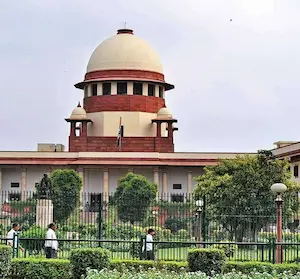
New Delhi. The decision to implement Merchant Discount Rate (MDR) on select merchant payments of more than Rs 2,000 through UPI has been challenged in the Supreme Court. While hearing the case, the top court has sought answers from the central government and other concerned parties. However, the court has currently refused to stay the new MDR system. The court has directed the Center and other parties to file counter affidavits within four weeks. Further hearing in the case will be based on the response of the government and the parties concerned.
Court said- the matter is related to technical aspect
During the hearing, the Supreme Court described the matter as mainly of technical nature. The court asked for further hearing after hearing the stand of the Center and other concerned parties. The petition challenges the decision to impose MDR on eligible (Person-to-Merchant) (P2M) UPI transactions of more than Rs 2,000. The petitioner had sought a stay on the arrangement, but the court refused to impose an interim stay.
0.4% MDR on select UPI payments above Rs 2,000
Under the new regime, the normal MDR on eligible P2M UPI transactions above Rs 2,000 has been set at 0.4 per cent. The maximum limit of MDR on transactions of Rs 75,000 or more has been capped at Rs 300. This system is to be implemented from October 15, 2026. However, not all UPI payments will be covered under this fee. (Person-to-Person) There will be no MDR on (P2P) transactions and merchant payments up to Rs 2,000 will also remain fee-free. Zero-MDR system will continue for small businessmen also.
Government claims – about 96% merchant transactions are not affected
According to the central government, about 96 percent of UPI merchant transactions will not be affected by the new system. The government has clarified that MDR will be applicable only on merchant payments of more than Rs 2,000 made under prescribed conditions. According to official information, MDR is likely to be applicable on about 4 per cent of merchant transactions, while the remaining transactions will either be below the Rs 2,000 limit or fall in the zero-MDR category.
MDR will not be taken directly from customers
The government has clarified that MDR is not a fee to be collected from the customer. Banks have been asked to ensure that merchants do not pass on the burden of this fee to customers paying through UPI. UPI app providers will also not be allowed to impose additional platform or hidden charges on customers.
Separate fee system for some essential services
A flat MDR of Rs 5 has been set on eligible UPI payments above Rs 2,000 in essential and low margin sectors such as railways, telecom, insurance, fuel and agri inputs. At the same time, there is a provision of 0.02 percent MDR for payments related to mutual funds, securities and stockbrokers, the maximum limit of which is Rs 300.
Now further hearing on Centre’s reply
At present the Supreme Court has not banned the MDR system. Now after filing the replies of the Central Government and other concerned parties, the court will consider the matter further. Meanwhile, as per the fixed rules, the new MDR system is going to be implemented from October 15.