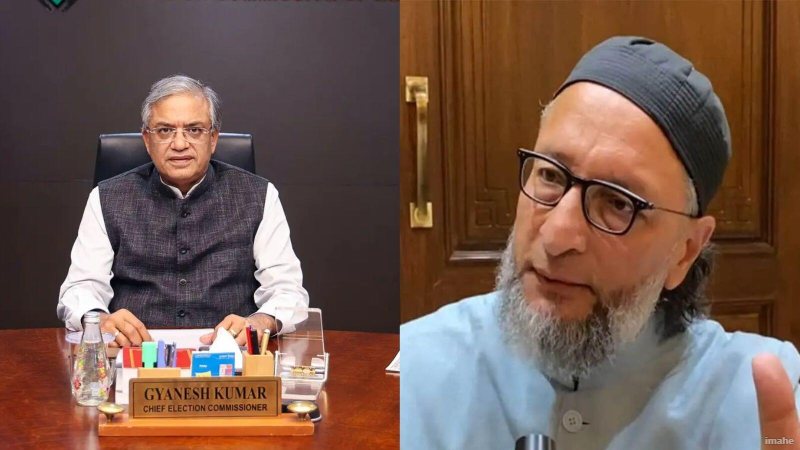
A new and extremely heated controversy has erupted in the country regarding the functioning of Indian political circles and the Election Commission, which has raised the temperature of national politics to the seventh sky. All India Majlis-e-Ittehadul Muslimeen (AIMIM) chief and MP Asaduddin Owaisi has raised very sharp and serious questions on the working style and recent processes of the Election Commission (ECI). Owaisi has directly termed the SIR process as ‘Backdoor NRC’ and said that the government and the Election Commission together are putting a new burden on the citizens of the country through this medium. Along with this, he has also asked this sharp and direct question to the Election Commission that when disagreements were registered 14 times during various meetings and discussions, then how were the decisions of the Commission declared unanimous. After these frank and aggressive statements of Owaisi, there has been an uproar in the country’s politics, and the rhetoric on this issue has intensified from the opposition parties to the ruling party, due to which this controversy can create a big political storm from Parliament to the streets in the coming days.
SIR and backdoor NRC controversy: What are Owaisi’s main concerns?
Asaduddin Owaisi, through his press conferences and public forums, has expressed deep concern over the way the processes related to SIR are being carried forward, which is pushing a large section of the country into a state of doubt and confusion. They allege that the country has already seen a lot of protests and concerns regarding the process of National Register of Citizens (NRC), and now an attempt is being made to implement the same system through the back door through SIR. Owaisi argues that due to such policy changes, citizens of the country’s poor, deprived and minority communities may face unnecessary difficulties in proving their identity. He also says that in any democratic country, an impartial constitutional institution like the Election Commission should work in a completely transparent manner, so that no doubt arises in the mind of any citizen that any secret or planned mechanism is working to influence their citizenship or voting rights.
Sharp question to the Election Commission: “When there was disagreement 14 times, how did the decisions become unanimous?”
The most sensational and technically serious aspect of this entire controversy is the question that Owaisi has raised on the decision-making process of the Election Commission. Keeping the statistics, he asked that when dissent was registered by members or experts on 14 different occasions on various issues within the Commission or in related meetings, then how was it claimed before the public that all the decisions were completely unanimous. Owaisi has demanded from the Election Commission to make public the minutes of its meetings and the notes of disagreement so that the people of the country can know what is the real situation behind these decisions being taken behind closed doors. His statement directly puts a question mark on the credibility and autonomy of the Election Commission, because it is very important for any independent constitutional body that its decisions are transparent and they are not affected by any kind of political pressure or bias.
Boiling in political circles and far-reaching political consequences of this dispute
After these sharp attacks by Owaisi, a war of words has broken out between the party and the opposition in the country’s politics. On one hand, while some leaders of the opposition parties are justifying these questions of Owaisi and demanding transparency from the Election Commission, on the other hand, the leaders of the ruling party have retaliated and said that the opposition always keeps making such baseless allegations to hurt the dignity of constitutional institutions and to earn their political bread. Analysts believe that as electoral activities and issues related to administrative reforms progress in the country, these topics related to SIR and citizenship will become more sensitive. This step taken by Owaisi may be a part of political debates at the moment, but it has once again sparked a serious legal and political discussion on the functioning of an apex body like the Election Commission, which may have far reaching consequences in the future.