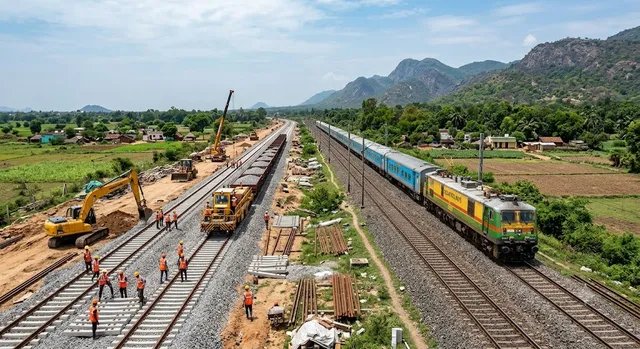
The busiest and strategically sensitive Delhi-Ambala railway section connecting the country's capital Delhi with Punjab, Haryana, Himachal Pradesh and Jammu and Kashmir is going to be rejuvenated. The Central Government and Indian Railways have accelerated the process of taking off the ground the mega project of laying the third and fourth railway lines on this 194 km long railway line. Tenders have been issued for this much-awaited multi-tracking project, to be built at a total cost of Rs 5,983 crore. At present this railway section is facing heavy traffic pressure of about 66 percent more trains than its sanctioned capacity. With the laying of two additional tracks, not only will there be a significant increase in the speed limit of passenger trains, but it will also provide relief from the old problem of lateness of trains and unnecessary standing on the outside on this busy route. The pressure of more than 150 trains every day and the compulsion to stop at the outer will end. This route between Delhi and Ambala is considered the lifeline of North India, from where more than 150 trains including Vande Bharat, Rajdhani Express, Shatabdi Express, Superfast, passenger and goods trains pass every day. Due to high traffic density, express and passenger trains sometimes have to stand at small stations or outer signals for hours to make way for premium trains. After the commencement of direct rail connectivity from Delhi to Kashmir Valley through Udhampur-Srinagar-Baramulla rail link, a huge increase in the number of trains is being recorded on this route. According to railway officials, after the laying of the third and fourth lines, separate dedicated paths will be available for goods trains (goods trains) and passenger trains, which will increase the average operating speed of trains by 20 to 30 km per hour. 194 km long track, 5 major districts and state-of-the-art infrastructure upgrade, this ambitious rail corridor will start from Delhi (Sabzi Mandi, Narela) and pass through five major industrial and agricultural districts of Haryana – Sonipat, Panipat, Karnal, Kurukshetra and Ambala Cantt. Under the project, modern passenger facilities, new platforms and expansion of loop lines will be provided at 32 railway stations. To make the infrastructure safe and speed-friendly, Rail Over Bridges (ROB) and Rail Under Bridges (RUB) will be constructed on the route to completely eliminate all unmanned and busy level crossings. In the first phase, tenders worth Rs 3,612 crore have been invited for track, civil work, modern automatic signaling, state-of-the-art telecommunication and overhead equipment (OHE) electrification works between Sabzi Mandi to Ambala Cantt. Strategically very important for the Indian Army and a model without land acquisition, the Delhi-Ambala railway line is not only for the common travelers but is also the backbone of the Indian Army from the national security and strategic point of view. Rapid movement of troops, heavy artillery, military equipment and supplies to the border posts of Punjab and Jammu and Kashmir takes place through this main corridor. The most special thing about this project is that there will be no need for new private land acquisition on a large scale for its construction. Railways already has adequate Right of Way (RoW) available on both sides of the existing track, which will enable the project to be completed expeditiously within the stipulated time period of 4 years without any legal or land disputes. Big benefit to tourists and pilgrims visiting Vaishno Devi, Srinagar and Shimla. This project is going to prove to be a game-changer for the tourism industry of North India. The journey of lakhs of devotees and tourists going from Delhi-NCR to Mata Vaishno Devi (Katra), Kashmir Valley, Amritsar Golden Temple, Chandigarh and Himachal Pradesh (Kalka-Shimla) will become very fast and timely. With the increase in the frequency of trains, the chances of getting confirmed tickets will increase significantly during the festive season and holidays. Along with this, the movement of tourists coming from India and abroad to the historical and religious city of Kurukshetra (Gita Sthali) in Haryana will also get a new impetus from this smooth rail network. Apart from providing uninterrupted coal supply to thermal power plants and huge reduction in logistics costs, this project will provide unprecedented strength to the country's energy and manufacturing sector. Continuous and fast supply of coal will be ensured to the major thermal power plants located at Panipat, Ropar, Guru Gobind Singh and Rajpura. There will be an additional addition of about 24.6 million tonnes per annum (MTPA) of freight capacity from Haryana's grain markets, warehousing hubs, textile clusters of Sonipat-Panipat and automobile industries. Hundreds of crores of rupees will be saved annually in freight time and logistics costs. From the environmental point of view, shifting the pressure of heavy trucks from roads to railways will prevent emissions of about 43 crore kilograms of carbon dioxide (CO2) every year.