Ram’s fantasy drama, starring Nivin Pauly, Soori and Anjali, attempts to explore immortality, eternal love and humanity, but is weighed down by an incoherent screenplay and distracting AI-generated visuals.
Director Ram’s ‘Yezhu Kadal Yezhu Malai’ arrives with the ambition of being much more than a conventional fantasy drama. It brings together ideas about immortality, reincarnation, love that survives across centuries, the collective guilt of humanity and even the possibility of universal equality. The problem is that the film struggles to translate these ideas into a coherent cinematic experience.
One of its most distracting elements is the use of AI-generated visuals. AI is not merely employed as an occasional visual aid here. The film repeatedly incorporates artificial-looking imagery that can pull viewers out of the narrative. Several of these visuals appear unfinished or poorly integrated, making them feel less like a deliberate stylistic choice and more like a shortcut.
The story begins on a Diwali night when a man played by Soori, returning to his hometown after spending eight years in Dubai, finds himself sharing an almost empty train compartment with a mysterious stranger, played by Nivin Pauly. He is on his way home to finally meet his son, whom he has never seen in person because he had left for Dubai when his wife was pregnant and was unable to return.
His anticipation of the reunion doesn’t last long. The strange passenger begins following him, and what initially appears to be an uncomfortable encounter gradually turns into something far more bizarre.
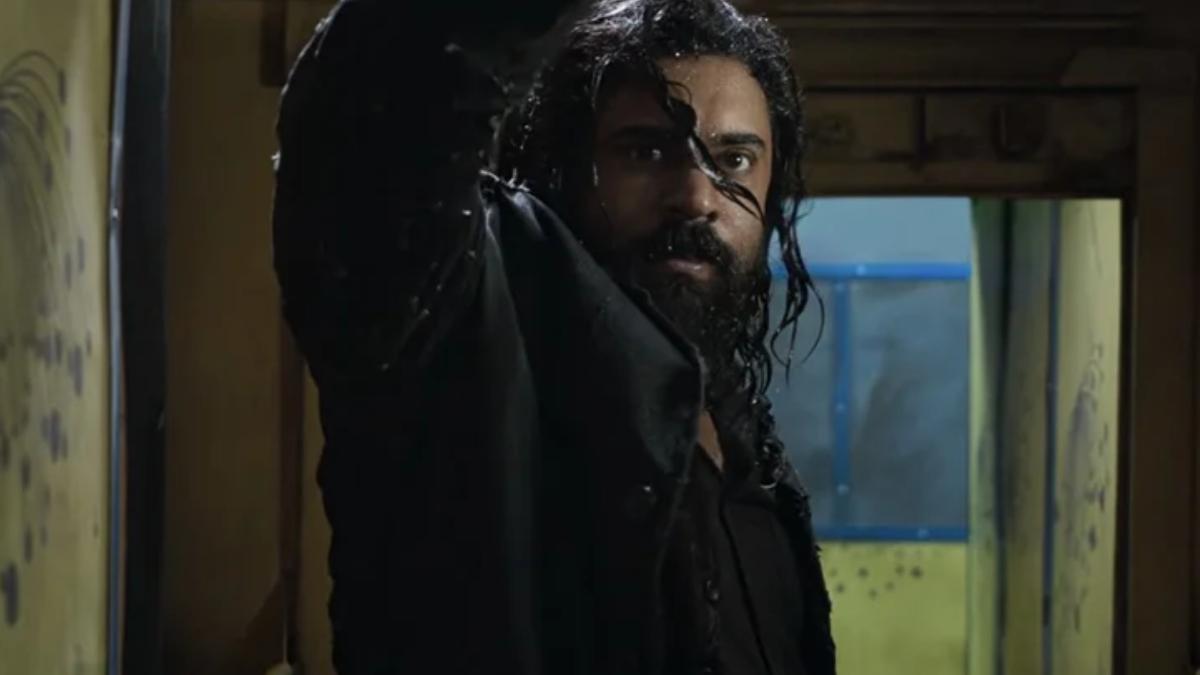
Nivin’s character claims to be 8,822 years old. He has spent centuries searching for the woman he loves, played by Anjali, who he believes has returned across four different lives. As the two men continue their conversation, Soori’s character discovers that his own life has become entangled with this extraordinary story.
A fantasy film struggling to find its tone
The biggest problem with ‘Yezhu Kadal Yezhu Malai’ is perhaps its inability to settle on what kind of film it wants to be.
The portions inside the train frequently resemble a gritty survival thriller, while the flashbacks move towards fantasy and mythology. Yet even when the story enters territory that demands a more imaginative visual and emotional treatment, the film often remains grounded in the director’s familiar brand of intense realism.
This tonal inconsistency makes the transitions particularly jarring. Instead of allowing the fantasy and realism to complement each other, the two approaches frequently seem to compete.
The film also occasionally uses exaggerated sound and visual cues to underline supposedly humorous moments. These choices can feel forced, especially when the jokes themselves fail to land.
Big ideas, weak execution
There is certainly no shortage of ideas in ‘Yezhu Kadal Yezhu Malai’. The film explores what happens to memory when someone lives for thousands of years, the psychological burden of immortality, humanity’s collective wrongdoing and the idea that love can survive beyond individual lifetimes.
Its characters are deliberately unnamed, with each seemingly representing a particular human quality.
Soori’s character is essentially the ordinary man desperately trying to survive an extraordinary situation. Nivin’s immortal figure appears obsessed with creating a world where justice extends to every living being, while Anjali’s character represents beauty, kindness and love.
The film has some striking imagery to communicate the extraordinary bond between Nivin and Anjali. In one sequence, the immortal character sleeps through a violent thunderstorm but wakes up when he senses Anjali approaching on her bicycle.
Moments such as these attempt to establish love as something capable of transcending time, death and multiple lifetimes. Unfortunately, the emotional foundation is never strong enough for the romance to have the desired impact.
The screenplay also throws in philosophical references, metaphors and pop-culture nods, including mentions of Hulk and She-Hulk. Rather than enriching the narrative, several of these additions make the already crowded screenplay feel even more cluttered.
Nivin Pauly and Soori put in the effort
Nivin Pauly and Soori are required to carry much of the film physically, particularly during the extended sequences inside the train compartment. Both actors commit to the action and physical demands of their roles.
However, the performances struggle against the writing.
Nivin’s dialogue delivery frequently feels awkward, while the character itself is written in a manner that makes it difficult to connect with him. Anjali has comparatively little to work with, although her presence brings some warmth to the film whenever she appears.
Soori gets more of the grounded perspective as the ordinary man caught in an extraordinary situation. His desperation provides some of the film’s more relatable moments, but even his character is ultimately trapped within an uneven screenplay.
Too much meaning, not enough impact
‘Yezhu Kadal Yezhu Malai’ constantly reminds viewers that there is supposedly something profound beneath its surface. But the film rarely succeeds in making those ideas emotionally accessible.
A film can certainly be abstract, philosophical or deliberately unconventional. However, the ideas still need to connect with the audience at some level. Here, the metaphors often feel more important than the characters and the story.
The result is a film where viewers may recognize the ambition without necessarily feeling the intended emotion.
That becomes particularly frustrating because Ram has previously demonstrated an ability to combine strong themes with memorable storytelling. In ‘Yezhu Kadal Yezhu Malai’, however, the ideas appear to overwhelm the narrative instead of strengthening it.
ALSO READ: ‘Drishyam 3’ X reviews: ‘Peak cinema’, ‘better than Part 2’; Ajay Devgn eyes Rs 50 crore opening
The technical departments provide some respite. Yuvan Shankar Raja’s music contributes atmosphere, while production designer Umesh J Kumar’s work adds visual texture to the film.
But these strengths cannot completely compensate for a screenplay that feels scattered and a visual treatment that is frequently undermined by distracting AI-generated imagery.
‘Yezhu Kadal Yezhu Malai’ clearly wants to be a philosophical fantasy about love, humanity and the passage of time. Yet its ambition gets buried under inconsistent storytelling, uneven performances, awkward dialogue and questionable visual choices.