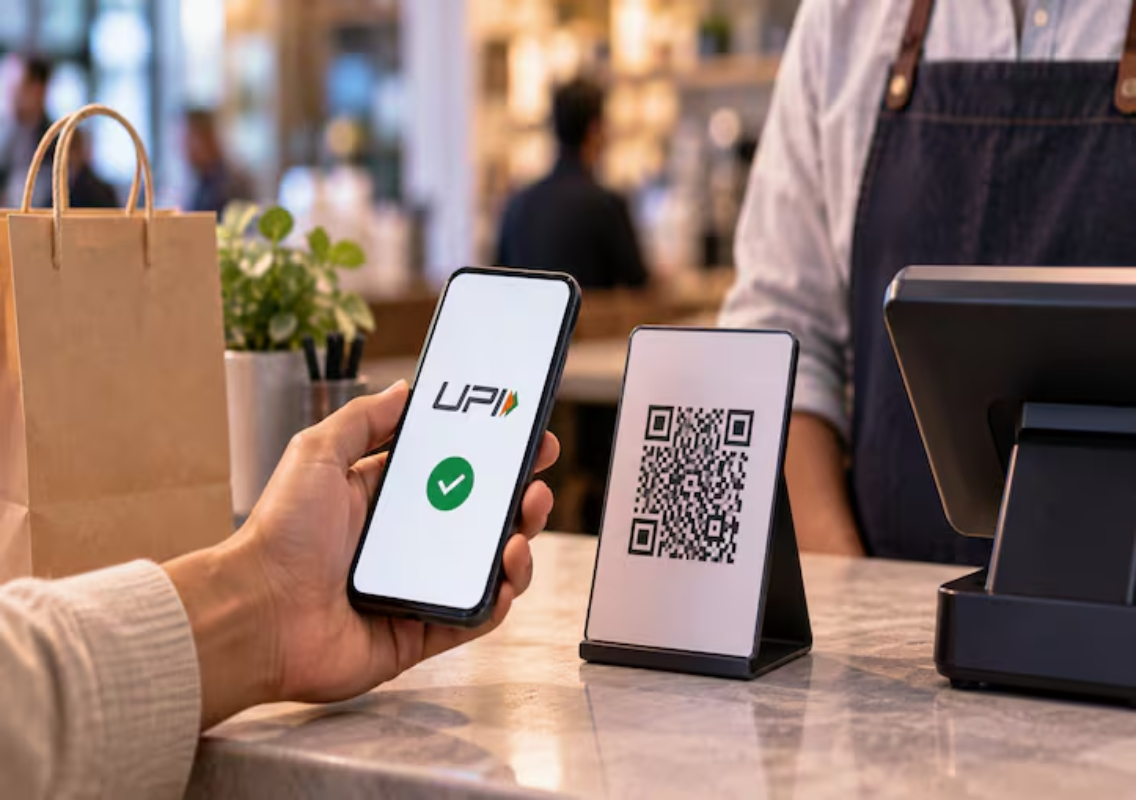
New Delhi: Indian Bank is considering waiving its share of the newly introduced Merchant Discount Rate (MDR) on eligible UPI transactions, a move that could reduce the cost burden for merchants when the new UPI fee framework takes effect from October 15.
Indian Bank MD and CEO Binod Kumar said the public sector lender is open to exploring a waiver of the 0.28% component of the MDR that is routed to the customer’s issuing bank. The final decision will be taken by the bank’s board.
Kumar said Indian Bank currently does not earn directly from UPI transactions, but the digital payment system has helped the lender reduce manpower requirements and cash-handling activities. He also said the introduction of MDR would be incrementally positive for banks, although it is unlikely to make a substantial difference to their income or materially affect profitability.
UPI MDR begins from October 15
Under the new framework announced by the National Payments Corporation of India (NPCI), eligible person-to-merchant (P2M) UPI transactions above ₹2,000 will attract an MDR of 0.4% from October 15, 2026.
The charge will be capped at ₹300 for transactions of ₹75,000 and above. Importantly, the MDR is a merchant-side charge and is not supposed to be passed on to customers.
Person-to-person UPI transfers will remain outside the MDR framework. Small merchants classified under the P2PM category can also continue to receive UPI payments without MDR if their QR-based receipts directly into their accounts remain within the prescribed ₹1 lakh monthly threshold.
The new structure therefore does not mean that consumers will start paying a general fee every time they use UPI.
What Indian Bank is considering
The proposed waiver relates specifically to the 0.28% interchange component of the MDR.
Under the NPCI framework, the merchant pays up to 0.4% to the acquiring bank. The acquiring bank transfers 0.28% as interchange to the customer’s issuing bank. The issuing bank then pays a portion to the payer-side Payment Service Provider (PSP), with part of that amount flowing to the UPI application provider.
This means the 0.28% is not an additional fee charged directly to UPI users. It is part of the internal distribution of the MDR collected from eligible merchants.
Indian Bank is considering absorbing this component rather than retaining the revenue that would otherwise accrue to it.
Kumar indicated that the approach could be similar to how banks sometimes waive or partially absorb charges on credit and debit card transactions when merchant volumes justify such concessions.
Indian Bank has significant UPI volumes
The proposed move comes as Indian Bank handles a substantial number of UPI transactions.
The lender recorded 32.6 crore UPI transactions during the first six months of FY27, according to Kumar’s comments reported by The Times of India. Of these, around 1.6 crore transactions, or roughly 5%, were above ₹2,000 and would potentially fall within the new MDR framework, subject to the applicable merchant category and other exemptions.
As of September 30, Indian Bank had around 21.2 lakh P2M merchants and 8.2 lakh P2PM merchants under its network, according to the same report.
The figures indicate that while a relatively small proportion of the bank’s UPI transaction volume could be directly affected by the new MDR structure, the absolute number of affected payments could still be substantial.
Bank currently earns no direct UPI income
Kumar said Indian Bank currently earns nothing from UPI transactions. Despite this, he highlighted operational benefits from the rapid shift towards digital payments.
UPI has reduced the need for physical cash handling and associated manpower at bank branches, while also moving a growing share of customer payments to digital channels.
Indian Bank’s own profile shows the scale of its digital banking expansion. The lender said digital channels generated ₹67,327 crore of business during the first quarter of FY27, while its mobile banking user base had grown 22% year-on-year to 2.48 crore.
The proposed MDR therefore represents a change from a system in which banks gained largely indirect operational benefits from UPI to one where certain participants can receive direct revenue from eligible merchant transactions.
How the 0.4% MDR is distributed
The new UPI MDR does not go to the government as a tax.
Under the framework, the merchant pays up to 0.4% to the acquiring bank. Of this, 0.28% is transferred to the customer’s issuing bank as interchange. The remaining economics are distributed among other participants in the payment chain.
The issuing bank retains 0.16% of the total MDR, while the acquiring bank retains 0.12%. The payer-side PSP receives 0.04%, and the third-party application provider receives 0.08%.
The arrangement is intended to create a revenue stream within the UPI ecosystem rather than impose a general charge on consumers.
Merchants cannot pass the MDR to customers
The new system has been structured so that merchants are not supposed to recover the MDR from customers by adding a separate UPI fee.
The Finance Ministry has said banks should ensure merchants do not pass the MDR on to customers, while UPI application providers are not permitted to impose platform fees or hidden charges under the framework.
Indian Bank is also preparing monitoring mechanisms for the new regime.
Kumar said the bank was developing an application programming interface (API) to monitor transactions and identify cases where merchants may charge customers more than the listed amount. The bank expects the mechanism to be ready within days of his comments.
Other UPI transactions have different rates
The 0.4% MDR is not applicable to every high-value UPI payment.
Specified sectors such as railways, telecom, insurance and fuel will attract a flat ₹5 MDR on eligible transactions above ₹2,000. Capital-market transactions, including certain payments involving mutual funds, securities and registered intermediaries, will have a separate 0.02% MDR capped at ₹300.
Small P2PM merchants also remain protected from MDR when they meet the prescribed monthly receipt conditions.
These exemptions mean the impact of the October 15 change will vary considerably depending on the type of merchant and transaction.
What Indian Bank’s move could mean
If Indian Bank’s board approves the proposed waiver, eligible merchants using the lender’s acquiring services could see a lower effective MDR burden.
The decision would also illustrate how banks may compete within the newly monetised UPI ecosystem. Rather than uniformly passing the full MDR economics through the payment chain, banks could choose to absorb some charges to attract or retain merchants.
For Indian Bank, Kumar said the introduction of MDR is expected to be incrementally positive, but not large enough to materially alter the bank’s profitability. The lender’s willingness to consider a waiver suggests that merchant relationships and transaction volumes could be more important considerations than the additional income from the charge.
The final decision, however, rests with the Indian Bank board. Until the board approves a waiver, the proposal should be treated as under consideration rather than a confirmed policy.