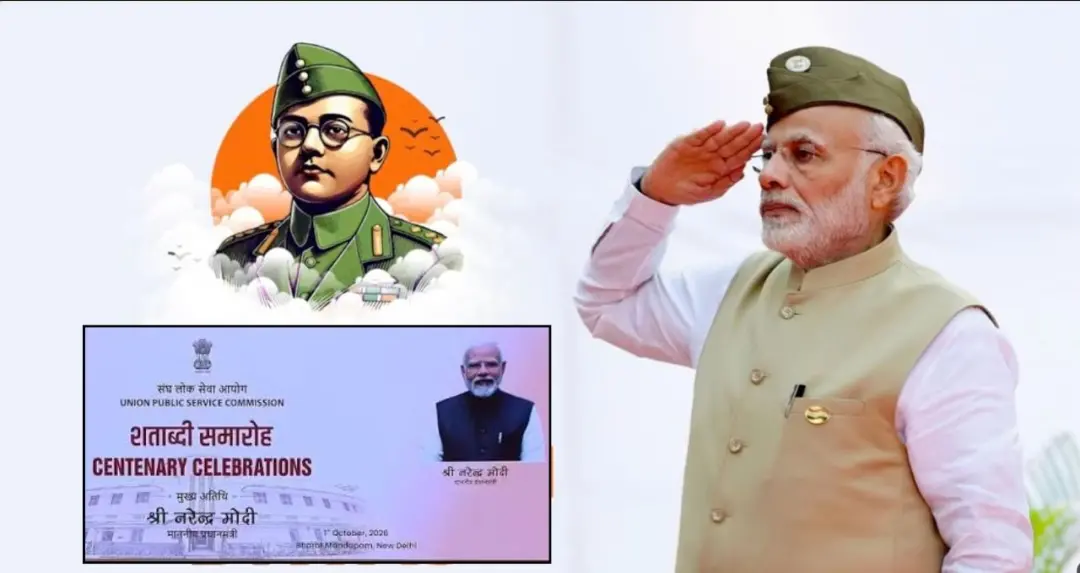
Prime Minister Narendra Modi on Thursday praised freedom fighter Subhash Chandra Bose, saying he had given the Civil Services Examination in Sanskrit in 1920 during the British rule.
UPSC Centenary Celebration: On the occasion of completion of 100 years of Union Public Service Commission i.e. UPSC, Prime Minister Narendra Modi addressed the centenary celebrations organized at Bharat Mandapam in New Delhi. During this, he talked about the century-long journey of the Commission, the role of Civil Services Examination and the development of the administrative system of the country. In his address, PM Modi also shared an interesting incident related to freedom fighter Netaji Subhash Chandra Bose.
The Prime Minister said that after seeing the exhibition organized during the function, he got information related to the era of 1920. According to him, at that time India was under British rule and Subhash Chandra Bose also went through the same examination process. PM Modi said that at that time there was a Sanskrit question paper in the examination and Subhash Chandra Bose had given his examination in Sanskrit.
What did PM Modi say on completion of 100 years of UPSC?
PM Modi described the centenary of UPSC not just as an institutional achievement but an occasion linked to the aspirations of millions of youth of the country. He said that every year a large number of youth dream of joining civil services and people's trust on UPSC is one of its most important assets.
According to the Prime Minister, in the last 100 years, generations changed, governments changed, technology expanded and the exam syllabus also changed, but people's faith in UPSC remained. He also urged the people present at the function to visit the centenary exhibition. On this occasion, a commemorative postage stamp and a special coin related to the 100 years of UPSC's journey were released. Apart from this, a compilation of 100 important judicial decisions related to UPSC and Public Service Commissions was also released.
Subhash Chandra Bose gave ICS exam in 1920
Subhash Chandra Bose had passed the Indian Civil Service i.e. ICS examination in 1920. Later, instead of serving the British government, he chose the path of independence movement. Prime Minister Modi mentioned this Sanskrit incident related to his examination experience at the centenary celebrations of UPSC. Citing the historical information present in the exhibition, PM Modi said that during the British rule, there used to be a Sanskrit paper in the examination and Netaji had written it in Sanskrit. Through this mention, he also drew attention towards the historical journey of UPSC and the earlier civil services examination system.
Discussion on role of UPSC after independence also
The Prime Minister noted the gap between the administrative system during the British rule and the needs of independent India. He said that after independence, the country was not only faced with the challenge of maintaining independence, but it was also necessary to prepare the administrative structure of a new nation. In this context, PM Modi remembered the contribution of Sardar Vallabhbhai Patel.
He said that Patel played an important role in creating the strong administrative structure that was needed for the reconstruction of independent India. According to the Prime Minister, Patel contributed in strengthening this institution and giving it a place among the major institutions of independent India.
Emphasis on 'Nation First' and 'Citizen First'
At the centenary celebrations of UPSC, the Prime Minister also spoke about the future of civil services. He described 'Nation First' and 'Citizen First' as two important criteria. He said that such youth should come forward in public services, who are inspired by the spirit of public service rather than position. The Prime Minister also said that the purpose of recruitment examination should not only be to assess the knowledge of the candidate, but also to try to understand why a youth wants to join the civil services. According to him, administration in 21st century India will have to move forward with a people-centric, proactive and good governance based work culture.