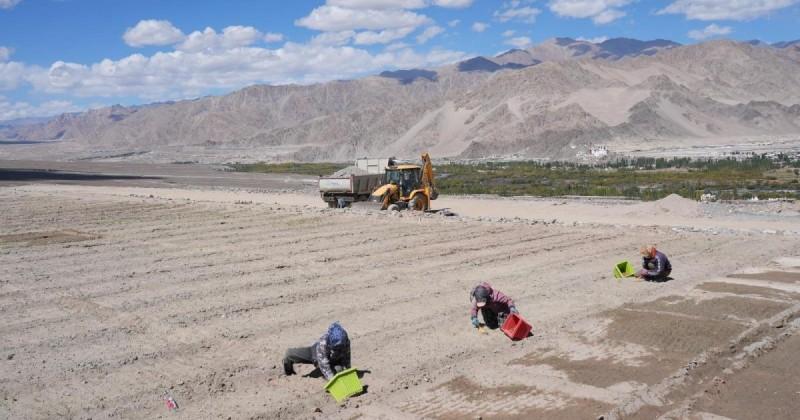
Land that was barren until three months ago in the cold desert of Ladakh is now being used to cultivate premium saffron for the first time in the region. Approximately 800 kilograms of premium Iranian saffron corms have been planted across around 4,000 square metres of land, covering a total area of approximately 90,000 square metres. Significantly, the barren land has been made cultivable again under Project Him Sarovar.
Following the successful cultivation of Lilium in Ladakh, saffron cultivation is now being experimented with in the cold desert. The initiative was launched under the guidance of Lieutenant Governor Vinai Kumar Saxena with the aim of exploring new farming options and diversifying the agricultural sector in Ladakh. Agricultural experts hope that the planted saffron corms will produce a significant yield.
The project uses high-quality Iranian saffron corms considered suitable for cultivation under the region’s climatic conditions.
LG Saxena outlines saffron cultivation plan.
Lieutenant Governor of Ladakh Vinai Kumar Saxena said the pilot saffron cultivation project is underway at Gate No. 27 in the Command Area of Spituk Phadka in Leh. High-quality Iranian saffron corms, measuring 8 to 10 cm in circumference, 2.5 to 3 cm in diameter, and weighing 10 grams or more, have been planted. These specifications are considered suitable for high-quality saffron production.
I am pleased to announce an ambitious experiment of introducing saffron cultivation to Ladakh, for the very first time, on a large scale.
Building on the incredible success of our highest-altitude Lilium fields, we have sown 800 kg i.e 90,000 nos of premium, high-quality… pic.twitter.com/z4wx1q0XZZ
— LG Ladakh (@lg_ladakh) October 2, 2026
“I am pleased to announce an ambitious experiment of introducing saffron cultivation to Ladakh, for the very first time, on a large scale.
Building on the incredible success of our highest-altitude Lilium fields, we have sown 800 kg i.e 90,000 nos of premium, high-quality Iranian saffron corms, perfectly suited to our unique high-altitude agro-climatic conditions.
The saffron cultivation is being done over 4000 sq meters of previously barren land at Spituk Pharka in Leh, which has been successfully rejuvenated and transformed under project Him Sarovar.
This landmark initiative is driven by Prime Minister Narendra Modi Ji’s vision of agricultural diversification for farmers’ financial sustainability and financial empowerment.
This pioneering project has immense potential to strengthen our local economy, creating lucrative and sustainable new livelihood opportunities for our hardworking farmers, youth, and Self-Help Groups”, Ladakh LG posted on his social media handle.
Saffron cultivation has significant potential to strengthen the local economy by introducing another high-value crop suited to Ladakh’s unique high-altitude agro-climatic conditions. Saxena said the initiative would also dispel the misconception that saffron cannot be grown in Ladakh and that barren or degraded land cannot be restored.
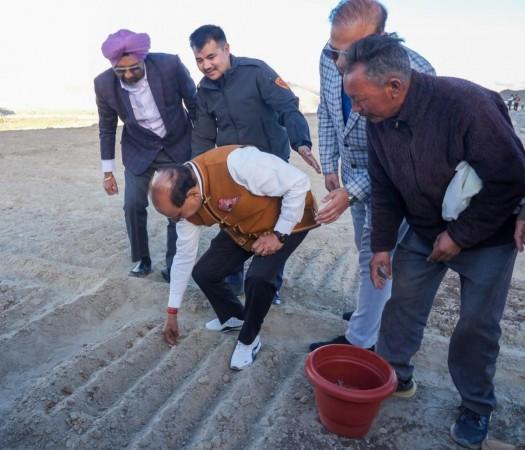
“Our effort is to transform degraded and barren land into fertile land and create new opportunities for farmers. Starting saffron cultivation is another important experiment in crop diversification,” LG Saxena said.
He said the initiative could open new avenues for farmers to increase their income through a high-value crop.
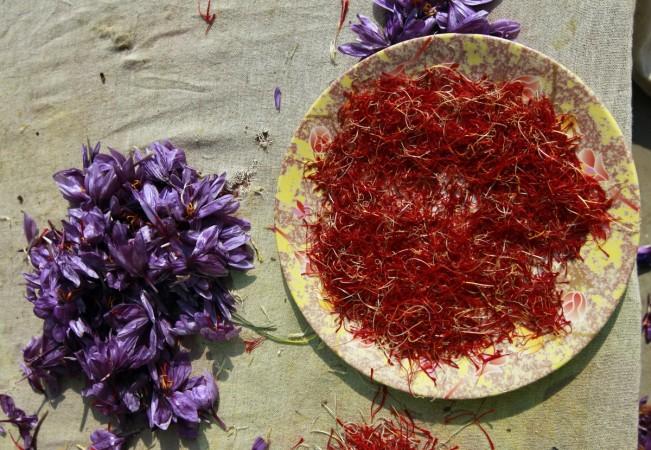
Why is saffron cultivation being explored in Ladakh?
Saffron is a high-value crop that enjoys strong market demand and commands a premium price. It could provide farmers with an additional source of income. In India, saffron is primarily cultivated in Jammu and Kashmir, which accounts for the vast majority of the country’s production.
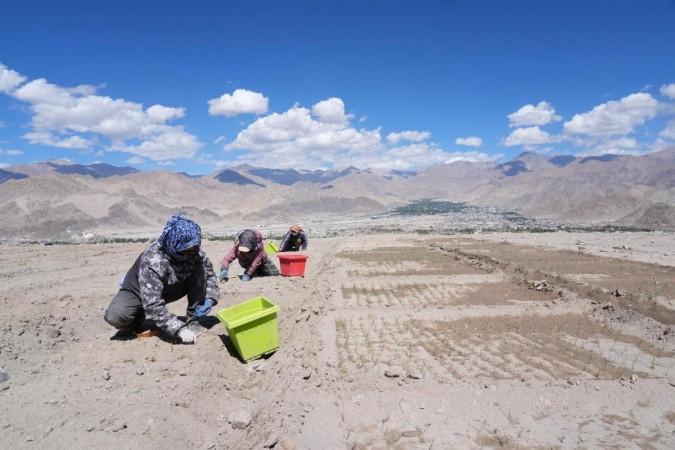
The initiative in Ladakh is being undertaken as a pilot project to assess the crop’s suitability to the local climate and evaluate its economic potential.
Canal water to help reclaim barren land
The saffron cultivation site is part of an 800-acre tract of land being reclaimed in Leh. Water is being supplied from the nearby irrigation canal, which was recently renovated and restored. At the lieutenant governor’s direction, excess canal water is being diverted to the barren land to increase soil moisture and make it suitable for cultivation.
The area also has four water ponds developed under “Project Him Sarovar”. Located near the saffron cultivation site, the ponds have a combined storage capacity of approximately 24 million litres.