While Nissan’s reputation is spotty at best when it comes to certain cars and equipment, one example being the spontaneously disassembling CVT, it also produced some absolute bangers. Chief among them, as any JDM enthusiast would recognize, is the Skyline model range — a dream car for many an importer, owing to its exclusivity to the JDM market and massive popularity. The GT-R, especially, was so beloved for its stout RB26DETT that it became a cultural icon of JDM motoring around the world.
Sadly, Nissan discontinued the R34 after a brief five model years, from 1998 to 2002, save for exclusives like the Nismo Z-Tune. This left a gap in the model range, and with the informal ending of the 276-horsepower limit from the gentlemen’s agreement, Nissan had carte blanche to create something brand-new. So, the company pulled a Pontiac GTO, separating what was trim level into two distinct cars: One was the Skyline itself, also known as the Infiniti G35, while the other, Nissan’s new halo car, became the Nissan GT-R — not a Skyline in name, the halo car GT-R. That car carried the VR38DETT, a 500-plus horsepower monster of an engine.
The true power figure of the VR38DETT – which stands for VR engine family, 3.8 liters, dual overhead-cam, electronic fuel injection, twin turbo — that’s a matter of debate. First of all, it depends what model you get, with early GT-Rs boasting “just” 480 horsepower; this number increased to 600 horsepower by the end of production, available in exclusive Nismo models. How did Nissan do it? Let’s discuss.
A racing engine for the road
Most manufacturers start off with a road car and adapt it for racing; Nissan developed this engine from the ground up to play both roles. That’s hardly surprising, considering what car it lives in; the GT-R name has been associated with motorsports since the 1960s — the S20 engine that powered the original KPGC10 Skyline GT-R was basically a racing engine shoved into a road car.
Similarly, the R35 GT-R has represented Nissan’s premiere racing entry in FIA and Super GT motorsports since its debut, powered by the same VR38 as the road car. In fact, this engine powered not just the GT-R, but multiple other prototype and GT-class racers, such as the Renault RS01, and also Nissan’s DPi entry for IMSA.
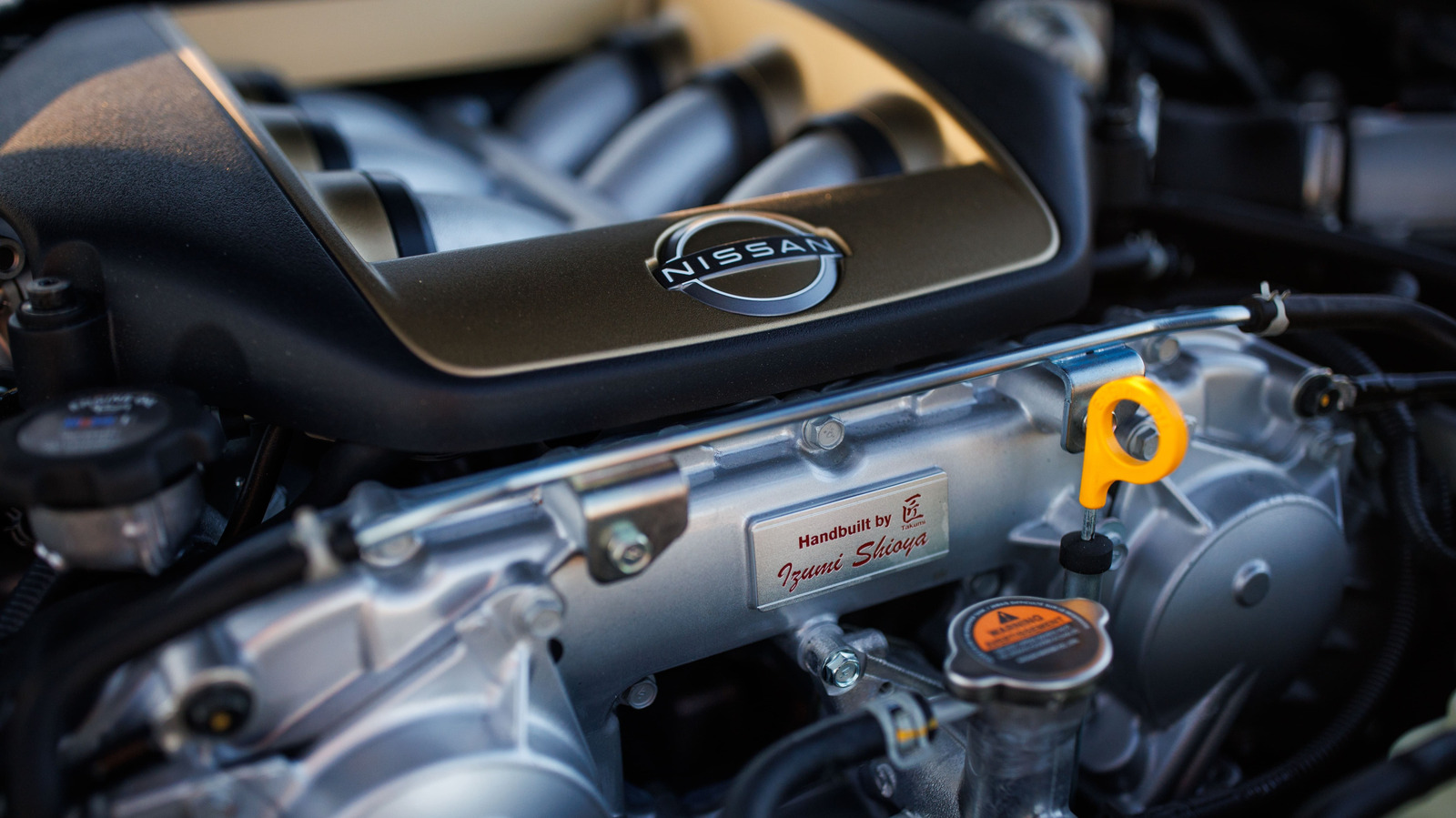
Of course, such a fine engine takes a lot of precision to engineer correctly, and that was the job of exactly four men; Takumi Kurosawa, Tsunemi Ooyama, Izumi Shioya and Nobumitsu Gozu. They represent the master craftsmen entrusted to hand-build every single VR38DETT, racing or production-based, from the ground up. Yes, Nissan, maker of the Altima, had a workshop within its Yokohama plant where artisans actually crafted these engines by hand. Every engine has its own plaque as well, placed on the front of the timing cover and engraved with the builder’s name.
Hand-fitting such parts, as opposed to mass-producing them, works like a person crafting a luxury watch. You can minimize all the tolerances to an OCD level of satisfaction, leading to a product so tight that an automated machine simply cannot replicate it with the same minute precision.
How well-built is the VR38?
Anyone familiar with the hand-fitting of classic British Leyland will be the first to tell you that hand assembly isn’t always a good thing, but these weren’t a bunch of barely-functioning salarymen on a Thursday night. Those four individuals were hand-selected to build just these specific engines because of their passion and fanaticism. In short, the VR38DETT is easily one of the finest products Nissan had crafted at any point in the 21st century.
Consequently, it’s well-regarded in the enthusiast community as being incredibly overbuilt for its application. What does this mean? Well, if you plan on keeping it stock (or stock-ish; let’s be real, you’re putting some upgrades in this thing), it’ll last a long time. Overbuilt means understressed components, especially the engine’s bottom-end. That bottom-end is so good that it can easily accept well over 1,000 hp, with some engines eclipsing 2,000 hp with a displacement increase to accompany the turbos, valvetrain, fuel systems, and so on. It’s one of the best engines in the world for tuners, certainly among Japanese-built stuff, perhaps only rivaled by the American LS platform in terms of sheer customizability.
Is it a perfect engine? Not particularly, but no engine is. For one, a straight-piped or racing VR38 sounds kind of like a trumpet to some people, though it does have a mean idle and the turbo sounds are lovely. It’s also expensive, with a factory long block costing as much as $17,000 and the GT-R itself running well over $100,000 for a daily-driven example in decent shape because it’s been discontinued. But, as they say, you get what you pay for.