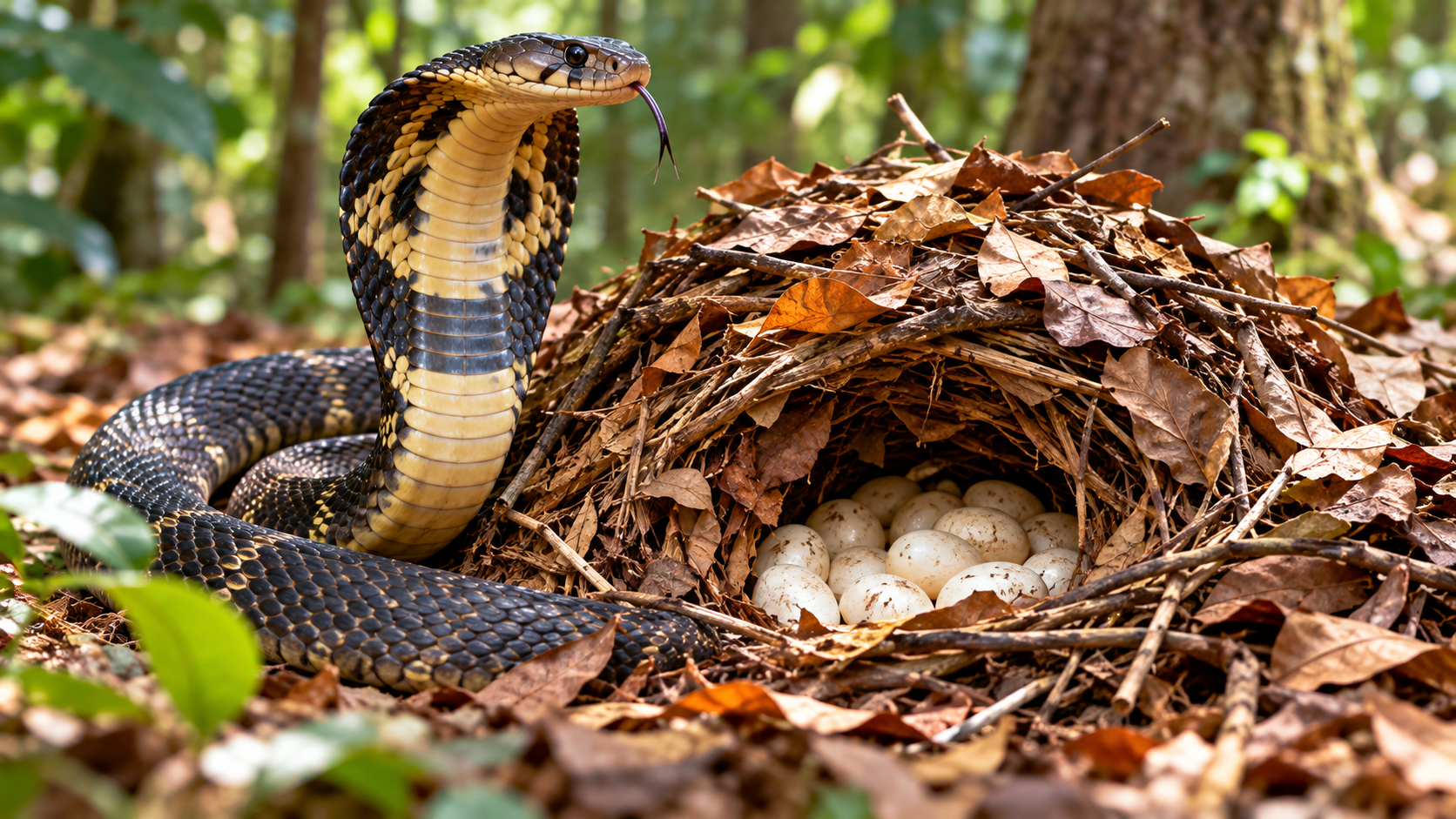
Snakes are often associated with holes, burrows and anthills, which they commonly use as shelters. Unlike many birds and animals, snakes generally do not construct their own homes. They typically occupy burrows abandoned by other animals, natural gaps in the ground or anthills. Female snakes may also choose protected areas such as piles of leaves, tree hollows or spaces beneath trees when they are ready to lay eggs.
However, the King Cobra follows a remarkable nesting behaviour that sets it apart from other snakes. Instead of using an existing burrow or hiding place, the female King Cobra builds a nest specifically for her eggs.
How the King Cobra Builds Its Nest
During the breeding season, the female King Cobra gathers dry leaves and small branches using her body and tail. She gradually pushes the material together to create a large mound.
A chamber is then formed inside the centre of the mound, where the snake lays her eggs. The structure provides a protected environment for the eggs and helps keep them at a suitable temperature.
The decomposing leaves inside the nest also produce heat, which helps create warmer conditions for the developing eggs.
Nest Temperature Helps Protect the Eggs
Researchers who studied 25 King Cobra nests in India’s Western Himalayas found that the temperature inside the nests was around 3 degrees Celsius higher than the surrounding environment.
The female King Cobra typically lays between 21 and 40 eggs inside the protected chamber. Unlike most snakes, she remains near the nest and guards it until the eggs hatch.
This nesting behaviour makes the King Cobra particularly unusual among snakes, as the female not only constructs a dedicated nest but also stays nearby to protect her eggs during the incubation period.
Disclaimer: This article is intended for general informational and educational purposes. The information presented here is based on the details provided in the source material and should not be considered professional wildlife, scientific or veterinary advice.