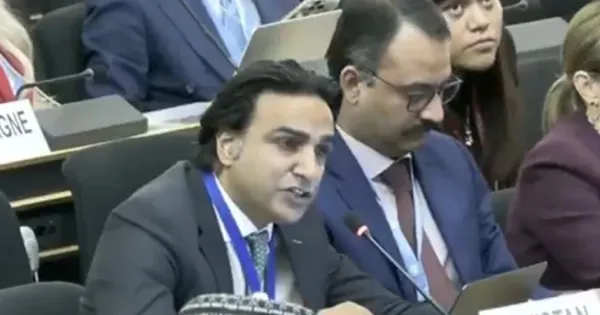
Vienna (Austria)/Geneva (Switzerland). Pakistan once again tried to encircle India by using the Indus Water Treaty as a pawn. Deputy Prime Minister and Foreign Minister Mohammad Ishaq Dar even warned India of serious consequences at the International Water Symposium in Vienna. Adil Mumtaz Khokhar, Secretary (First) in Geneva, has expressed concern over the use of water to exert political pressure at the United Nations. He has said that India’s action regarding the Indus Water Treaty is like turning water into a weapon. He warned that shared water resources should not be used for coercion, political gain or war.
According to The News report, Ishaq Dar said on Tuesday at the International Water Symposium organized under the aegis of the Diplomatic Academy of Vienna that any attempt to deny share of Indus waters could have serious consequences on regional peace and security. Dar said Islamabad knows how to protect its rights.
It is noteworthy that in April last year, India had postponed this water agreement. India took this step after the terrorist attack on tourists in Kashmir. After this, there was a military conflict between the two countries in May 2025. Dar stressed that no one should have any misunderstanding about Pakistan’s determination to protect its rights and interests under the Indus Waters Treaty and international law. He said, “The water of Indus River is the source of life and livelihood for more than 25 crore people of the country.”
Pakistan’s Secretary (First) Khokhar presented Pakistan’s side in the 63rd session of the United Nations Human Rights Council. The Council was considering a resolution on the human right to safe drinking water and sanitation. This proposal was presented by Germany and Spain. This proposal was adopted without voting. “Where water is shared, responsibilities are also shared,” Khokhar said. He said cooperation on shared water resources between neighboring countries is not a matter of favor or concession, but a shared responsibility.
“No upstream country can use water as a means of exerting political pressure or influence,” Khokhar said. He stressed that water management should be based on the principles of cooperation and mutual responsibility, and not as a means of political pressure. Khokhar described India’s unilateral action regarding the Indus Water Treaty as “weaponizing water” and said water should never become a means of coercion, political gain or war.