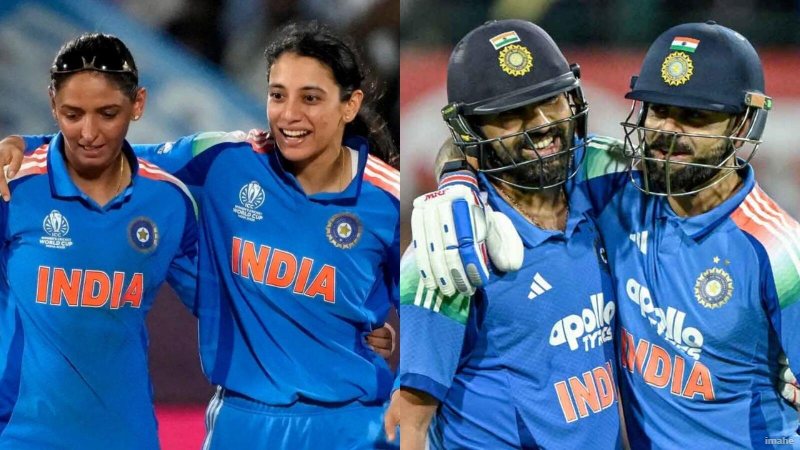
The Board of Control for Cricket in India (BCCI) and the team management are currently facing a complex and serious crisis, which has given sleepless nights to the selectors. Just as in men's cricket, there has been a constant debate over the future of senior stalwarts Rohit Sharma and Virat Kohli, their retirement or selection from T-20 and ODI formats, the same confusion and strategic dilemma is now being seen in the women's cricket team as well. Intensive discussions have begun within the team management regarding the future of two of the strongest pillars and veteran players of the Indian women's cricket team – captain Harmanpreet Kaur and vice-captain and star opener Smriti Mandhana and their playing in the longer formats. The most interesting and surprising thing is that exactly four years ago, a similar incident had happened with the men's team, when the team had no concrete option for the transition period and the entire strategy was revolving around the senior players. Today, when the blueprint is being prepared for the Women's World Cup and the upcoming international series, the biggest question before the selectors has become whether the team can afford to move ahead without these two legendary players or whether four years old mistakes are being repeated once again. Let us know in detail in this special report what is the real reason for this new headache that has arisen in women's cricket and what far-reaching effects it is going to have on the Indian sports world.
Why did Rohit-Virat like transition crisis arise in women's cricket also?
There comes a period in the history of any sports team when it has to move ahead of its long-serving veteran players and give opportunity to the youth of the new generation. In men's cricket, Rohit Sharma and Virat Kohli have won countless matches for the country, but after putting an end to their T20 careers due to age and workload management, discussions are now common about their replacement in ODI and Test formats. Similarly, Harmanpreet Kaur and Smriti Mandhana have been the pillars of batting and captaincy in the Indian women's cricket team for more than a decade. But for some time now, questions have started being raised about his consistently poor performance and strike rate in the knockout matches of big tournaments. The biggest dilemma facing the selectors is that if they drop these two experienced players from the team, then there is no experienced face in the bench strength who can replace them immediately. This is the reason why the women's management and BCCI officials are stuck in the same dilemma with which the men's team management was struggling four years ago.
Those bitter memories of four years ago and how is history repeating itself?
If we look back exactly four years from now, there was a similar turmoil in the Indian men's cricket team. The selectors then had no clear roadmap on how to gradually bid farewell to the senior players and prepare the young players for the big stage. The result was that sudden decisions without any clear policy affected the atmosphere in the dressing room and the team had to suffer the consequences in ICC tournaments. Now the exact same history is being repeated in women's cricket. Amidst the questions being raised about the captaincy of Harmanpreet Kaur and her form, the selection committee is not able to decide whether this is the right time to hand over the reins of the team to a young player or not. Smriti Mandhana's class is firm in its place, but as per the demands of modern cricket, unless other young batsmen stand with her, the middle order of the team will look weak. Not learning from the mistakes made four years ago has become the biggest reason for this new headache today.
The biggest strategic challenges facing the team management and selectors
At present, the phase the Indian women's cricket team is going through, every decision needs to be taken in a very measured manner. The head coach and selectors have to understand that if they rely too much on Harmanpreet and Smriti, the upcoming young players will never get enough opportunities to prove themselves. On the other hand, taking the field without these two stalwarts could prove to be a big risk as there is no substitute for experience in moments of pressure at the international level. There is also a discussion going on within the team management on whether some new faces should be tried directly in the main team on the basis of their performance in domestic cricket and Women's Premier League (WPL). But due to fear of inexperience, selectors repeatedly return to old and trusted faces, due to which this maze is becoming more complex.
What is the right path and solution for the future of Indian cricket?
An end to this problem of Rohit and Virat is possible only when the BCCI and the Women's Selection Committee prepare a long-term and transparent 'Transition Plan'. Open communication should be established with the players so that it is clear where the future of the team is headed. If Harmanpreet Kaur and Smriti Mandhana are still to remain an important part of the team, then along with them, young players should also be given consistent opportunities under the rotation policy so that the bench strength can be strengthened. The eyes of cricket fans and sports lovers are now completely focused on the upcoming selection meetings to see whether the management is able to take any bold steps this time or whether the same old trend continues. The big tournaments to be held in the coming months will decide how successful Indian women's cricket is in overcoming this headache.