Outside, 43-year-old Ho Thang Chi sets up tables and chairs in the alley, lays out dipping sauces and wipes the tables clean.
“Chi doesn’t talk much and works a little slowly, but he is eager to help,” Ling says. “Whatever we teach him, he tries to do.”
Ling and Ngoc Lien, both ethnic Chinese with roots in Guangdong, began working at Chi’s family noodle stall in 1977. Neither married or had children, and both now live with relatives elsewhere in the city.
The stall was started by Chi’s grandfather and later taken over by his parents, Ho To Ha and Tuyen. At its busiest, the family sold more than 150 bowls of noodle soup a night.
Ling and Lien remember their employers as kind people who often helped their families when they were in need.
Chi, the youngest of three children, has had an intellectual disability since childhood.
|
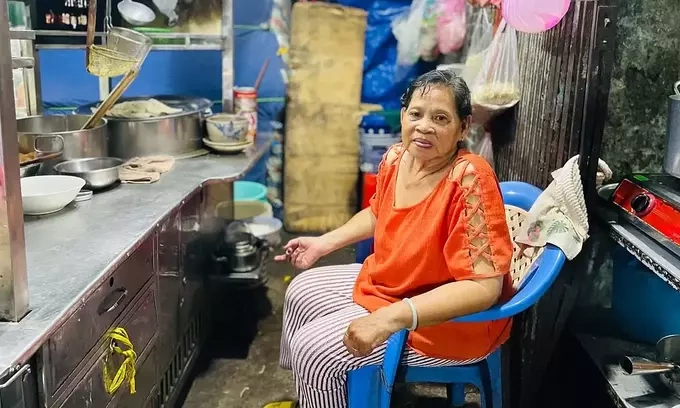
Phung Ling beside the family noodle cart near Xa Tay Market, Cho Lon Ward, Ho Chi Minh City, on the evening of Sept. 8, 2026. Photo by Ngoc Ngan |
His father died in 1998, and his two older siblings died in road accidents. His mother kept the cart running with Ling and Lien until she died of heart disease in 2021.
At that point, Chi could cook a few simple dishes and care for himself, but he did not know how to buy ingredients or prepare the stall for business. After his mother’s funeral, he lived alone in a 26-square-meter loft above the shuttered stall. He walked around the market, bought small items or watched traffic before going home.
Ling was cycling past the market one afternoon when she saw Chi selling lottery tickets, and how Chi stood bewildered as all of his tickets were snatched away.
Witnessing the incident spurred her to action.
“His parents and siblings are all gone. If I left too, who would he have to turn to?” she asks.
She asked Lien to join her. They pooled their money with part of the inheritance Chi’s parents had left him and put the family’s cart, tables, and equipment back to work.
At first, Chi carried tables and cleaned up.
The women then taught him to tie rubber bands around bags of takeout noodles. He worked slowly and tied them too loosely, so Ling sat beside him and guided his hands until he could do it himself.
They added one task a day: breaking up ice, refilling tea, preparing bags and serving customers.
If Chi forgot something, they taught him from scratch again the next day. Each new task he mastered gave Ling a little more peace of mind.
 |
|
Ho Thang Chi works at his family’s noodle cart in Ho Chi Minh City’s Cho Lon Ward on Sept. 8. Photo by Ngoc Ngan |
Xa Tay Market is quieter now, and the stall sells 40 to 50 bowls a night. Sales cover ingredients and Chi’s living expenses. The three split any remaining profit equally; on slow nights, there may be nothing to divide. Chi still has some of his parents’ money, but uneven earnings leave little to add to his savings.
Ling and Lien do not know how much longer they can work. They are teaching him every part of the business, from preparing ingredients to serving customers so that he can eventually support himself. Hours on her feet leave the aging Ling with back pain.
One night in June, a sharp pain made her buckle, and she had to brace both hands on a table to stand, she says. “Sometimes I think about quitting, but whenever I think about Chi being all alone, I ride my bicycle back to the stall the next day.”
Tran Le Tran, 71, a neighbor of Chi’s family for more than 50 years, says the women have helped him manage daily life.
Chi does not know how to use banking services, and so when customers pay by transfer, she often receives the payment and hands Chi the equivalent cash.
“For now, with the two women beside him, Chi still has someone to guide him,” she says. “I worry about what will happen when they can no longer work and he is alone.”