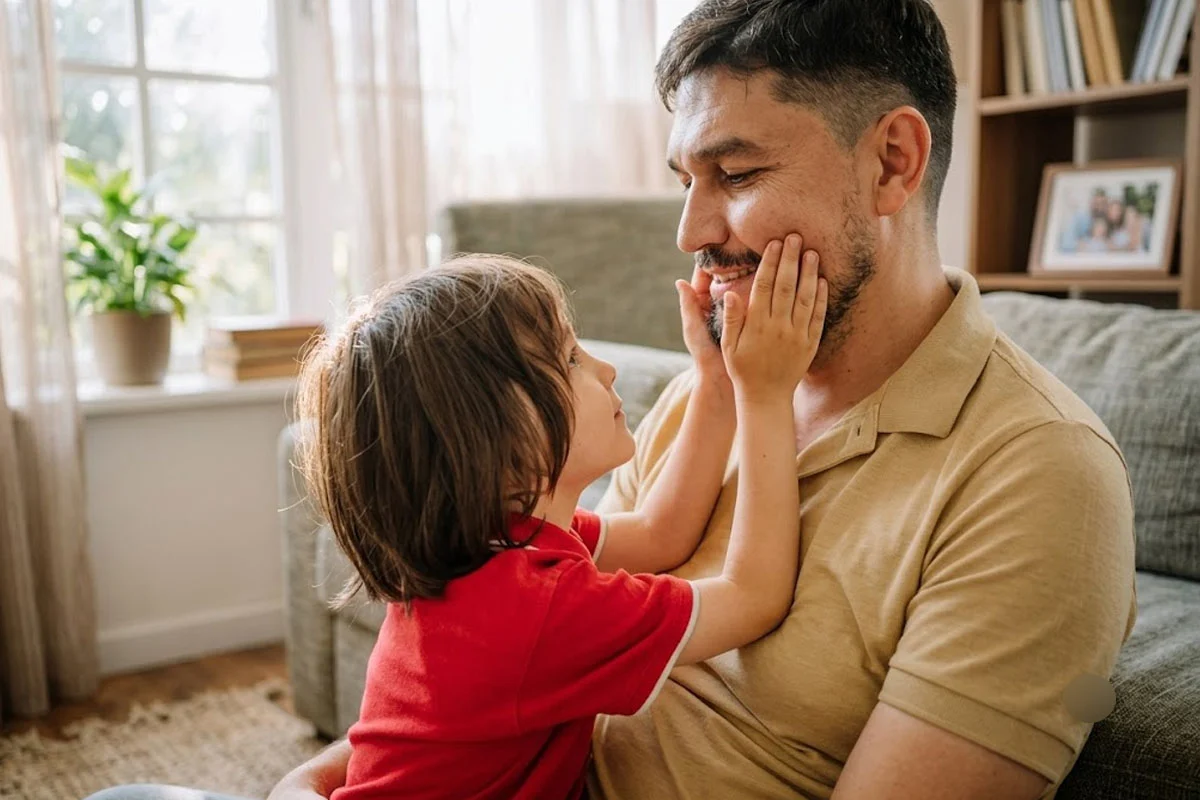
Do you have a hand on your forehead and cheeks while talking about what happened all day at play-school? This image is not exactly new to new parents. Children often put their hands over their parents' mouths while talking. Sometimes he touches his eyebrows, sometimes he holds his chin, and sometimes he continues his story by gently tapping his nose. The guardian removed the hand, but after a while the little hand returned to the face.
Many parents dismiss this habit as mere mischief or restlessness. But really so (Parenting Tips)?
Touch while talking Why does the tendency come?
For babies, leaning on parents, holding hands, playing with hair or putting it in their mouths becomes part of the conversation. Children, especially, want that person's undivided attention when talking to someone.
Parents' faces Why do you want to touch?
A parent's face is very important to a child. His initial introduction to the society was held by his parents. Ekratti wants to understand whether mother is laughing or not, father is upset or not, whether parents are amused by hearing his story or not.
It is normal for parents to be busy with their own work. At the end of the day, you may feel tired. But when the child talks to the parents, he wants to occupy all the attention. Maybe saying 'look at me' in plain language doesn't work for him. But repeated touching by parents is equivalent to saying so.
A child's sense of security is also deeply intertwined with parents. As a result, what he cannot do in the outside world, he wants to do with the guardian. Outside, that awkward expression of him, when he comes to his parents, it is erased in an instant.
Parents often dislike such touchy talk. Many say that the child is doing this for 'attention seeking'. But psychologists say it is never appropriate to judge children's behavior by the standards of adults. This little touch is really an expression of the love of the child towards the parents.
The child must be taught the concept of personal boundaries. For example, refrain from touching the eyes or mouth, while talking, take care to control the tendency to touch the other person's face at least a little. But that said, don't nag him unnecessarily to change this habit.