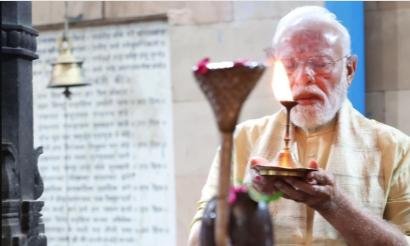
Prime Minister Narendra Modi violated a long-held tradition when he visited a highly revered temple dedicated to Hindu god Vinayak in the heart of the national capital, causing widespread dismay.
Modi’s faux pas may have been unintentional, perhaps a result of ignorance of some aspects of traditions involving temple worship originating in South India.
Nevertheless, it drew sharp reactions from devotees, including those who are otherwise fond of the prime minister.
Moolavar shouldn’t be photographed
It was on October 7 that Modi prayed at the Siddhi Buddhi Karpaga Vinayagar temple at Sarojini Nagar, one of the oldest South Indian shrines in Delhi whose origins date back to the 1950s.
The occasion was to mark a quarter century of his being a government head, starting from his innings in Gujarat.
One of the many photographs released on the occasion showed the moolavaror the main deity, in the Garbha Griha or sanctum sanctorum. The back of Modi’s head was also in the frame.
Also read: ‘We will do it’: Modi sets 3 targets for India as he completes 25 years in public service
Photography of the main deity in the sanctum sanctorum in South Indian temples is strictly prohibited to maintain spiritual sanctity.
The main reason is that the idol undergoes dedicated Vedic rituals to awaken a living divine presence. Traditions emphasize that the sacred energy must be experienced directly through darshan, and not captured on a camera.
On select occasions, some temples allow photography under certain conditions. But the moolavar is a strict no-no.
Devotees upset
Many South Indian temples have printed declarations on their premises prohibiting photography and the use of mobile phones. Some temples insist on a dress code for men and women. North Indian temples are not this strict.
Knowing his penchant for visiting temples, one can concede that it may not have been Modi’s intention to violate any tradition.
Also read: Why Modi’s 25 years in power mark the biggest consolidation of power in Independent India
Either the over-enthusiastic photographer did what he was not supposed to do or temple officials failed to warn the cameraman about rules governing the main deity.
But the damage was done.
“To take photo of (the) Moolavar deity is unacceptable,” was the instant reaction on X of a devotee well versed in south Indian temple religious etiquette. “Wishing NaMo a long innings.”
“How did they allow this?” asked a south Indian pundit rooted in Vedic traditions. “This is very wrong.”
A shrine for Tamils…and non-Tamils too
I know this Sarojini Nagar temple very well. I must have visited it hundreds of times.
It was in the 1950s when the Tamil community, after feeling the need for a space to perform daily prayers and rituals as it slowly swelled in the city, began tapping voluntary contributions.
Vinay Nagar, later renamed Sarojini Nagar, provided a perfect venue as most Tamils were employed in the central government and lived in and around the middle-class neighbourhood.
The temple was finally consecrated in August 1961. While the temple drew only South Indians initially, today it witnesses devotees from the North who either equal or even outnumber their South Indian counterparts.
Why get photographed while praying?
Besides what happened on October 7, I have often wondered why the prime minister insists on photography whenever he prays at temples.
I ask this as someone who strongly believes in temple worship. At one point, for almost two decades, I prayed at temples every single day.
Also read: Modi, Gen Z protests and INDIA bloc: ‘BJP’s moral halo is gone,’ says analyst
But a Hindu who visits temples daily is not greater than those who either do not pray at temples regularly or, perhaps, not at all. This is because the divine connection we forge with gods when we pray (at home or in temples) is something deeply personal. God doesn’t differentiate between the faithful who pray in their heart or at home or in temples or in pilgrimage spots.
So, this brings me back to the question: why does Modi get his temple visits photographed?
Is it simply for personal record? If yes, then why release the photos to the public?
If it is meant to show that the prime minister is a devout who visits temples, a simple news story would suffice, although I don’t see the logic for this.
The devout need no pleadings
There are some friends who argue that Modi does this to encourage people at large to go to temples too.
Again, I don’t see this as a sound reason. Those who desire to pray at temples will do so on their own. They need no pleadings.
I do believe that temple worship has certain positives. The more we go and the more we offer monetary and other donations, the better it is for the temple’s upkeep as well as the financial stability of the not-so-well-paid purohits.
Yes, some YouTubers specialise in telling the story of Hindu temples. They, of course, fall in a separate basket.
Also read: From seva to spectacle: How Modi’s birthday became a political project
When devotees start taking photographs inside temples (assuming they have permission), they can inadvertently slip up – as it happened with the prime minister on October 7.
Remember the old Hindi saying: Go to the temple whenever you are called. (You will go to a temple when divinity calls.)
It is as simple as that. Pray where you can. As long as your heart is in it, reading the Hanuman Chalisa on a bus or metro train is equally pious.
Temple worship is fine but please avoid photography inside the sacred premises.