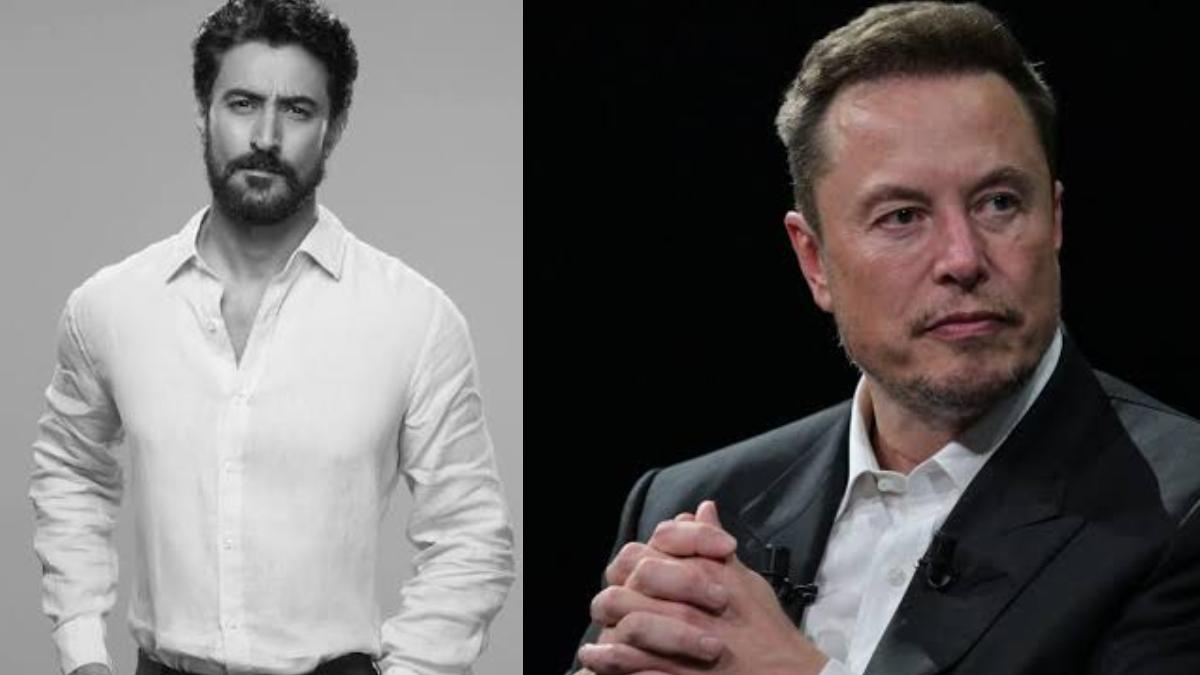
Actor Kunal Kapoor has taken a dig at Elon Musk amid the ongoing controversy over Starlink's proposed entry into India, accusing Western tech billionaires of displaying a “savior complex” when expanding their businesses into other countries. His remarks come after the SpaceX founder questioned whether Reliance Industries chairman Mukesh Ambani was influencing the delay in securing final approval for Starlink's commercial launch in India.
In a post on X, Kapoor criticized the way powerful technology entrepreneurs present themselves as bringing progress to a country but question its institutions when they face regulatory hurdles.
“Watching Elon Musk this week has been a fascinating character study in the savior complex of Western tech billionaires,” Kapoor wrote.
“They arrive in your country selling you the future. Welcome them, and you're a country that wants progress. Make them wait, and suddenly your people are victims who need rescuing from their own institutions by the chosen one,” he added.
Kapoor argued that this pattern was not unique to the current controversy, pointing to earlier incidents involving Musk in Thailand and Brazil.
Kunal Kapoor recalls Elon Musk's past controversies
Kapoor referred to the 2018 controversy surrounding the rescue of 12 boys and their football coach who were trapped in a cave in Thailand. Musk had proposed a mini-submarine to help rescue them, but British diver Vernon Unsworth, who was involved in the rescue effort, dismissed the idea as impractical.
Musk subsequently attacked Unsworth on social media, calling him a “pedo guy”. The billionaire later apologized for the remark.
Kapoor also cited Musk's confrontation with Brazilian Supreme Court Justice Alexandre de Moraes over court orders involving X, formerly Twitter. Musk publicly criticized the judge amid a dispute over the platform's compliance with Brazilian legal requirements.
Drawing a parallel between these incidents and the Starlink controversy, Kapoor wrote, “The script rarely changes. Only the country does.”
He argued that the issue went beyond an entrepreneur's desire to expand a business, describing what he sees as a mindset in which a wealthy outsider assumes that a country should welcome him as a saviour.
“The colonial mindset isn't always about wanting to rule a country. Sometimes it's the assumption that you arrive as its savior, and if the country doesn't immediately recognize you as one, something must be wrong with the country,” he added.
Why Elon Musk questioned Mukesh Ambani over Starlink
The controversy began when Musk criticized the delay in securing final approvals for Starlink, the satellite internet service operated by his aerospace company, SpaceX.
On Wednesday, Musk accused unnamed powerful business interests of maintaining a “monopolistic chokehold” on Indian consumers. He also described efforts to block Starlink's entry as “a crime against the people of India”.
A day later, he directly questioned the influence of Mukesh Ambani, whose Reliance conglomerate owns Jio, one of India's largest telecom operators.
“Starlink is licensed in over 165 countries and has spent five years complying with every single law and requirement of the government of India, so why still no license? Is Ambani the real boss of India?” Musk wrote on X.
Starlink has been seeking to enter the Indian market since 2021 and has secured key licenses. However, it still needs final security clearances and spectrum allocation before it can begin commercial operations.
Musk's remarks suggested that influential domestic business interests could be standing in the way of Starlink's entry. However, no publicly established evidence in the reported dispute has demonstrated that Ambani or Reliance caused the delay.
India rejects Musk's allegations
India's Ministry of Communications rejected the suggestion that the country's satellite communications regulatory framework was unfair or discriminatory.
The ministry said Starlink, Eutelsat OneWeb and Jio Satellite Communications were at broadly the same stage of the approval process, with all three awaiting security clearances and spectrum allocation before launching commercial services.
The controversy is unfolding even as SpaceX has partnerships with Reliance Jio and Bharti Airtel. In March 2025, both companies signed agreements with SpaceX to distribute Starlink equipment and services in India, subject to government approval.
The partnerships highlight the complex relationship between the companies, which could cooperate in distributing services while also competing in the expanding satellite internet market.
Starlink could potentially improve connectivity in remote parts of India where conventional broadband infrastructure is difficult or expensive to establish. However, questions remain over the service's eventual pricing and accessibility for Indian consumers.
Kamal Haasan and Kangana Ranaut weigh in
The controversy has also drawn reactions from actor-politician Kamal Haasan and actor and BJP MP Kangana Ranaut.
Haasan defended India's right to determine its own policies, arguing that wealthy business leaders should not dictate a sovereign nation's decisions.
“India is a democracy, not a colony. We welcome the world, but we, the Indian people, will decide our own future,” he wrote on X.
Kangana backed Haasan's response, praising his remarks for their sharpness and sarcasm.
“Ouch!! That must hurt,” she wrote, before adding, “No billionaire should dictate a nation's policy- Indian or American. Well said and well explained. Sharp, on point and sarcastic.”
ALSO READ: 'Prime Minister Ambani': Elon Musk launches scathing attack over Starlink's blocked entry in India
While Haasan and Kangana emphasized national sovereignty, Kapoor questioned the broader narrative through which powerful technology entrepreneurs present themselves as bringing progress to other countries.
His remarks add another dimension to the Starlink dispute, which has evolved from a disagreement over regulatory approvals into a wider debate about corporate influence, competition and the relationship between global technology companies and national institutions.