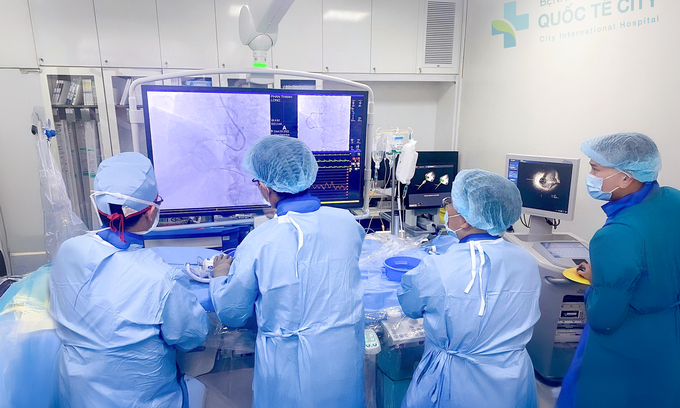
The VivoHeart IVUS system at City International Hospital’s Vascular Intervention Unit provides detailed images of coronary arteries, allowing doctors to assess vessel structure, plaque buildup and stent placement.
Used alongside digital subtraction angiography (DSA), IVUS offers additional information about abnormalities that may not be fully visible on conventional angiographic images.
|
City International Hospital has introduced IVUS technology to support cardiovascular and peripheral vascular interventions. Photo courtesy of the hospital |
IVUS provides detailed views of coronary artery lesions
According to the hospital, the VivoHeart system offers high-resolution images, rapid scanning, AI-assisted functions and synchronization with DSA images.
During an examination, a miniature ultrasound probe is inserted into a coronary artery to produce cross-sectional images of the vessel and its walls. Doctors can use these images to measure the vessel lumen and assess plaque buildup, calcification, blood clots and other abnormalities.
The technology can be particularly useful for complex lesions involving heavily calcified arteries, vessel bifurcations or the left main coronary artery.
Before stent placement, IVUS helps doctors assess vessel dimensions, lesion length and plaque characteristics to guide stent selection. After implantation, it can reveal whether the stent has expanded adequately and fits against the vessel wall, identifying issues that may require further intervention.
These details may not be apparent on conventional angiography alone, allowing doctors to make additional adjustments when needed.
Combining IVUS, FFR and IVL in coronary interventions
City International Hospital is also integrating IVUS with fractional flow reserve (FFR) and intravascular lithotripsy (IVL), three technologies that provide complementary information for treating coronary artery disease.
IVUS examines vessel structure and plaque characteristics, while FFR measures the physiological impact of a narrowing on blood flow. FFR can help determine whether an intermediate coronary stenosis warrants intervention.
IVL uses acoustic pressure waves to modify calcified plaque, helping prepare heavily calcified lesions for stent placement.
Together, these techniques can help doctors evaluate coronary lesions and tailor treatment to individual patients. Their use depends on the patient’s condition and the characteristics of the affected arteries.
The hospital said this approach reflects a broader shift in interventional cardiology toward assessing lesion anatomy and function, selecting appropriate devices and evaluating treatment results rather than focusing solely on reopening narrowed arteries.
Hospital strengthens cardiovascular services and training standards
City International Hospital said it is continuing to develop its cardiovascular services through specialist expertise, updated equipment and international quality standards.
Its Vascular Intervention Unit recently received I-CARE-HF Accreditation at the specialized center level from the Heart Failure Association (HFA) of the European Society of Cardiology (ESC), recognizing its heart failure care services against the program’s standards.
 |
|
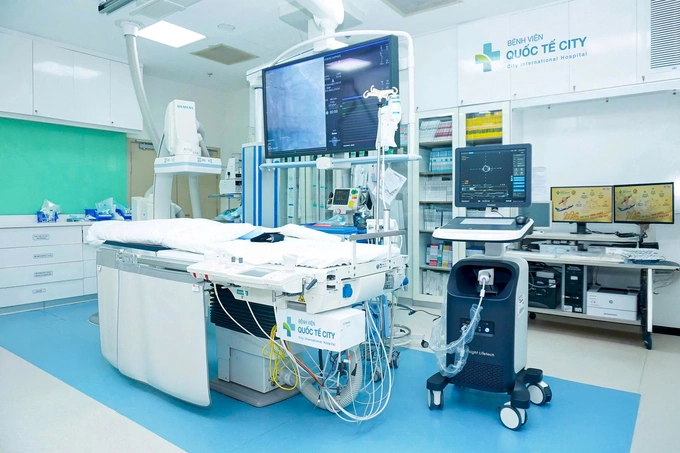
City International Hospital’s Vascular Intervention Unit has received I-CARE-HF Accreditation at the specialized center level. Photo courtesy of the hospital |
The hospital said the VivoHeart IVUS system adds anatomical information to angiography and other assessment methods, helping its cardiovascular team make more informed treatment decisions during complex coronary interventions.
City International Hospital
Hotline: 19008146
Address: No. 3, Street 17A, An Lac Ward, Ho Chi Minh City, Vietnam
License No.: 42/BYT-GPHD
Outpatient clinic hours: 7:30 a.m.-4:30 p.m. (Monday-Friday); 7:30 a.m.-11:30 a.m. (Saturday)
Scope of professional activities: Multispecialty Hospital