Department director Tran Quang Lam outlined the goal during the “Citizens Ask – Government Answers” program on Oct. 11.
He emphasized that resolving these hotspots remains a top municipal priority through 2030.
Priority will be given to completing ongoing and planned projects to ease congestion at key locations. These include the My Thuy and An Phu interchanges, National Highway 13, the Nguyen Khoai bridge-and-road project, and Binh Tien.
|
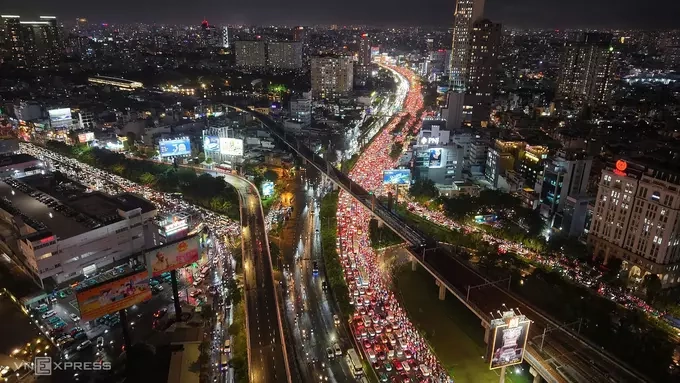
Traffic congestion on Dien Bien Phu Street near Hang Xanh intersection in Ho Chi Minh City during heavy rain on the night of Oct. 1, 2026. Photo by VnExpres/Thanh Tung |
Lam noted that addressing the 28 bottlenecks is just one component of a broader infrastructure strategy. The city also aims to complete its wider transport network, improve regional connectivity, and develop new economic corridors.
Surveys conducted prior to the city’s administrative merger with Binh Duong and Ba Ria-Vung Tau provinces last year identified several persistent bottlenecks.
These included the Hang Xanh intersection, Nguyen Tat Thanh Street, and the An Phu and My Thuy interchanges.
Similar congestion issues plague intersections and industrial parks in the former Binh Duong and Ba Ria-Vung Tau areas.
Beyond existing projects, authorities are studying plans to construct steel overpasses at various locations to further alleviate traffic.
Transport hub
Ho Chi Minh City serves as a major national and regional transportation hub, integrating aviation, maritime shipping, inland waterways, and railway networks.
The megacity currently handles approximately 37% of Vietnam’s air passenger traffic and 65% of its container cargo volume.
However, widespread infrastructure bottlenecks and poorly integrated transport networks remain significant challenges. Localized congestion continues to hamper residents’ daily lives, economic development, and the overall investment climate.
Following the recent administrative merger, the city identified three primary focus areas for transport development.
The immediate priority is eliminating existing bottlenecks.
The second goal is completing backbone infrastructure and strengthening regional connectivity via ring roads, expressways, and national highways.
The third priority involves expanding the metro network in alignment with the Transit-Oriented Development model.
The city expects to largely complete its backbone transport infrastructure by 2030.
 |
|
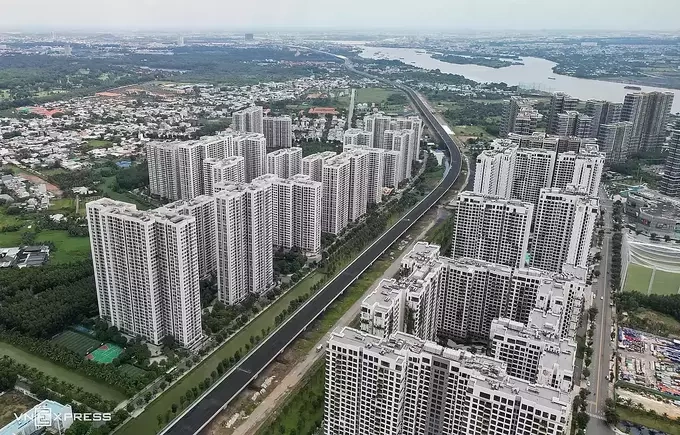
The elevated section of Ho Chi Minh City’s Ring Road 3 passes through Vinhomes Grand Park urban area, August 2026. The road is a key part of the city’s transport infrastructure. Photo by Read/Quynh Tran |
However, the department warned that these initiatives alone will not sustain a megacity of 14 million residents, which is projected to reach 25 million in the future. Officials have identified the expansion of the urban railway network as the fundamental long-term solution.
The metro network is expected to expand to 255 km by 2030, and to roughly 500 km over the subsequent decade. Under the revised master plan, the network will ultimately reach 1,500 km in total length.
“These are not merely targets the city has set; preparations have already been made to ensure that implementation is feasible,” Lam said.
He noted that metro projects now benefit from special administrative mechanisms that grant the city greater autonomy. New urban development policies are also helping authorities mobilize resources, diversify investments, and accelerate implementation.
Department of Finance deputy director Truong Tan Vu confirmed that transportation infrastructure remains a top investment priority. Projects are being categorized to ensure the efficient use of resources. Funding will focus on initiatives that address congestion, mitigate flooding, and boost economic development.
The city has allocated approximately VND500 trillion (US$19.29 billion) for investment programs during the 2026-2030 period.
This includes VND200 trillion earmarked for 98 transport projects, which covers the initiatives targeting the 28 congestion hotspots.
Another VND120 trillion is allocated for 37 regional connectivity projects.
An additional VND50 trillion is designated for 59 projects addressing severe flooding.
The city will also continue relocating homes situated along canals and waterways. These efforts will be combined with urban renovation and transport infrastructure improvements to enhance the overall living environment.