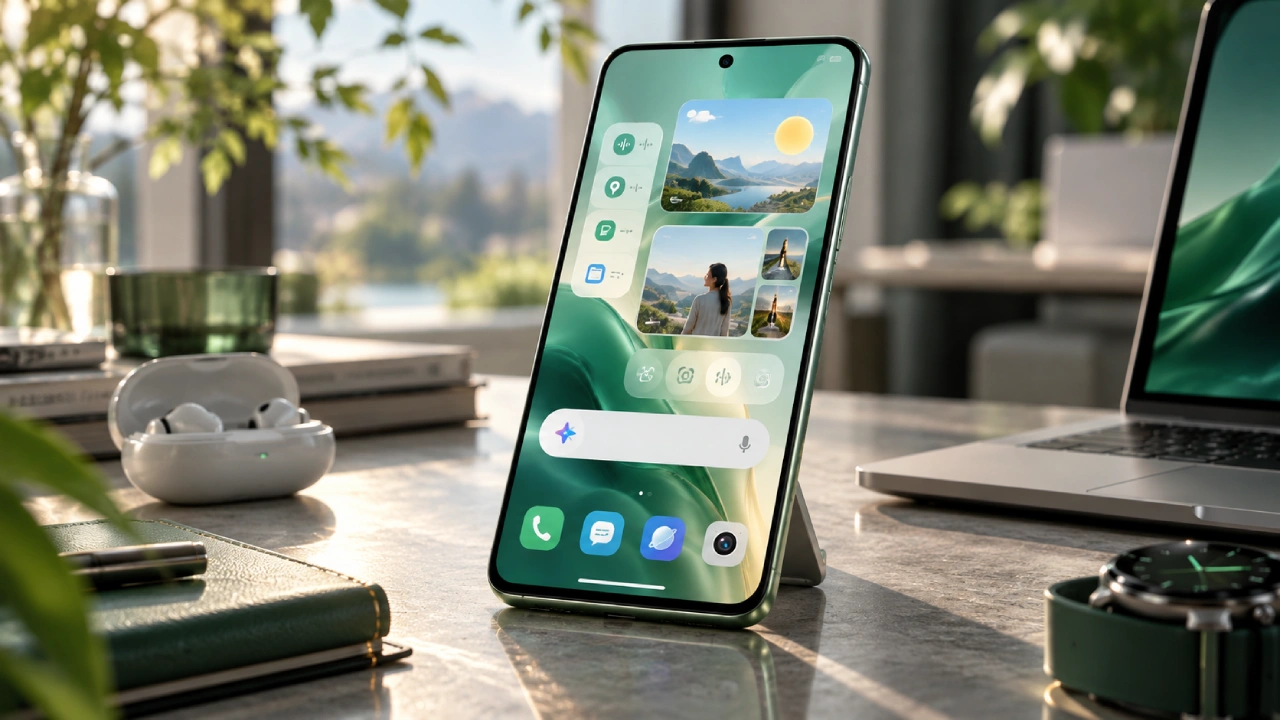
OPPO is expanding its software strategy with ColorOS 17, focusing on more natural interactions and AI assistance that can anticipate useful actions. The update combines interface changes with system-level optimisation, contextual services and connected-device features. OPPO’s published announcement also describes upgrades to privacy, accessibility and on-device AI. OPPO’s global ColorOS 17 launch event began on October 13, 2026, at 2:30 PM IST, with the official livestream available on YouTube.
The event details are also listed on OPPO’s official ColorOS 17 event page. OPPO had already detailed the software’s core capabilities in its China-market announcement, but the availability of individual features can differ across regional software versions. OPPO also hosted a Community watch-party thread for viewers following the launch.
Fluid Design and Tidal Engine Target Smoother Performance
As detailed in OPPO’s official ColorOS 17 announcement, Fluid Design is the main visual change in the new operating system. OPPO says the interface combines refined lighting effects, fluid animations, and flexible feedback to make interactions feel more connected across the system.
The approach extends beyond individual applications to navigation and transitions between different parts of the interface. Tidal Engine uses personalized perceptual and resource scheduling to improve application responsiveness and background task retention, according to OPPO.
These are manufacturer-described improvements rather than independent performance-test results. These are manufacturer-described improvements rather than independent performance-test results. The new interface builds on changes explored in News’s earlier ColorOS 17 animation coverage, but the broader software announcement places those visual changes alongside AI and system optimisation.
AI Features Focus on Contextual Assistance
ColorOS 17 expands OPPO’s Xiao Bu assistant with tools designed to turn useful information into reminders and tasks. In its China-market announcement, OPPO describes the assistant identifying information such as pickup codes, contacts and upcoming events, then converting relevant details into personalised to-do items. Most of the detailed AI capabilities below were announced for the China build of ColorOS 17.
OPPO says software features can vary by region and software version, so they should not yet be treated as confirmed India features unless included in the global build. The update also introduces AI-assisted photo editing using OPPO’s Da Vinci visual-understanding model. AI Notes is designed to organise information into a personal knowledge-management space, including the ability to export information summaries visually.
OPPO also highlights connected-device functions, including continuing navigation after leaving a car through its Car+ system and real-time interpretation through compatible earbuds. However, these integrations may rely on regional services, supported devices, and local partnerships, so their availability should not be assumed across every international version.
On-Device AI, Privacy and Accessibility
OPPO says its On-Device Compute model uses a new Linear Attention architecture that natively supports 128K context, with claimed 48% lower memory use and 55% lower energy consumption than the previous-generation on-device AI architecture.
These figures are OPPO’s own comparisons, not independently verified results. The software also introduces a Care Mode intended to simplify the experience for older users while enabling additional protection settings. OPPO highlights AI-assisted fraud warnings, safeguards against suspicious applications and sensitive permissions, and an accessibility screen reader that can read and speak on-screen content.
These features reflect OPPO’s effort to bring AI into everyday system functions rather than limiting it to a standalone chatbot. Their practical availability will depend on regional software builds and supported hardware.
ColorOS 17 Rollout: What Indian Users Should Know
ColorOS 17’s stable rollout has already begun for selected devices in China. The missing piece is a separate India/global stable-update schedule for existing phones. The global unveiling does not automatically mean that every eligible OPPO phone in India can download the stable update immediately.
OPPO’s China announcement names the Find X10 series and OnePlus 16 as launch devices for ColorOS 17, while OPPO has separately confirmed that the global Find X10 series will ship with ColorOS 17. That does not establish an India rollout date for existing devices.
The date of a global presentation, a beta programme and the release of a stable over-the-air update are different milestones. ColorOS 17 beta testing is already underway on selected devices in India, but OPPO has not yet published a confirmed device-by-device India stable-rollout calendar.
Readers can revisit News’s earlier ColorOS 17 and OxygenOS 17 preview for background on the software transition, but should rely on official regional announcements for their phone’s final eligibility and update date.
Conclusion
ColorOS 17 combines Fluid Design, adaptive resource management and contextual AI features with accessibility and privacy improvements. Its direction is to make smartphone software feel more responsive while helping users organise information and complete everyday tasks.
For existing Indian users, however, the key practical detail remains the stable rollout schedule for their specific devices. The global unveiling should not be mistaken for an immediate update guarantee.