
After years of working directly under her strict Korean boss in Hai Phong, Pham Anh Tho trusted her so deeply that when the woman’s son proposed after just three months of dating, she agreed to marry him.
Tho, a graduate of Vietnam Maritime University, joined a technology equipment installation company in Hai Phong in 2021 as a safety officer and interpreter. There, she worked directly under Park Soo-jeong, 58, the Korean woman who ran the business.
“At work, I was terrified of her because she was strict and disciplined, but outside the office, she was very warm and friendly,” Tho recalls.
Tho lived in Le Chan District, near the company dormitory. When Park noticed that she often worked late and missed the bus home, she would give her a ride in the company car. Knowing Tho loved kimchi, Park frequently invited her over whenever she cooked Korean food. She also took the young employee grocery shopping, to concerts and on food tours around Hai Phong.
“I was fond of her, but I never imagined she would one day become my daughter-in-law,” says Park, a Seoul native.
|
(From left to right) Tho, her mother, husband, and mother-in-law on her wedding day in 2021. Photo courtesy of Tho |
In March 2021, Park’s son Gil-sun moved to Vietnam to help with the family business. The 1.85-meter-tall Korean man soon noticed Tho, who stood just 1.5 meters tall. “My mother and sister are both tall, so I have always liked petite, cute women,” the now 34-year-old says.
Tho also noticed him, not least because he was the youngest and tallest among the Korean staff. Gil-sun began buying her snacks and inviting her to dinner, joking that he needed her to act as his tour guide in Hai Phong. Their friendship quickly developed into a romance.
Park was pleased when she realized her son was interested in Tho, though she also worried about the challenges of a cross-cultural relationship. “You must be serious about her because she is a good girl,” she told him, warning him to be thoughtful and avoid misunderstandings arising from cultural differences.
Around two months later, Gil-sun had to return to South Korea. With the Covid-19 pandemic making it unclear when he could come back to Vietnam, he asked his mother to formally approach Tho’s family on his behalf and ask for her hand in marriage as proof of his commitment.
Tho initially hesitated. But her years of working with Park had given her confidence in the family. She believed that a disciplined woman like Park would have raised her son to be responsible and respectable.
Tho’s parents in Hai Phong were also skeptical at first. But after meeting Gil-sun and seeing his modesty and sincerity, they gave the couple their blessing.
Their wedding was held simply during the pandemic. Park personally carried a ceremonial tray to Tho’s home as part of the traditional marriage proposal.
 |
|
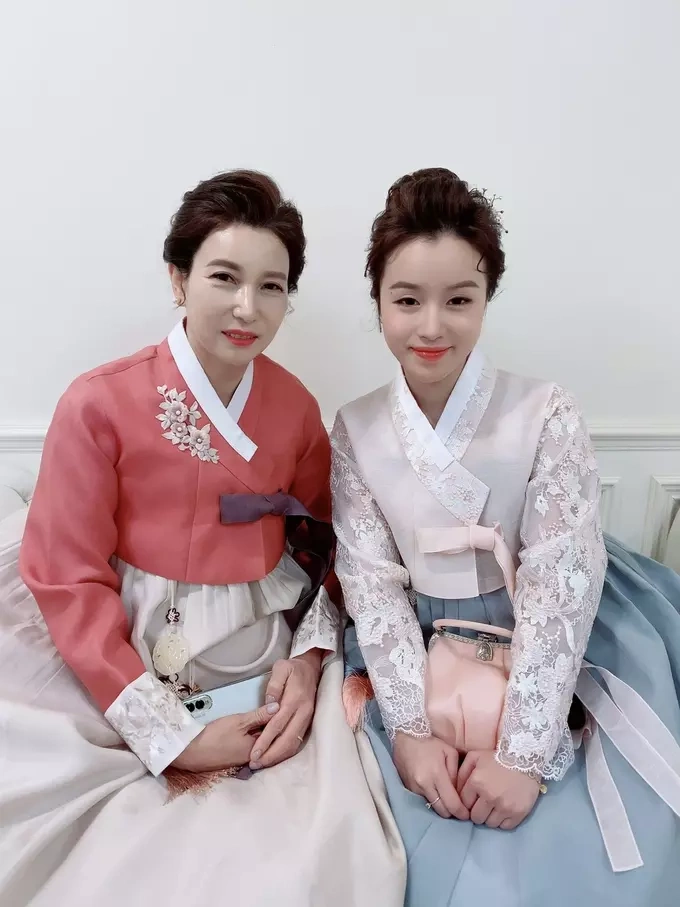
Tho and her Korean mother-in-law pose for a photo in traditional Korean attire. Photo courtesy of Tho |
After the wedding, Tho moved to Seoul to live with her husband’s family. There, however, she encountered a way of life very different from the one she had grown up with.
Gil-sun’s paternal family came from an old aristocratic lineage and placed strong emphasis on tradition and etiquette.
Park herself had lived under similarly strict expectations when she was a young daughter-in-law. While her own mother-in-law was alive, she was expected to prepare three meals a day, make late-night snacks and keep the house immaculate regardless of how busy she was.
Those habits stayed with her. She expected Tho to wake up early, prepare breakfast and other meals, maintain a tidy home and observe proper forms of respect when speaking to her and her husband.
 |
|
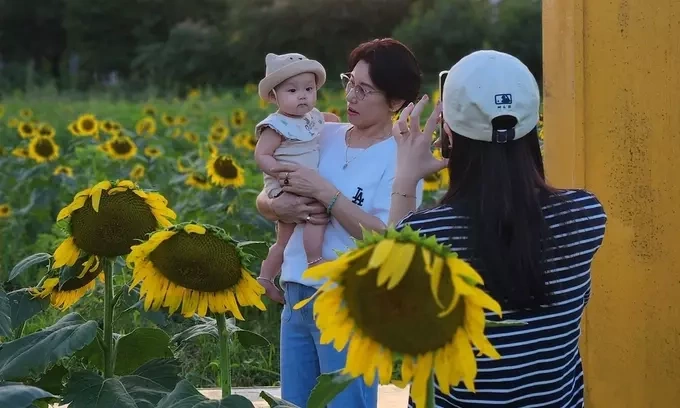
Park, her grandchild and daughter-in-law go sightseeing and take photos at a sunflower hill. Photo courtesy of Tho |
Tho, by contrast, had been pampered by her parents and grew up in a relatively carefree household. She enjoyed going out for coffee, walking around town and eating out with her husband.
Adjusting to the rigid household routine in Seoul proved difficult. Small conflicts gradually emerged over meals, everyday habits and later parenting. When disagreements arose, Tho often asked her husband to explain her perspective to his mother, but Gil-sun’s clumsy attempts at mediation sometimes made matters worse. “In the beginning, I felt trapped because I was not used to that kind of lifestyle,” Tho says.
Her sister-in-law eventually became an important ally. As a daughter-in-law herself, she helped Park understand how difficult the transition was for Tho.
Over time, Park began to relax her expectations. “I realized it was not that Tho was unwilling to be a good daughter-in-law. I was simply being too strict,” she says. “Because I had spent so many years living that way myself, I assumed everyone should do the same.”
Tho also made an effort to bridge the gap. Instead of avoiding difficult conversations, she began speaking openly with Park. Knowing her mother-in-law enjoyed Vietnamese food, particularly bun dau mam tom—rice vermicelli served with fried tofu and shrimp paste—and northern Vietnamese dishes, she cooked them for her.
She also discovered that Park loved beauty treatments, so she took her to skincare clinics and gave her cosmetics as gifts. “After that, whenever I was not completely thorough with something, she became more willing to overlook it,” Tho says.
Tho gradually came to realize that the same thing she had observed when Park was her boss remained true at home: beneath her stern exterior was a deeply caring woman.
When Tho and her husband argue, Park does not automatically defend her son. Instead, she listens to both sides and often reminds Gil-sun to be more accommodating because his wife left her homeland to build a life with his family in South Korea.
One moment remains especially vivid in Tho’s memory. After giving birth, she suffered from a clogged milk duct and had difficulty producing breast milk. When Park heard about it, she immediately called to reassure her. “Your health is what matters most. Do not listen to anyone else. If you are tired, just give the baby formula,” she told her.
Park then personally chose what she believed was the best formula for her grandchild. She has also broken with some traditional expectations placed on Korean daughters-in-law.
In many families, daughters-in-law are expected to shoulder much of the cooking and housework during major holidays. But every year, Park buys plane tickets for Tho, her husband and their child to return to Vietnam for Tet. “Your parents must miss you and their grandchild very much since their daughter married and moved so far away,” Park tells her.
Five years after first becoming colleagues, the two women have developed a relationship far removed from the tense boss-employee dynamic Tho once knew. “Every now and then, the two of us go shopping and eat out together, just like we did when we were boss and employee in Vietnam,” Tho says.