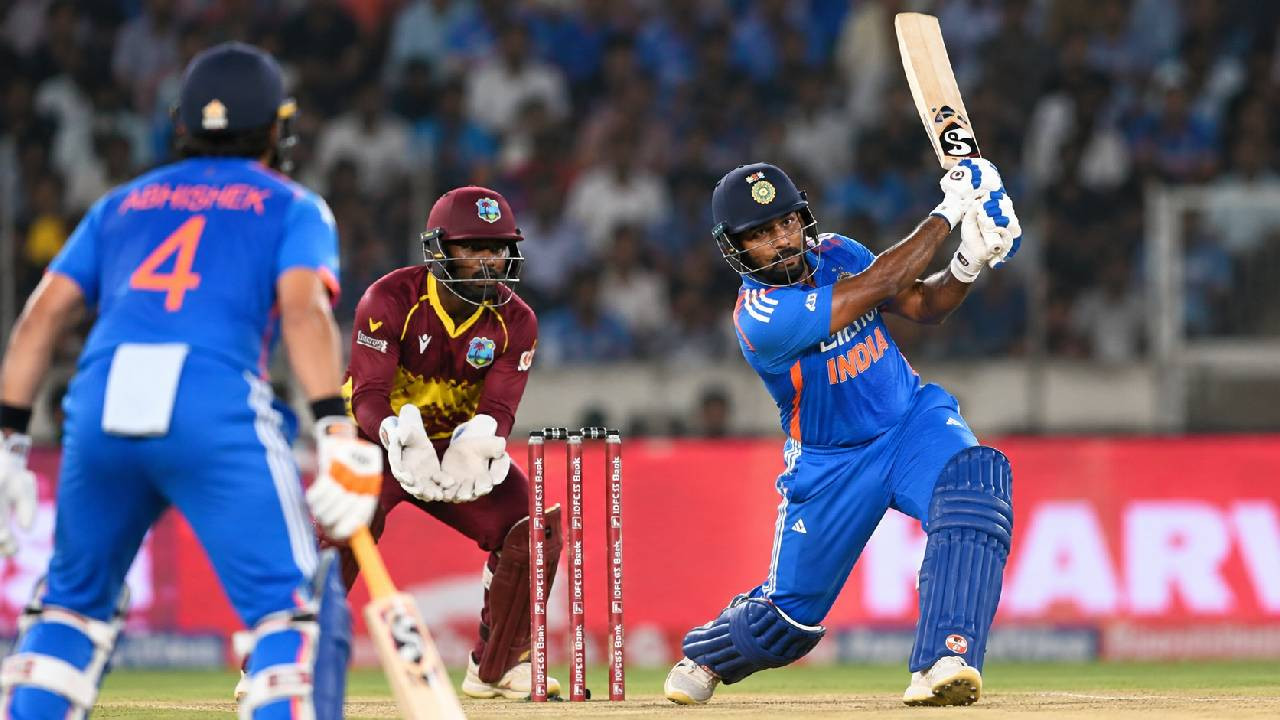
Facing the huge target of 247 runs, the Indian team needed a fast start and Sanju Samson started showing aggressive style as soon as he entered the field. In the match played at Rajiv Gandhi International Stadium in Hyderabad, Sanju continuously attacked the West Indies bowlers. The effect of his batting was quickly visible on the scoreboard and India crossed the 50-run mark in just 18 balls i.e. three overs. During this time, the role of Abhishek Sharma present at the other end was completely different. When the team's score reached 50 runs, Sanju was playing with 47 runs on 18 balls, while Abhishek had only one run in his account. Extra runs also helped the team. Sanju's bright start raised hopes in the match for the Indian team chasing a big target.
Sanju's storm on one side, Abhishek's slow start on the other side
There was a big difference in the performance of both the opening batsmen in the initial overs of the Indian innings. Sanju Samson did not give the bowlers a chance to recover and hit shots in different parts of the field. On the other hand, Abhishek Sharma could not add much runs in the beginning. After three overs, Sanju was on 47 runs and Abhishek was unbeaten after scoring only one run. Reaching 50 runs in such a short time was a great start for India, but to achieve the target of 248 runs, the rest of the batsmen also needed to score runs continuously.
West Indies posed a big challenge to India by scoring 247 runs.
Batting first, West Indies scored 247 runs for four wickets in the stipulated innings. After such a big score, the Indian batsmen were under pressure to maintain the run rate. In T20 cricket, the pace of initial overs can play an important role in chasing the target. Keeping this need in mind, Sanju batted aggressively from the beginning. His innings put pressure on the opposition bowlers and gave a strong start to the Indian camp. However, when faced with a big goal, a quick start is not enough; Partnerships and the strategy of saving wickets are equally important.
Sanju Samson returned after scoring 56 runs in 23 balls.
Sanju Samson continued his innings and scored 56 runs on 23 balls. During this, six fours and four sixes came from his bat. His strike rate was 243.48, which shows his aggressive batting. Sanju gave the much needed momentum to the Indian innings by adding quick runs in fewer balls. However, he could not convert his starts into longer innings. West Indies bowler Keemo Paul dismissed him. His dismissal certainly came as a shock to India, but Sanju's innings played an important role in putting the team in a good position to chase the target.
Will India be able to achieve such a big target?
After Sanju's explosive innings, the Indian team's eyes were fixed on the rest of the batsmen. To reach the target of 247 runs, the team had to maintain the run pace and also save wickets. The responsibility of handling the innings was on Abhishek Sharma and the middle order batsmen. Sanju's start made the match exciting, but further batting was going to be decisive to decide the result.