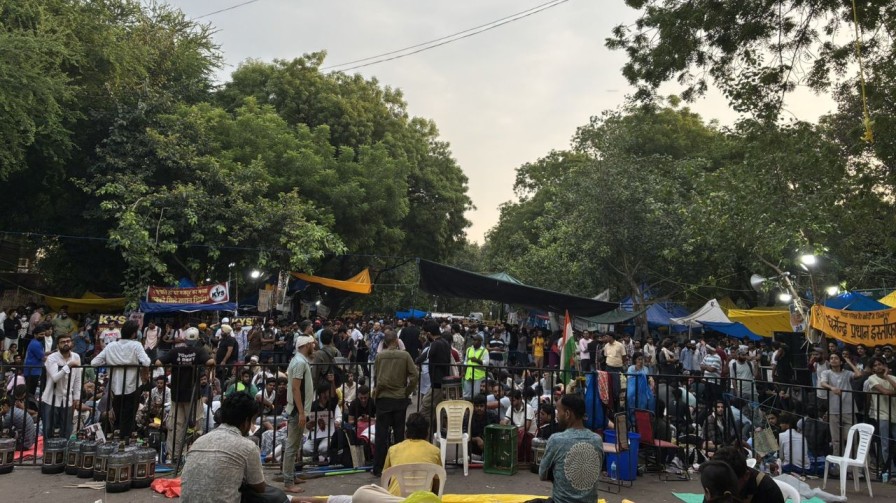
In a democracy, protests are an important way of conveying the voice of the people to the government. Regarding these protests, socialist thinker and freedom fighter Dr. Ram Manohar Lohia had said that when the roads become deserted, the Parliament becomes a vagabond. In Indian democracy, demonstrations have been taking place near the Parliament for the last several decades and the voices of the protesters have been reaching the corridors of the Parliament. Earlier the demonstrations used to take place in the Boat Club area, located just a few meters away from Parliament. In the 90s, this place was changed to Jantar Mantar, but now Jantar Mantar has also been out of the list of protest sites.
Once upon a time, big movements used to take place at the Boat Club near India Gate, then Jantar Mantar became the main place of protest and now Delhi Police has removed Jantar Mantar from the list of designated protest sites. On 12 October 2026, the police decided Ramlila Maidan, Burari Maidan and East Delhi's CBD Ground as alternative protest sites. This raises the question whether the space for protest in Delhi is gradually moving away from Parliament and the centers of power?
Also read: Livestock scam: Yogesh Kumar arrested, will the punishment fall on Rajkishore Singh?
The story started from boat club
The Boat Club area in Delhi was the center of major mass movements for a long time. This place is near India Gate and very close to Parliament and many offices of the Central Government. Demonstration here meant that the voice of the movement reached directly to the corridors of power and many times public representatives from the Parliament used to come to hold talks in the protests taking place in this area. In October 1988, a huge movement of farmers under the leadership of farmer leader Mahendra Singh Tikait also took place in this area. Thousands of farmers gathered in the lawn of the Boat Club with their demands and remained there for several days. This movement attracted the attention of the then Rajiv Gandhi government.
However, the large demonstrations also raised concerns over traffic, security and law and order. During the Ram Janmabhoomi-Babri Masjid movement, around February 1993, the then central government imposed restrictions on the Boat Club to control large demonstrations and gatherings. The tense atmosphere created in the country after the demolition of Babri Masjid also increased security concerns and the police did not allow the protesters to gather in the Boat Club area. Following these restrictions, Jantar Mantar emerged as a major alternative site for protests in Delhi. In this way, the Boat Club, which was once a big platform for raising the voice of the people close to power, gradually became a restricted area for big protests.
Many demonstrations took place at Jantar Mantar
After restrictions on the Boat Club, Jantar Mantar emerged as a major place for protesters. It was not very far from Parliament, but it was relatively easy to control the crowd and manage the traffic. Gradually this place became a well-known venue of protests, hunger strikes and political movements. Movements like Anna Hazare's movement against corruption and the demonstration of wrestlers against the then Indian Wrestling Federation chief Brij Bhushan Sharan Singh in 2023 gave Jantar Mantar recognition across the country. However, questions continued to be raised regarding the performance in this area. In 2018, the Supreme Court had said that instead of completely banning the protests in Jantar Mantar and Boat Club area, the demonstrations should be allowed under appropriate rules.
During the Cockroach Janata Party demonstration in 2026, thousands of crowds gathered at Jantar Mantar. It became very difficult for the police and administration to control the people and in the end the government had to accept the demands of the protesters. After this, now demonstrations are being held demanding the resignation of the Chief Election Commissioner, but this time the police neither allowed Rahul Gandhi nor any other organization to protest at Jantar Mantar. After this, it has now been removed from the list of protest sites.
Also read: Haryana delegation reached Sweden under the leadership of CM Nayab Saini, emphasis on investment
Are the protests going away from Parliament?
The Boat Club is located near India Gate and its distance from Parliament House is about 1 to 2 kilometers by road. Jantar Mantar is about 2 to 3 kilometers away from Parliament and has been a major site for protesters for a long time. At the same time, among the newly determined sites, Ramlila Maidan is about 4 to 5 kilometers away from Parliament, CBD Ground of East Delhi is about 14 kilometers and Burari Ground of North Delhi is about 23 kilometers away. It is clearly evident from this that the place of protest is continuously moving away from the Parliament.