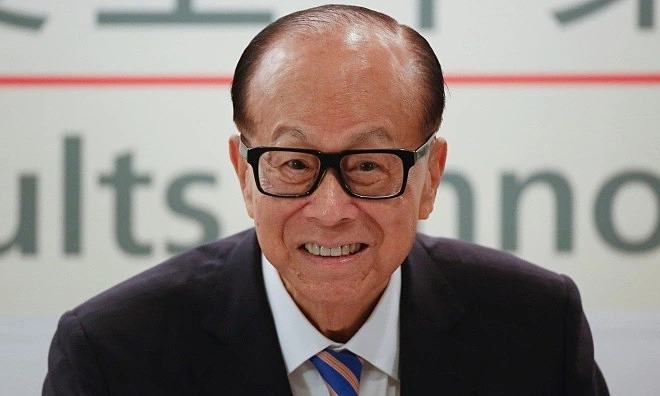
Canadian producer Cenovus Energy, in which Li’s CK Hutchison Holdings and a trust established by him jointly own roughly 29%, agreed earlier this month to buy Canadian peer Athabasca Oil for C$5.7 billion (US$4 billion), according to Reuters.
The agreement follows Cenovus’ C$8.6 billion acquisition of Canadian oil sands producer MEG Energy, completed less than a year earlier. Cenovus is the Li family empire’s main investment in the oil industry.
“In the world of heightened geopolitical risk, it’s wiser to not put all your eggs in one basket,” said Tommy Ong, managing director of financial advisory firm T.O. & Associates Consultancy, according to the South China Morning Post. He said Li’s group was seeking to maintain a balance between new- and old-economy businesses.
|
Billionaire Li Ka Shing in 2018. Photo by Reuters |
Kenny Tang Sing-hing, chairman of the Hong Kong Institute of Financial Analysts and Professional Commentators, said the Athabasca acquisition would “create synergies” in Canada’s oil industry, where the Li family has operated for decades.
CK Hutchison and a family trust invested in Husky Energy in the late 1980s and owned nearly 70% of the company when it merged with Cenovus in 2021.
CK Hutchison’s first-half profit, primarily driven by asset sales, also received a boost from its Cenovus holding, according to the group’s interim report. The U.S.-Israel war on Iran disrupted global energy supplies and increased demand for oil produced outside the Middle East.
Meanwhile, major asset sales have given the group substantial cash reserves. Earlier this year, a CK Hutchison subsidiary and its associated companies sold British electricity distributor U.K. Power Networks to a French buyer for 10.5 billion British pound ($13.9 billion).
The group’s cash and equivalents reached HKD179 billion ($22.8 billion) at the end of June, up 25% from the end of last year. That total excludes proceeds from the VodafoneThree sale.
At CK Hutchison’s annual general meeting in May, chairman Victor Li Tzar-kuoi, Li’s elder son, reaffirmed the group’s cautious approach.
“Cash is king,” Victor said, adding that quality, stability and return continued to guide new investment decisions, according to AASTOCKS Financial News.
Li Ka-shing’s investment decisions attract close scrutiny. Experts pointed to his ability to time asset sales, including Hutchison Whampoa’s exit from British mobile operator Orange near the peak of the dot-com bubble and CK Asset’s disposal of a landmark Hong Kong office tower more than a year before the city’s commercial property market peaked.
The group’s continued commitment to fossil fuels contrasts with broader global investment trends. The International Energy Agency forecasts $2.2 trillion in clean-energy investment this year, nearly twice the $1.2 trillion expected to flow into fossil fuels.
Leading global investors are also increasing their exposure to AI. Berkshire Hathaway, for instance, recently raised its stake in Google parent Alphabet to approximately $36 billion, citing Google’s role as a “significant player” in AI as a fundamental consideration.
Ong, however, said energy remained “the main determinant” of success even in rapidly growing technology sectors such as AI. The CK group is developing a broad portfolio of energy businesses around the world to pursue different opportunities, he added.
“Many of the group’s investments have always leaned towards traditional infrastructure projects with stable cash flow,” said Tang of the Hong Kong Institute of Financial Analysts and Professional Commentators.
“Although the oil industry will gradually feel the impact of clean energy in the long run, it can still bring very stable income.”
Li’s net worth stood at $48.4 billion at the time of publishing, making him the richest man in Hong Kong and 38rd wealthiest in the world, according to Forbes.