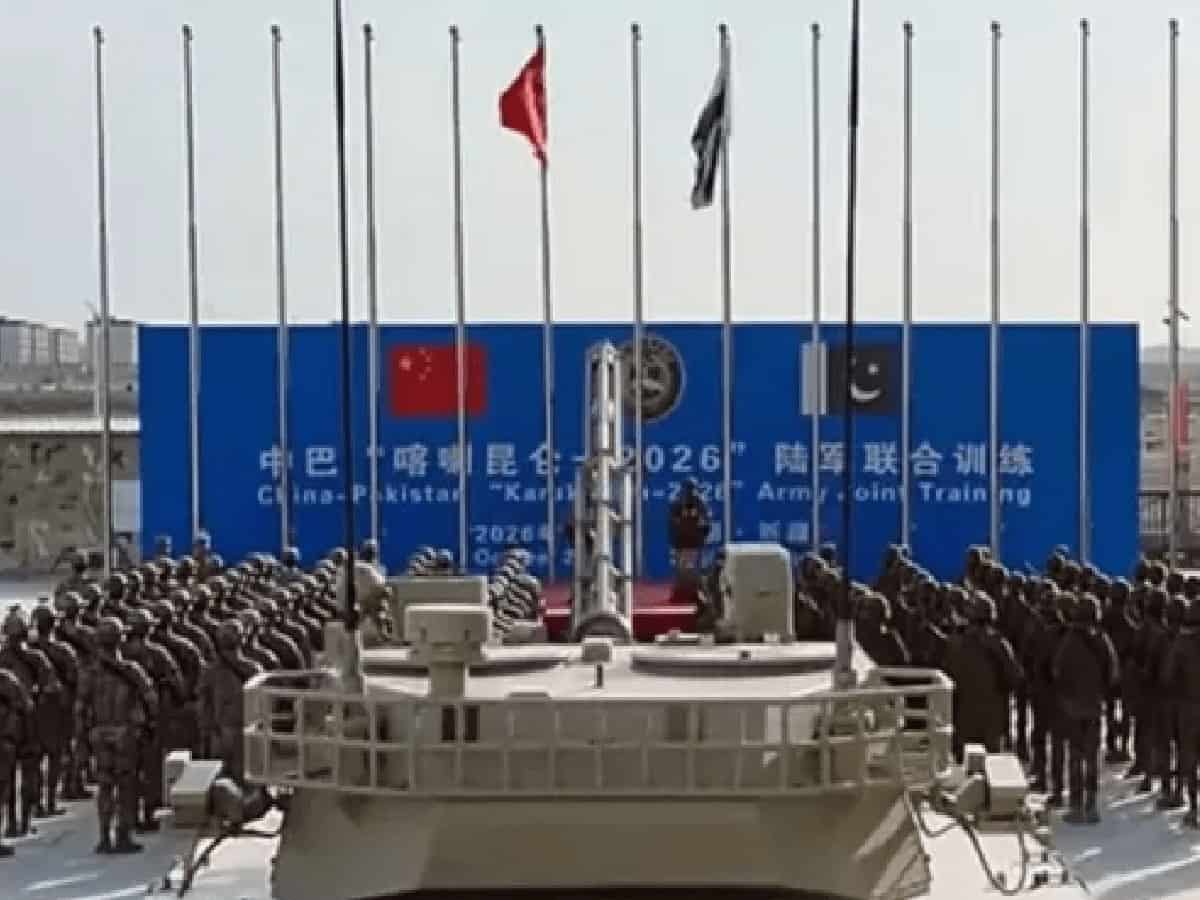
In an unprecedented operational convergence escalating regional security concerns, the land forces of China and Pakistan have launched their first-ever joint army combat maneuvers, codenamed Karakoram 2026in the rugged, high-altitude terrain of the Xinjiang Uygur Autonomous Region close to the Indian frontier. Commencing at a dedicated tactical training facility in Korla in northwestern China, the bilateral war games mark an evolutionary leap in Sino-Pakistani defense coordination, expanding their longstanding annual air force and naval drills into integrated high-altitude ground warfare. Notably, the entire contingent of participating Pakistani army troops is operating exclusively with state-of-the-art infantry gear, heavy armor, and unmanned drone systems provided directly by the People’s Liberation Army (PLA).
Focus on High-Altitude Combat: Counter-Terror and Enemy Clearance Drills Near the Border
The war games focus heavily on cold-weather mountain tactics and complex tactical operations across contested border geographies:
Maiden Ground Force Integration: While the two nations have conducted regular air (“Shaheen”) and maritime (“Sea Guardians”) exercises for years, “Karakoram 2026” marks the very first time both armies have deployed joint infantry and mechanized corps side-by-side on rugged mountainous land.
Specialized Operational Directives: Ground drills are centered on joint tactical assault formations, high-altitude counter-terrorism maneuvers, perimeter cordoning, and rapid-response enemy-clearance missions tailored for mountainous landscapes.
Strategic Korla Base: Staged within the strategic training corridors of Korla, the maneuvers simulate combat scenarios under extreme climate conditions, testing troop endurance and mechanized transport capabilities in proximity to sensitive South Asian border belts.
Chinese Arms and Armor in Action: Pakistani Troops Train on PLA Arsenal
China Central Television (CCTV) confirmed that Pakistan’s infantry and armor personnel have been fully outfitted with frontline PLA weapons systems for the drills:
Advanced Small Arms and Squad Weapons: Pakistani infantry units were equipped with China’s flagship Type 191 assault rifles and Type 201 squad light machine guns, ensuring interoperability between ground troops.
Wheeled Armored Deployments: Mechanized drills prominently featured Type 11 wheeled armored assault vehicles and Type 08 amphibious infantry fighting vehicles (IFVs), engineered for rapid tactical movement over rough mountainous roads.
Drone and Counter-UAS Tactics: The exercise integrated sophisticated unmanned aerial vehicles (UAVs) alongside counter-unmanned electronic warfare platforms, simulating modern asymmetrical battlefields where drone warfare and artillery fire-direction play decisive roles.
High Arms Dependence: The operational integration underscores Pakistan’s reliance on Chinese military hardware, with Beijing currently supplying over 80 percent of the weapons, platforms, and munitions utilized by Pakistan’s army, navy, and air force.
Geopolitical Ramifications: Experts Highlight Wheeled Mobility and Two-Front Synergy
Defense analysts in the region are closely tracking the strategic implications of the joint Xinjiang maneuvers:
Rapid Mountain Maneuverability: Chinese military affairs expert Wang Yunfei noted in state media that both types of combat vehicles deployed in Korla operate on high-mobility wheeled chassis, enabling rapid troop movement and flexible deployment along paved border highways without requiring heavy tank transporters.
Enhanced Interoperability: By training Pakistani ground forces directly on Chinese tactical command frameworks and automated equipment, both militaries are establishing common operational procedures for combined border responses.
Monitoring by Security Agencies: Indian defense planners and intelligence agencies are closely observing the military synergy unfolding in Xinjiang, as coordinated Sino-Pakistani land capabilities along northern and western high-altitude zones add a critical layer to regional defense calculations.