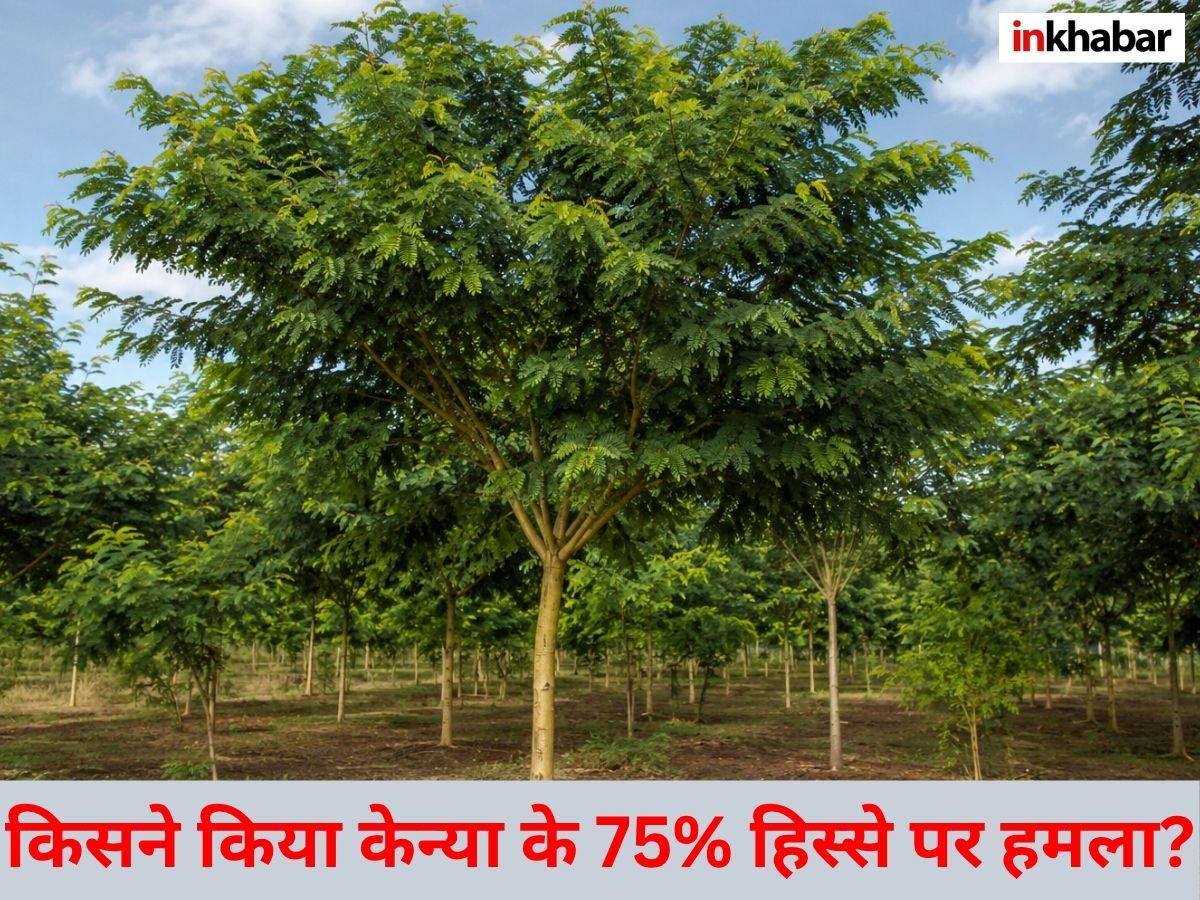
America Mathenge trees attack Kenya: A shocking case has come to light in Kenya. In an effort to solve the desert, a tree was planted here, which spread over several thousand hectares in about 3 decades. While this brought happiness, this tree took the lives of thousands of cattle. Some villagers lost all their animals. A tree named 'Mathenge' was planted to stop desertification in some parts of Kenya. A study by Mbabu and his colleagues has been published in the journal 'Remote Sensing'. According to this, Mathenge trees were spread over 882 hectares in the low-lying areas of Baringo County in 1988, which increased to 18,792 hectares by 2016. A cattle farmer named John Lamakato says that due to the spread of these trees he had to lose most of his cattle.
A cattle farmer who lost almost everything
John Lamakato lives in Lerata village, at the foot of Mount Ololokwe in Samburu County. They remember the time when the pastures here were covered with grass and their animals roamed freely. Now he says that Mathenge trees have grown all over the land, which cannot be eaten by cattle. Because of this their animals had to go far in search of grass. A few years ago his cattle strayed into a protected area in Laikipia. The area is known for land use disputes between local cattle herders and commercial cattle herders. 193 of his cattle were killed there. He once had 200 cattle, of which now only seven are left. He says that some of his cows were shot. These trees did not kill the animals directly, but their animals had reached that disputed area in search of grass.
How a rescue plan turned into trouble
Mathenge tree is scientifically called 'Prosopis Juliflora' (now 'Neltuma Juliflora'). This plant is originally from America. In the 1970s it spread throughout East Africa. It was seen as a solution to stem the increasing extent of the desert, providing tree cover, soil protection, fuel and fodder for animals. The Food and Agriculture Organization of the United Nations (FAO) and the Government of Kenya had promoted its installation.
According to Mbaabu's study, this tree was planted in Baringo district in the 1980s. Researchers analyzed Landsat satellite images taken every seven years between 1988 and 2016. The area of this tree increased from 882 hectares to 18,792 hectares, which is more than 20 times its initial size. The satellite data in the study is only till 2016, so these data do not show the current spread of this tree. The researchers also found that this tree was responsible for more than 30% of the negative changes in land cover in the study area. The researchers have cited this as the main reason for these changes.
What effect does it have on the land and animals?
The Kenya Forestry Research Institute estimates that 'mathenge' has taken over about 2 million hectares of land across Kenya and is expanding by 15% each year. According to the modeling of the researchers, the affected area is less than this i.e. 7,000 to 12,000 square kilometers (7 lakh to 12 lakh hectares), hence different estimates come out. The damage is not limited to just the loss of grass. Many animals die after eating this weed.
Why do animals die?
'Mathenge' has sharp thorns which can injure the legs of animals. Its seeds can harm their teeth. It has deep roots, which can go up to 35 meters under the ground. Families who depend on animal husbandry do not allow other plants to get water. These problems become increasingly serious for them.
Why is almost 75% of Kenya at risk?
Researchers at the University of Bern estimate that about three-quarters of Kenya—about 450,000 square kilometers out of 580,000 square kilometers (about 77% of these figures)—is suitable for the 'mathenge' plant to grow. Endangered does not mean that this tree is growing everywhere now, but it does mean that the conditions there can help it flourish. In a study published in 'Ecosphere' in 2020, Eckert and his colleagues have also indicated something similar. Their models show that many large areas of East Africa, where the tree has not yet spread, are adapting or will adapt to climate change. Researchers also say that this tree may have started adapting itself to the new climatic conditions. This is a possibility, not a sure thing.
is there any way?
The authors of the Baringo study say that this tree needs a better and integrated management. Eckert and his colleagues believe their methods can help improve policy and management. Some groups are also trying to turn this problem into an opportunity. A similar project is going on in Samburu, where more than 95% people use firewood or charcoal for cooking. There, 'briquettes' (fuel pellets) are being made from 'Mathenge' wood. This reduces pressure on local trees and also creates a new source of income. The big lesson to be learned from this is very simple. A quick solution to any problem can create new problems, so long-term planning is very important.
The post What made America unknowingly attack Kenya? Gone Know; 75% of the country 'occupied' appeared first on Tezzbuzz.