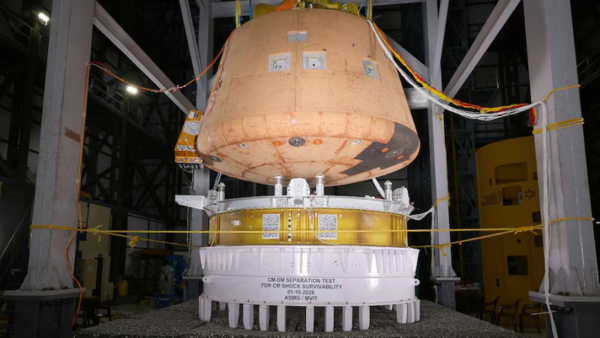
Gaganyaan is India's first human space flight programme. Under this, there is a plan to send Indian astronauts to low Earth orbit and bring them back safely after the completion of the mission. In this mission, it is very important for different parts of the spacecraft to function properly. Gaganyaan's orbital module mainly consists of two parts. The first is the crew module in which the astronauts will travel. The second is the service module which provides essential services and technical support during the mission. While the spacecraft is in flight, both modules remain connected together and perform their assigned functions.
The most critical phase of the mission comes when the crew module has to be returned to Earth. During this time it has to be separated from the service module. There are many connections between the two modules for electricity and other essential services which are separated as per the prescribed procedure. Many technical devices work together in this entire process. If any connection or separation system malfunctions, the spacecraft's return may be affected. Therefore, ISRO is already testing the capability and reliability of these systems to minimize any potential risks during the actual mission.
This test was conducted at Vikram Sarabhai Space Center in Thiruvananthapuram, Kerala. Here, by connecting the crew module and service module, a system was created so that the process taking place during the actual flight could be assessed. The test examined whether the connections connecting the two modules could be separated at a specified time. Along with this, the strength of various technical systems was also tested keeping in mind the shocks arising during isolation and their effects.
ISRO also checked the functionality of critical components like the avionics inertial navigation system heat shield and the deployable umbilical shield. These systems help keep the spacecraft on course and provide the necessary protection as it re-enters Earth's atmosphere. The crew module has to face extreme temperatures during return, so it is extremely important for its safety systems to function properly. Apart from this, temperature and humidity controlling devices were also checked.
Now ISRO is eyeing Gaganyaan's first unmanned mission G1. The target has been set to send this mission in the year 2026. In this, various systems and safety procedures will be tested by sending the vehicle into space without astronauts. The results from this flight will help in preparations for further missions. The success of Gaganyaan can give India a new identity in the field of human space flight. It will also be an important step towards taking the country's scientific capability and indigenous space technology to new heights.