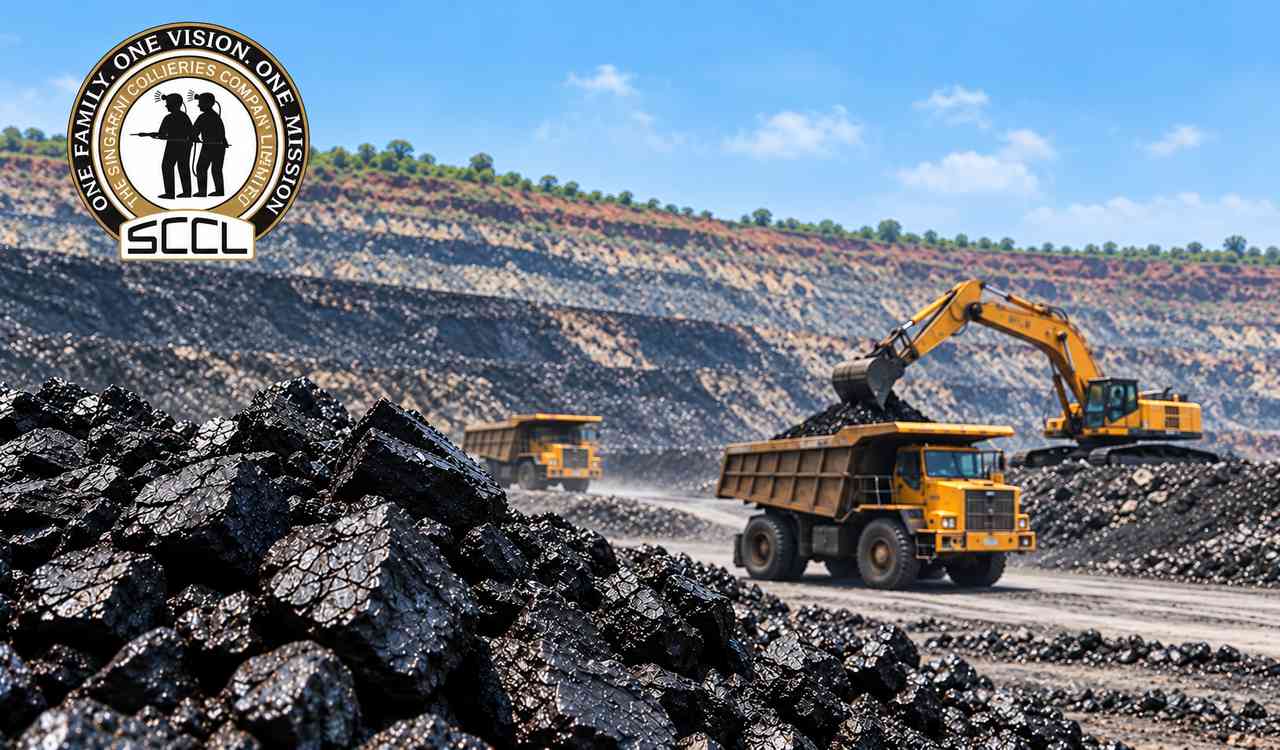
SCCL’s coal wealth belongs to the public, and its performance must remain open to public scrutiny
Published Date – 19 October 2026, 12:53 AM
By Pittala Ravinder
For Telangana, Singareni Collieries Company Limited (SCCL) is more than a coal-mining company: it is an economic lifeline, an industrial landmark and a symbol of the struggle that helped shape the State. Yet, more than 12 years after Telangana’s formation, a troubling question demands an answer: is Singareni emerging as a stronger public enterprise, or is its historic legacy being overshadowed by declining production, a shrinking regular workforce, disputed financial claims and uncertainty over its future?
Political celebrations cannot substitute for scrutiny, just as allegations cannot be treated as proven facts. What Telangana needs is an evidence-based assessment of the company’s performance, its unresolved problems and the public interest it is expected to serve.
Production Figures
Production rose from 60.38 million tonnes in 2015–16 to a peak of 70.02 million tonnes in 2023–24. It then declined to 69.01 million tonnes in 2024–25 and plunged to 58 million tonnes in 2025–26. Against a target of 72 million tonnes in 2025–26, the shortfall was nearly 19.5 per cent. Such a decline cannot be dismissed as a routine fluctuation. Delays in opening new mines, land acquisition, clearances, overburden removal, weather conditions and operational constraints may all have contributed to the decline.
The company and the government must establish their respective roles through a mine-wise performance review. The production-dispatch figures raise further questions. In 2024–25, production stood at 69.01 million tonnes against dispatches of 65.23 million tonnes. In 2025–26, production fell to 58 million tonnes, while dispatches reached 62.07 million tonnes. Drawing down earlier stocks could explain this reversal, but the inventory position requires transparent verification.
Meanwhile, output per manshift (OMS) rose from 5.79 tonnes to 7.56 tonnes. These figures may reflect changes in mine composition, mechanisation or operating methods, but the simultaneous decline in production and workforce makes an explanation essential.
Regular Vs Contract Labour
SCCL’s regular workforce declined from 58,491 in 2015–16 to 40,335 in 2025–26— approximately 31 per cent. The Ministry of Coal reported that 21,993 people had received employment between Telangana’s formation and December 2024: 17,203 through compassionate appointments and 4,790 through external recruitment. Why, then, has the overall workforce continued to shrink? How many employees retired, how many were recruited, and how heavily does the company now depend on contract labour? Year-wise figures are necessary to answer these questions.
There have been significant welfare measures, including raising the retirement age to 61, expanding compassionate employment and increasing the profit-sharing benefit from 18 to around 33 per cent. The Ministry of Coal reported that the enhanced benefit amounted to approximately Rs 3,583.94 crore between 2014 and 2024.
Singareni’s success must be measured not merely by how much coal it extracts, but by how securely it employs its workers and how transparently it answers to the people of Telangana
Yet welfare cannot be measured by bonuses alone. Reports on the 2026 Dasara payments indicated an average of Rs 1,53,912 for regular employees and Rs 5,500 each for 29,717 contract workers. Such payments matter, but contract workers also need adequate wages, provident fund and ESI benefits, accident insurance, healthcare and safe working conditions. SCCL should publish comparable annual data on permanent and contract employees, recruitment, retirements, vacancies, accidents and welfare expenditure. Higher productivity must not come at the cost of workers’ security or dignity.
New Mines
With reserves in existing mines declining, opening new mines on schedule is critical. VK Opencast, Ramagundam OC-I, Golleti Opencast, Manuguru OC expansion, RKP OC Phase-II and JK Opencast must be assessed against clear timelines, not announced capacities. The Ministry of Coal’s 2025–26 annual report records the commencement of overburden removal at the VK Opencast in October 2025, but this is distinct from securing clearances and beginning commercial production. The company must disclose production dates, investment, land acquisition, clearances and rehabilitation plans.
The Venkatapur/PVNR opencast project in Mulugu district highlights the need to balance mining ambitions with heritage conservation, forests, water systems and local livelihoods. Independent assessments of environmental impacts, groundwater, blast vibrations and cumulative risks must inform decisions, with findings made public.
Allocation and Output
The Naini coal block in Odisha, allocated to SCCL in 2015, has estimated extractable reserves of about 341 million tonnes and a planned capacity of 10 million tonnes annually. Production began in July 2025, but the Ministry of Coal reported only about 80,000 tonnes by December that year. Naini offers an opportunity to expand beyond Telangana, but its contribution will depend on production ramp-up, transport infrastructure, clearances and commercial viability.
The same scrutiny should apply to other allocated or proposed blocks, including New Patrapara, Penagadapa, Tadicherla-II and Koyagudem Block-III. Securing a coal block is not, by itself, an achievement. Timely clearances, operational readiness, dependable transport and commercially viable production determine whether an allocation delivers value. SCCL should also publish a complete list of mines opened and closed since 2014, together with plans for redeployment, local employment and restoration of exhausted mining lands.
Clarity on Dues
Financial transparency is another pressing concern. In July 2026, Coal Minister G Kishan Reddy cited coal supplies and power generation dues exceeding Rs 54,000 crore. In October, Telangana Deputy Chief Minister Bhatti Vikramarka reportedly referred to receivables of around Rs 29,000 crore.
These figures must not be conflated. Their periods, components and institutional coverage may differ. An audited, institution-wise statement should identify the amounts owed by Telangana GENCO, power distribution companies, NTPC and other buyers, separating undisputed claims from outstanding bills and accounting for payments already received. Declared profits do not necessarily translate into cash available for investment. Delayed receivables can constrain operating expenditure, worker benefits and new projects.
Domestic Coal, Imports
Why should Telangana’s power sector rely on imported coal when SCCL is a major domestic producer? On October 15, 2026, BRS leader KT Rama Rao alleged possible irregularities worth Rs 3,000 crore in coal imports and demanded a white paper. This remains a political allegation, not an established finding. Nevertheless, procurement contracts, tender procedures, supplier selection, logistics charges, quantities delivered, and reasons for any domestic supply shortfall should be disclosed. An independent inquiry should follow wherever documentary evidence warrants it. The objective must be to establish whether imports were technically and economically necessary, not to presume either wrongdoing or justification in advance.
SCCL operates a 2×600 MW thermal power plant and is also expanding into solar energy. The Ministry of Coal reported 245.5 MW of commissioned solar capacity by December 2025, with another 227 MW under construction. Renewable energy offers opportunities to diversify revenue, but expansion must be accompanied by measurable environmental accountability. The company should disclose data on groundwater, air pollution, land restoration, plantation survival and compliance with environmental clearances. Workers and mining-dependent communities must also be included in plans.
Public Wealth
With the Telangana government holding 51 per cent and the Centre 49 per cent, responsibility for SCCL’s future is shared. Telangana needs a comprehensive public review of SCCL since 2014, covering production, employment, contract labour, welfare, finances, new mines, procurement and environmental compliance. Targets must be compared with actual outcomes; verified findings must be separated from allegations; and responsibility must be fixed wherever failures are established.
The objective is not to undermine Singareni, but to protect its long-term strength. Coal from beneath Telangana’s soil has powered industries, illuminated homes and sustained generations of families. The workers who made this possible deserve more than selectively presented statistics and political rhetoric. Singareni’s success must be measured not merely by how much coal it extracts, but by how securely it employs its workers, how responsibly it manages public resources and how honestly it answers the people of Telangana. Its coal wealth belongs to the public and its performance must remain open to public scrutiny.
(The author is a senior journalist, Convener of the Singareni Affected Areas Research Community — SAARC and State Convener of the Telangana Astitva Vedika-TAV)