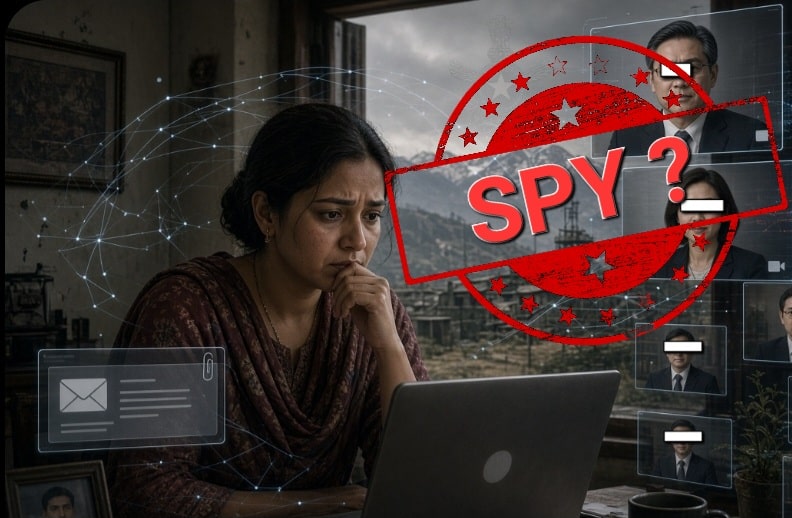
In a concerning security breach, the Jammu and Kashmir Police have charged the wife of a senior Indian Army officer for allegedly sharing sensitive operational and strategic data with foreign intelligence operatives, including Chinese agents who approached her disguised as academic researchers.
Investigators suspect the woman unknowingly fell into an elaborate “intellectual trap,” believing she was contributing legitimate academic articles on regional and defense subjects.
Modus Operandi: The “Intellectual Trap”
According to preliminary findings by national intelligence agencies, foreign operatives systematically cultivated the target using professional social and academic vectors:
- Initial Contact: Foreign agents posed as university researchers and academic editors seeking commissioned writing on benign topics such as climate change, environmental policy, and regional geopolitics.
- Gradual Escalation: Over time, the contacts persuaded her to pivot toward topics directly concerning defense infrastructure, military operations, and strategic deployments.
- Data Transmission: Intelligence sources allege that sensitive documents, photographs, and electronic files were collected and transmitted via encrypted messaging platforms.
The woman—a resident of Telangana currently living within the jurisdiction of the Gandhi Nagar Police Station in Jammu—came under surveillance following actionable intelligence indicating clandestine data transfers.
Legal Charges and Ongoing Investigation
The Jammu and Kashmir Police have registered FIR No. 290/2026 at the Gandhi Nagar Police Station under stringent national security laws:
- Official Secrets Act, 1923: Section 3 (penalties for spying and actions prejudicial to national safety) and Section 5 (wrongful communication and handling of classified information).
- Bharatiya Nyaya Sanhita (BNS): Section 152 (acts endangering sovereignty, unity, and integrity of India) and Section 61(2) (criminal conspiracy).
Investigating teams are currently analyzing seized digital devices to establish the full extent of the data breach, trace the encrypted communication channels, and determine how the foreign operatives initially established contact with the target.