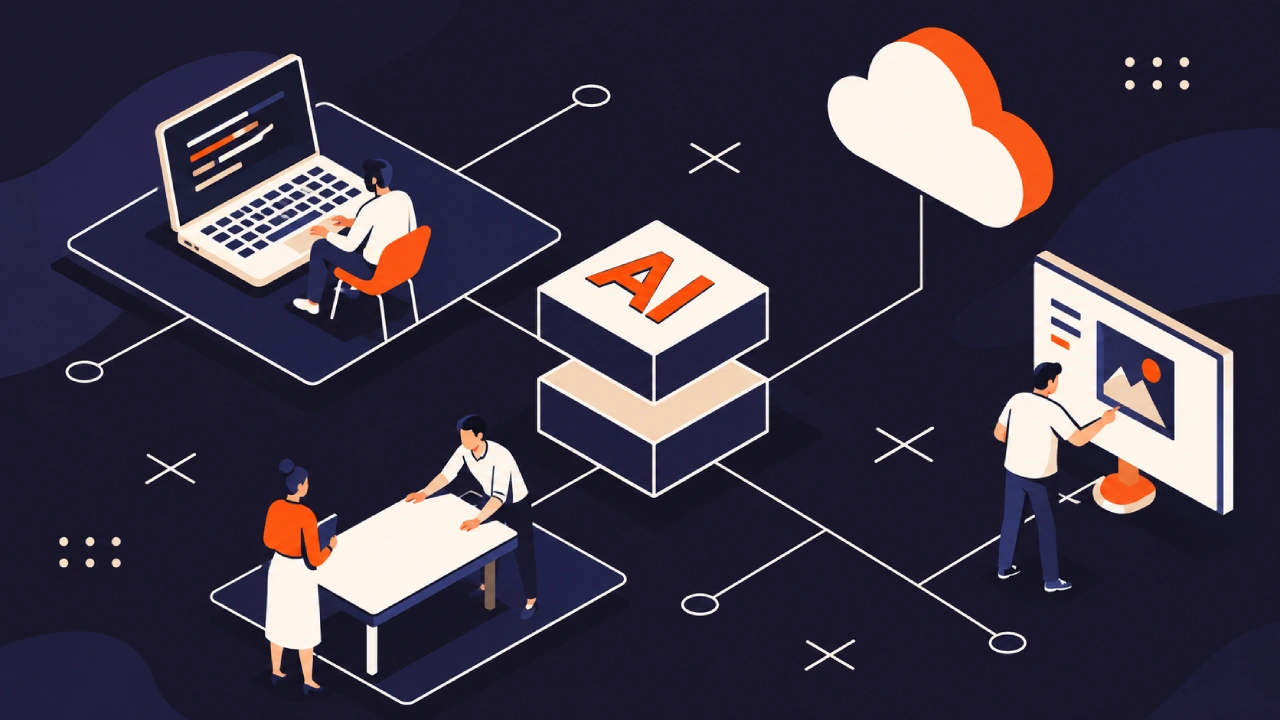
AI applications often depend on cloud infrastructure for model inference. A camera, sensor, or user device sends data to a remote server; the AI model processes it, and the result is sent back. While this approach provides access to powerful computing resources, network delays and connectivity requirements can become limitations.
Edge AI offers another deployment model. Instead of moving all data to a central cloud, AI inference can happen on or near the device generating the data. This approach is becoming useful across manufacturing, retail, transportation, healthcare, security, and consumer applications where quick decisions or local processing are important.
What Is Edge AI Deployment?
Edge AI deployment means running AI models on devices or computing infrastructure located close to where data is generated. This can include smartphones, industrial machines, gateways, cameras, vehicles, and specialised edge computers.
For example, a factory camera could run an image-recognition model locally to identify damaged products as they move along a production line. The system does not need to upload every frame to a cloud server before deciding whether an item requires inspection. The cloud can still be used for storing selected results, retraining models, or managing devices.
Running Models Near Users
Edge AI can improve applications that require rapid responses. When inference happens locally, data does not always need to travel to a remote data centre and back, reducing the network round trip.
Consider an interactive application that uses a camera to recognise objects. If the model runs close to the camera, the system can process frames without depending on a cloud connection for every decision. This can make the experience feel more responsive, particularly when even small delays can affect how users interact with an application.
Sensors Can Make Faster Decisions
Sensors generate continuous streams of information in many environments. Sending every reading to the cloud may not be necessary when the important task is identifying an immediate event.
An industrial sensor, for instance, could feed data into a local AI model that detects unusual machine behaviour. If the model identifies a potential problem, the system could trigger an alert or inspection process immediately. The cloud could receive only relevant events rather than every raw sensor reading, reducing unnecessary data transmission.
Cameras Create a Major Edge AI Use Case
Video generates large amounts of data, making cameras an important use case for edge AI. A retail camera system could analyse activity locally to identify events such as unusually long queues or an empty checkout area.
A security system could similarly analyse footage on the device and send selected alerts rather than continuously transmitting video. Local processing can reduce the need to move raw footage across networks, although developers still need to carefully consider privacy, data retention and access controls when deploying computer vision systems.
Offline Capability Improves Resilience
Edge AI systems do not necessarily need continuous internet access to perform inference. This can be valuable in remote locations, vehicles, industrial facilities, or environments where connectivity is unreliable.
For example, an agricultural monitoring device could identify signs of plant stress locally even when a field has limited network coverage. It could store important results and synchronise them with a central system once connectivity becomes available. This makes edge deployment useful for applications where operational continuity matters.
Hardware Constraints Change Model Deployment
Edge devices generally have fewer computing resources than large cloud servers. They may have limited memory, storage, processing capacity, and power. Developers therefore need to select models based not only on accuracy but also on resource requirements.
A model that performs well on a powerful server may be impractical on a small camera or battery-powered sensor. Techniques such as quantisation, pruning, and hardware acceleration can help reduce resource consumption. Developers should also test models on the actual target hardware rather than relying only on development-machine performance.
Reliability Requires More Than the Model
Deploying an accurate model is only one part of building a reliable edge AI system. The surrounding software and hardware also need to remain operational, so teams should consider what happens when a device loses connectivity, runs out of storage, experiences a software failure, or receives invalid input.
Systems may need local logging, health checks, automatic recovery, and safe fallback behaviour. For example, an industrial inspection system should have a defined response if the AI model becomes unavailable. Simply allowing production to continue without a suitable fallback could create unnecessary operational risk.
Managing Many Edge Devices
A single edge device may be straightforward to manage, but hundreds or thousands of devices distributed across locations are much harder. Teams need mechanisms for deploying model updates, monitoring device health, tracking software versions, and responding to failures.
Remote updates can also introduce risks if a faulty model or software release is pushed across an entire fleet. Staged rollouts can reduce this risk by allowing teams to update a small group of devices first, monitor the results, and gradually expand deployment when the new version proves stable.
Edge and Cloud Can Work Together
Edge AI does not have to replace cloud AI. In many systems, the two work together, with the edge handling immediate inference while the cloud manages larger-scale analytics, model training and centralised monitoring.

A camera might detect an event locally and send only relevant metadata to the cloud for further analysis. This hybrid approach allows teams to balance speed, resource use, connectivity and centralised management according to the application’s requirements.
Monitoring Model Performance After Deployment
An AI model can perform differently after deployment because real-world data may change over time. Lighting conditions, sensor behaviour, user patterns and operating environments can all affect results. Teams should therefore monitor model outputs and system performance after deployment.
Monitoring should cover both AI metrics and technical metrics such as processing time, memory usage, device temperature and connectivity. Unexpected changes can indicate that the model needs to be updated or retrained, helping teams maintain reliable performance as operating conditions evolve.
Conclusion
Edge AI deployment brings AI processing closer to users, sensors, cameras, and other devices, making it possible to respond quickly while reducing dependence on continuous cloud connectivity. It can support real-time applications, improve resilience, and reduce the amount of raw data that needs to travel across networks.
However, reliable edge AI requires more than placing a model on a device. Hardware limitations, software reliability, security, fleet management, and model performance all need to be considered. For many modern AI systems, the strongest architecture may not be entirely on the edge or entirely in the cloud, but a carefully designed combination of both.
(Source)